SOUTH24 CENTER FOR NEWS & STUDIES
SOUTH24 CENTER FOR NEWS & STUDIES


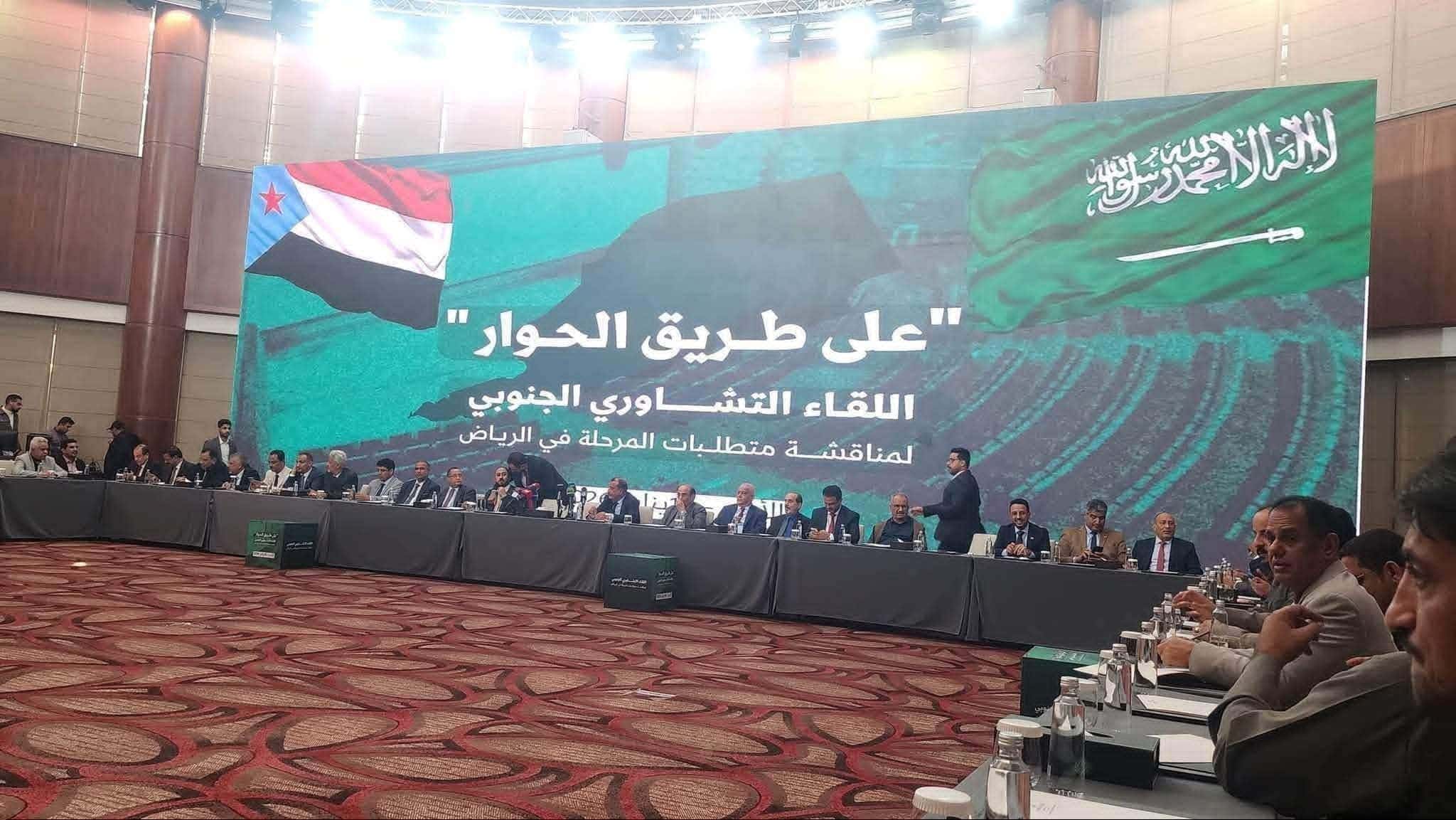
Southern activists attending the Southern Consultative Meeting in Riyadh as part of preparations for the Southern Dialogue, January 18, 2026. (Southern Transitional Council delegation)
08-02-2026 at 8 PM Aden Time

Abdullah Al-Shadli (South24 Center)
Amid intense military and political shifts that have upended the balance of power in South Yemen, Saudi Arabia’s capital, Riyadh, has emerged as a platform for shaping a new political reality. At its center is the “Southern Dialogue” initiative, which Saudi Arabia announced it would sponsor following a request submitted by southern figures close to Riyadh and affiliated with Yemeni political parties, calling for the convening of such talks.
The Southern Dialogue initiative goes beyond being a mere “response” to local appeals. The timing chosen by Riyadh does not appear coincidental; rather, it came as the culmination of a series of military and political measures that led to the withdrawal of Southern Armed Forces from Wadi Hadramout and Al-Mahra under heavy airstrikes, replaced by “Nation’s Shield” forces and other northern military units.
The call for dialogue also coincided with Saudi efforts to dismantle the Southern Transitional Council (STC). These efforts resulted in a delegation, sent by the STC to Riyadh, announcing the dissolution of the council on January 9 under unclear circumstances, following days of lost contact with delegation members and reports of their detention.
While Saudi media attempted to portray the dialogue as a response to an official initiative, claiming it was requested by Yemeni Presidential Leadership Council Chairman Rashad Al-Alimi, the political context suggests that some of the figures involved in launching the call, themselves affiliated with traditional Yemeni parties, served as conduits for Saudi Arabia’s desire to contain developments in the south.
Conversely, some observers view the Saudi initiative as a rare opportunity to internationalize the southern issue and advance it along regional and international tracks, particularly as Saudi Arabia seeks to fill the vacuum left by the UAE in South Yemen across military, political, and security spheres.
This ambition, however, collides with a deeply rooted southern collective memory shaped by pain and bloodshed over recent weeks, manifested in unprecedented mass demonstrations in Aden and other South Yemen cities. These protests rejected the dissolution of the STC and expressed support for its president, Major General Aidarous Al-Zubaidi, whose current whereabouts remain unclear, though he managed to mobilize supporters twice in January through his online platforms.
What Is the Goal of the Dialogue?
From an optimistic perspective, southern politician Adel Al-Shabahi argues that the expected outcome of the “Southern Dialogue in Riyadh” is the formulation of a unified political vision agreed upon by the various southern components and figures participating in the anticipated conference, one that reflects southern aspirations and embodies their political will.
Al-Shabahi told South24 that the tweet issued by Saudi Defense Minister Prince Khalid bin Salman clearly outlined the framework of the Saudi-sponsored process, including support for dialogue, inclusion of all southern factions, linkage to international backing, and affirmation of respect for the South aspirations and will.
He added that the dialogue’s core objective extends beyond drafting a political position to establishing a vision capable of achieving social peace, security, and stability; ending cycles of conflict and war, creating a stable environment where citizens can live peacefully with acceptable levels of basic services, and curbing the logic of weapons and violence.
Political analyst Dr. Omar Abdulilah Ba’bad offered a more cautious assessment, stressing that the rapidly changing situation makes fixed evaluations difficult. While supporting the principle of dialogue, Ba’bad argued that the most realistic path to successful external talks must begin with internal dialogue among southern governorates (Aden, Hadramout, Dhalea, Lahj, Abyan, Shabwa, Al-Mahra, and Socotra) to unify positions.
He told South24 that current risks stem from how invitations to preparatory consultations in Riyadh are being managed, noting that the absence of clear geographic or political criteria for selecting participants, particularly academics and cadres, could exacerbate divisions rather than resolve them. He described the ad-hoc coordination as a key factor in deepening fragmentation and undermining political pathways linked to the dialogue.
Rasha bin Hamil, a member of the political bureau of the Hadramout Comprehensive Conference, argues that the Southern Dialogue is more closely linked to the broader Yemeni file and Saudi Arabia’s conflict with the Houthis than to resolving the southern issue itself.
She told South24 that the true drivers behind the dialogue lie in Riyadh’s desire to rebuild the faltering pro-government camp. “Riyadh understands that any serious negotiations with the Houthi group require a strong and cohesive actor on the ground, and that continued fragmentation of the southern front weakens the negotiating position of both the coalition and the internationally recognized government,” she said.
Political analyst Madina Adlan believes that the Southern Dialogue in Riyadh represents an opportunity to entrench a culture of dialogue among southern forces, grounded in their shared belief in the legitimacy of the southern cause, an approach that could help contain disagreements and prevent them from escalating into conflict.
Speaking to South24, Adlan noted that the timing of the dialogue coincides with rapid regional and international shifts, making southern cohesion a key factor in strengthening the political standing of the southern issue. She stressed that a dialogue based on justice and respect for popular will would not undermine the goal of self-determination but rather help unify the path toward it.
Regarding Saudi guarantees, Madina Adlan explained that every state acts in accordance with its own interests, arguing that Saudi Arabia’s interest lies in removing the South from the cycle of conflict due to its strategic importance to regional security and maritime shipping routes.
She added that the conflict with the Houthis has taken on international dimensions, prompting Riyadh to seek a strong and unified southern partner.
Fragmented Representation and Absent Guarantees
From the perspective of some southerners, the composition of participants invited to the preparatory consultations for the Southern Dialogue in Riyadh did not reflect southern popular will as much as it reflected a Saudi desire to fragment southern representation.
The list included southern figures affiliated with traditional Yemeni political parties, while dozens of other southern figures lost their political cover following the dissolution of the Southern Transitional Council (STC) and became dispersed along governorate lines. At the same time, other Saudi-backed southern components, particularly in Hadramout and other southern governorates, were retained. These are the same groups that Saudi Arabia had previously sought to promote as potential rivals to the STC in the south.
Former STC Vice President and dismissed member of Yemen’s Presidential Leadership Council, Major General Faraj Al-Bahsani, called in an interview with Agence France-Presse on Sunday, January 11 for the Southern Dialogue to be held outside Saudi Arabia, arguing that the success of any dialogue requires a “conducive environment” free from pressure.
Rasha bin Hamil believes that the primary challenge lies in managing timing and political transitions. She warned of the risk of “reverse fragmentation” if the Southern Dialogue fails to fairly accommodate all parties, a scenario that could push marginalized tribal or political forces to seek alternative regional sponsors, potentially reopening the door to external interventions.
Bin Hamil added that Saudi guarantees do exist but are conditional on the rationality of the outcomes. She stressed that any results that strengthen state-building, preserve security, and prevent Iranian expansion would receive full Saudi backing, as part of efforts to protect the Kingdom’s national security and secure the Bab al-Mandeb Strait. She argued that Saudi Arabia would not force southerners into “political suicide,” but would instead treat a unified southern bloc as a pressure tool in negotiations with the Houthis.
For his part, Adel Al-Shabahi highlighted the potential risks, noting that the real danger does not lie in holding the dialogue itself, but in southerners’ failure to agree on a unified vision that ensures coexistence and translates years of sacrifice into tangible political outcomes.
Al-Shabahi said that concerns accompanying any political dialogue are natural but expressed hope that Saudi sponsorship could add real value, given Riyadh’s political weight and broad influence.
“No one involved in politics can downplay the importance of this dialogue,” he said, “especially after years spent seeking a supportive position from Riyadh, now clearly declared.” He emphasized the need to approach the dialogue with optimism, without prejudging its outcomes through negative expectations, and to ensure that its results align with southern aspirations and popular will.
He further stressed that the south issue must be addressed first and foremost from a southern perspective, grounded in the will and foundations of the southern people, while taking geography and the regional dimension into account. Achieving any southern political objective in isolation from Riyadh, he argued, is unrealistic, not as a concession of sovereignty, but as a reflection of regional power balances. While opportunities to realize southern demands remain possible through Riyadh, he warned, they become nearly nonexistent if Saudi Arabia’s role is bypassed or ignored.
Political analyst Omar Ba’bad focused on the necessity of ensuring “conducive conditions” for participants, stressing the importance of selecting a time and venue that guarantee freedom of participation, away from tutelage, enforced residency, or psychological pressure that could influence dialogue participants.
Ba’bad warned that continued randomness in selecting participants, without prior consensus within each governorate, could deepen divisions. He added that Saudi Arabia would be unable to support outcomes marred by discord and fragmentation among the dialogue’s parties.
Dialogue Without a Unified Southern Entity
Saudi moves culminated in the announcement dissolving the STC by the delegation sent to Riyadh, which included senior figures. According to STC leaders inside Yemen, the decision, read by the council’s secretary-general under Saudi pressure and in the absence of President Aidarous Al-Zubaidi, deepened skepticism toward both the dialogue and Saudi intentions.
Despite claims that the decision aimed to preserve unity, popular and institutional rejection across Aden, Hadramout, Al-Dhalea, and Lahj was widespread. Saudi measures were deemed “legally and politically invalid” for violating core principles of the South cause and lacking genuine consent. Key STC institutions, including the National Assembly, continue to operate.
Further doubts were raised about the legitimacy of the southern delegation in Riyadh, which derived its representative authority from the STC, now dissolved by its own declaration, thereby stripping it of leverage against other political actors.
Tensions escalated with indications of efforts to dismantle the STC’s presence on the ground. This included the temporary closure of the Southern National Assembly headquarters in Aden on January 29 by military forces, reopened on February 1, following a mass demonstration, as well as the storming and looting of STC offices in Seiyun, Wadi Hadramout, by Saudi-backed northern emergency forces on February 3, according to STC officials.
It can be argued that calls to address the southern issue from a purely southern perspective are insufficient on their own to guarantee a safe or productive political trajectory without a high degree of realism and critical scrutiny of proposed tools, chief among them the dialogue process itself and realities within southern governorates. Global precedents show that popular will often loses substance once it enters the arena of regional power balances, where it is reshaped according to others’ priorities rather than its original demands.
Accordingly, betting on the Southern Dialogue as a neutral pathway risks recycling the crisis rather than resolving it, keeping the southern issue under temporary management instead of advancing it toward political resolution, especially after Saudi Arabia’s representative told the UN Security Council on January 14 that outcomes of the southern dialogue would be placed on the table of comprehensive Yemeni peace talks, including the Houthis.
In this context, relying on Riyadh as an almost exclusive channel for achieving southern demands should be viewed not as a guarantee but as a path fraught with risks of dilution and delay. Regional dynamics operate on security and interest-based calculations rather than historical or moral entitlements. While this reality cannot be bypassed, engaging with it without independent leverage or pressure tools leaves the southern cause vulnerable to being absorbed into settlements that neither establish a state nor end external tutelage.