SOUTH24 CENTER FOR NEWS & STUDIES
SOUTH24 CENTER FOR NEWS & STUDIES


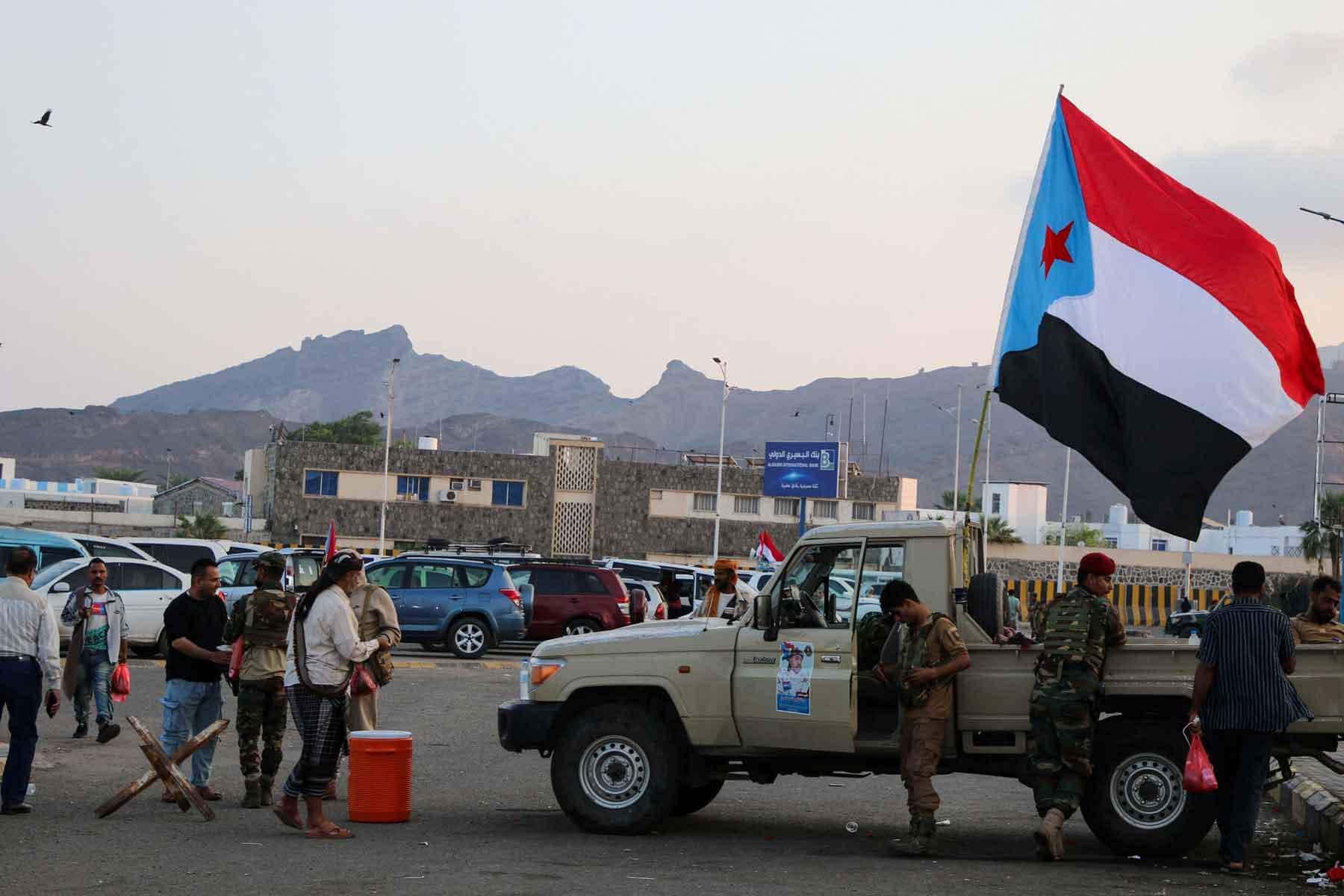
The flag of South Yemen flies above a military patrol in Aden, Yemen, on January 1, 2026. (Middle East Online)
14-01-2026 at 2 PM Aden Time

"Presenting a vision for “self-determination” through a Southern referendum at the Riyadh conference, along with a defined timeline under an UN-supervised mechanism, would be a realistic proposal better aligned with current dynamics"
Farida Ahmed (South24)
The year 2026 entered its first week amid rapidly unfolding, dramatic developments, following the retreat of Southern forces led by the Southern Transitional Council (STC) from their control over Hadramout and Al-Mahra, the two largest governorates in South Yemen by area.
Both regions hold exceptional geopolitical significance, overlooking the Arabian Sea on one side and bordering Saudi Arabia and the Sultanate of Oman on the other. This reversal came after a military operation led by northern religious forces affiliated with the “Muslim Brotherhood”, alongside other local forces spearheaded by the “Nation’s Shield,” with heavy Saudi air support.
At first glance, the Southern forces’ takeover through the “Promising Future” operation in early December appeared to be the result of calculated arrangements and undeclared understandings between Riyadh and Abu Dhabi, aimed at ending the influence of the First Military Region, which has long been dominated by Muslim Brotherhood–affiliated forces.
However, this perception quickly eroded once the dust of military operations settled and security arrangements were put in place. Saudi Arabia began demanding that the liberated areas in Hadramout’s Wadi and Desert be handed over to the “Nation’s Shield” forces it has supported since 2023. When the STC rejected any handover without prior political and security understandings that would preserve gains achieved on the ground, a different reality emerged, revealing that the Southern military operation was not governed by a Saudi-Emirati agreement, but rather reflected a temporary convergence of interests that soon collided with a clear Saudi orientation aimed at ending Emirati presence in South Yemen.
It is important to note that, for a broad segment of Southerners, the Southern Armed Forces’ control over Hadramout and Al-Mahra represented a pivotal moment that reshaped the political geography and effectively led to control over most of the borders of the former State of “South Yemen” prior to 1990.
This was widely viewed as a significant step forward in the Southern project seeking independence from the North. However, this moment was short-lived. Southern forces soon withdrew amid an unequal battle marked by intensive Saudi airstrikes, resulting in the killing, injury, and capture of more than 300 Southern fighters, in addition to civilian casualties.
This conduct created a stark contradiction in Southern public consciousness, on one hand, Riyadh was calling for dialogue and de-escalation; on the other, it decisively shaped events through airpower. This undermined trust in any negotiation track between Saudi Arabia and the STC leadership under Aidarous Al-Zubaidi.
The Southern Transitional Council and the Erosion of Gains
Over its eight years, the STC has managed to play an influential political, security, and military role in areas under its control in South Yemen, contributing significantly to a degree of relative stability. However, this trajectory has not been without flaws, particularly military decisions marked by miscalculation during the Hadramout events in early December, which ultimately led to adverse outcomes. Neither the STC nor the United Arab Emirates, its closest regional ally, anticipated that Saudi Arabia would opt for direct military intervention. This revealed a deep gap between the STC’s on-the-ground calculations with its allies and Saudi Arabia’s approach to managing the situation.
Moreover, the imbalance of the confrontation, due to Saudi Arabia’s extensive use of airstrikes, forced Southern forces to retreat and eventually withdraw. Simultaneously, ground battles, coupled with the unexpected Emirati withdrawal from the command-and-control headquarters in Mukalla, exposed shortcomings in the STC’s battlefield and media management. This compounded heavy human and material losses and ultimately resulted in the loss of the Hadramout coast as well, where the STC had maintained influence since 2016.
Events also demonstrated that the STC failed to engage realistically with the Saudi side in managing political and military dialogue, or to impose pragmatic approaches and options that could have salvaged the situation or mitigated its repercussions. This led to the loss of leverage that could have been retained or deployed more effectively.
Until the final moments, STC leaders bet on the possibility of containing the situation by responding to Saudi Arabia’s January 4 invitation to attend talks in Riyadh, aimed at discussing the causes of escalation in Hadramout and Al-Mahra in eastern South Yemen. However, Saudi claims that Al-Zubaidi had left for Abu Dhabi, along with the bombing of his home area in Zubaid, Al-Dhalea, disrupted the internal scene. This pushed the rest of the STC delegation, which arrived in Riyadh at dawn on January 7, to manage the crisis alone and under pressure. Ultimately, this led to their announcement dissolving the STC and its bodies at home and abroad.
While this announcement did not fundamentally alter the STC’s structure, it disrupted its institutions and exposed clear divisions in assessments between leaders confined for days in a Riyadh hotel without communication with the domestic front, and the council’s bodies, executive leadership, and senior figures who continue to be based in Aden and the United Arab Emirates. This was particularly clear after some officials issued televised and written statements expressing support for Saudi efforts and urging the Southerners to engage with them.
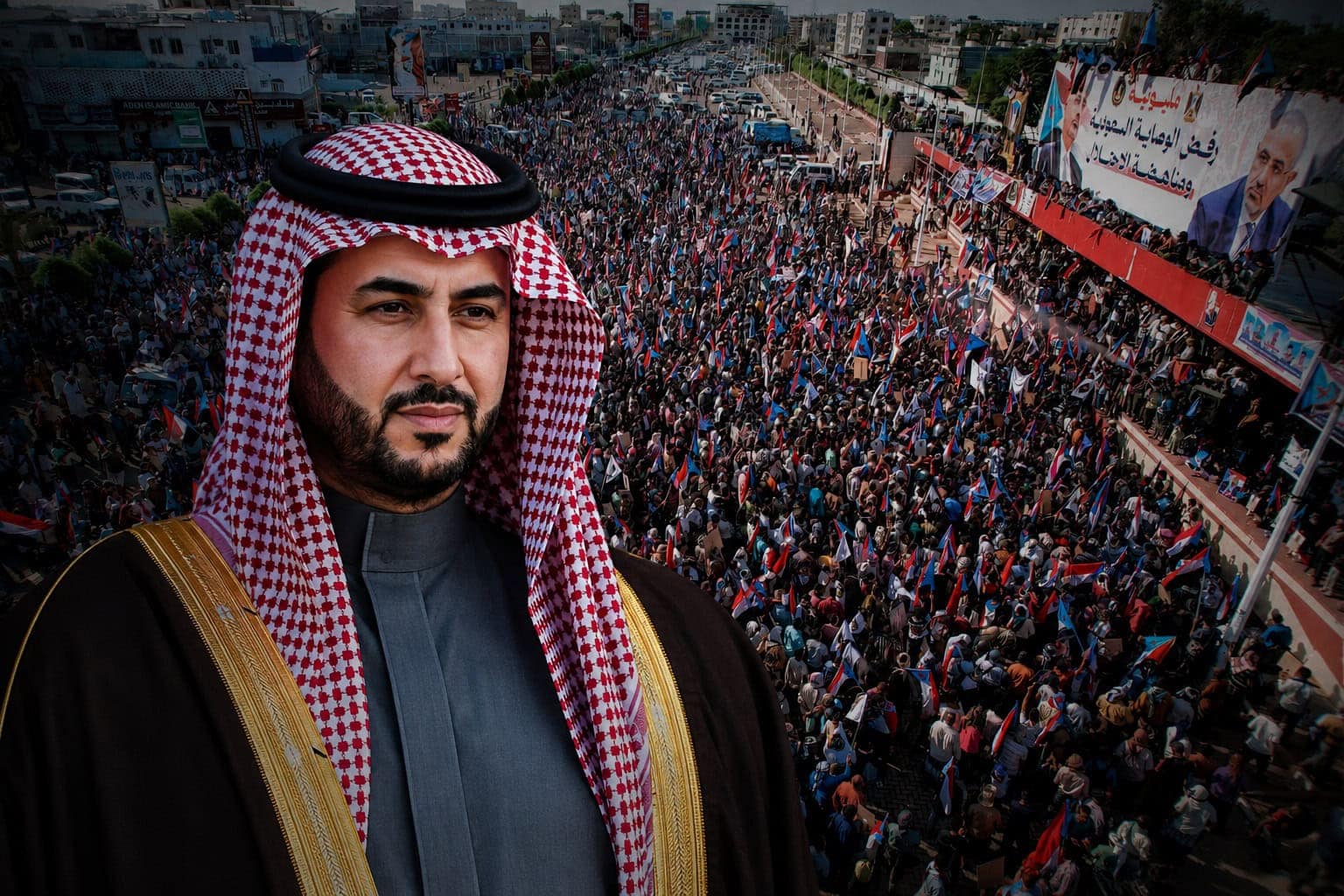
On the ground, many Southerners denounced the announcement, viewing it as issued under Saudi pressure, especially amid reports that the delegation was detained and stripped of their phones to limit external influence. All STC bodies in Aden and other Southern governorates rejected the decision, reaffirming the council’s internal legitimacy and its right to make decisions through its full institutional framework. This rejection was reinforced by an unprecedented mass demonstration in Aden the following day, involving tens of thousands, as well as similar protests in other Southern governorates, including Socotra.
Attempting to dissolve a Southern political entity with a broad popular base, after years of active security, military, and political engagement, and removing it from the political equation in such a drastic manner, from the territory of another state, and under opaque and abnormal conditions, constitutes an unprecedented move in Yemen’s political history. It may generate serious repercussions, particularly if the Riyadh conference fails to produce consensus supporting Southerners’ right to a referendum and the restoration of their state.
From Saudi Arabia’s perspective, this option may aim to avoid debates over the legitimacy of the current leadership versus Al-Zubaidi’s legitimacy, and to preempt potential Southern infighting. Maintaining a component with ties to the UAE may also be a source of concern for Riyadh, though such concerns could be alleviated through clear understandings with its leadership. Nonetheless, these calculations overlook a critical reality: Legitimacy for these entities and their leaders derives solely from the people of the South.
Southern Dialogue at the Center of Controversy
Following the Saudi Foreign Ministry’s announcement of sponsoring an intra-Southern dialogue conference in Riyadh to explore fair solutions to the Southern cause, based on a request by Presidential Leadership Council Chairman Rashad Al-Alimi, who claimed it came from Southern components, the move sparked widespread debate in Southern circles. Many questioned its appropriateness amid ongoing public anger following the deaths of Southern fighters in the deserts of Hadramout and the mountains of Al-Dhalea, and while Saudi aircraft continue to patrol Southern skies.
Some Southerners argued that an initiative led by a party directly involved in the conflict, and which conducted a broad military campaign against Southern forces, may not yield satisfactory outcomes, compared to a neutral international body or third-party mediator capable of ensuring more consensual and legitimate outcomes among Southern actors.
Other Southerners, however, view the Riyadh dialogue as a genuine opportunity to assert strong political presence through active participation, preventing Northern actors from exploiting Southern-Southern contradictions by bringing all parties to one table to propose realistic, consensual solutions, away from theoretical initiatives disconnected from realities on the ground. This is particularly the case if Saudi Arabia provides clear guarantees to Southerners before embarking on any future track with the Houthis, ensuring that the South cause is not sidelined and that Southerners interests and rights are protected.
Presenting a vision for “self-determination” through a Southern referendum at the Riyadh conference, along with a defined timeline under a UN-supervised mechanism, would be a realistic proposal better aligned with current dynamics. It would respond to the rising Southern street demand for this option. Delaying solutions to the South issue until after the “liberation of Sanaa” from the Houthis has only compounded grievances and deepened public frustration due to the lack of response to Southern demands and aspirations.
Therefore, it is imperative that this file receive serious attention and support from regional and international actors, particularly those welcoming the dialogue initiative, to achieve security and stability in South Yemen and the region at large.
Impact of the Broader Scene on the Houthis
President Rashad Al-Alimi’s statement regarding the formation of a Supreme Military Committee under the command of the Coalition to Support Legitimacy, tasked with preparing, equipping, and leading all forces and military formations, was perceived as a “declaration of war” against the Houthis, particularly if they lean toward peaceful solutions.
Nevertheless, the committee’s formation faced broad political and legal criticism, including from PLC member Faraj Al-Bahsani, who argued that it would not be a genuine decision-making partner but rather a “ceremonial committee” under Saudi leadership, executing operational orders and reinforcing external guardianship over Yemen’s political and military decision-making, while diluting the identity of Southern forces.
At this stage, entering a political settlement with the Houthis and signing a “roadmap” appears increasingly likely. This process is expected to be preceded by the formation of two delegations representing Yemeni parties, one from the North and one from the South.
The Southern delegation would reflect the vision emerging from the Riyadh dialogue regarding the South cause. Negotiations with the Houthis would then commence under Saudi and Omani sponsorship.
However, the political trajectory will ultimately depend on the Houthis’ own strategic posture, as any attempt to engage in power-sharing as a political component would threaten their project based on “Wilayah,” particularly given Yemenis’ refusal to relinquish their right to equal citizenship.
Abandoning their project would jeopardize the Houthis’ very existence. Consequently, despite all scenarios, the continuity of the Houthi project appears headed toward collapse. Their only viable option to maintain relevance remains the continuation of war, as their power is closely tied to their ability to endure in a conflict environment. Current regional dynamics and Iran’s state of disarray reduce the Houthis’ chances of survival, even if they fight fiercely, especially after losing significant military and security leverage due to intensive US and Israeli strikes in recent months.
Thus, accelerating a decisive approach to the Houthi track is crucial, as they remain in a state of silent anticipation. Any delay could allow them additional space to adapt to new realities, further complicating the crisis and increasing its political and military costs.
Overall, the scene appears to be heading toward a highly complex phase, particularly in South Yemen, amid the reshaping of new Southern power balances following the weakening of the most organized Southern political actor. This has been accompanied by rising public anger and the emergence of a political and security vacuum that is likely to expand unless managed with caution and realism. These developments coincide with Saudi efforts to reengineer the Yemeni political landscape in a manner that curbs Emirati influence and aligns the negotiating track with the Houthis to Riyadh’s security priorities.
At the same time, time remains a decisive factor in shaping Houthi behavior in the coming period. Yemen’s future stability will depend on the ability of regional and international actors to manage the crisis through a balanced approach that integrates political solutions with addressing the root causes of the conflict, chief among them the South cause, while preventing the reproduction of war in new, more costly, and more complex forms for Yemen and the wider region.