SOUTH24 CENTER FOR NEWS & STUDIES
SOUTH24 CENTER FOR NEWS & STUDIES


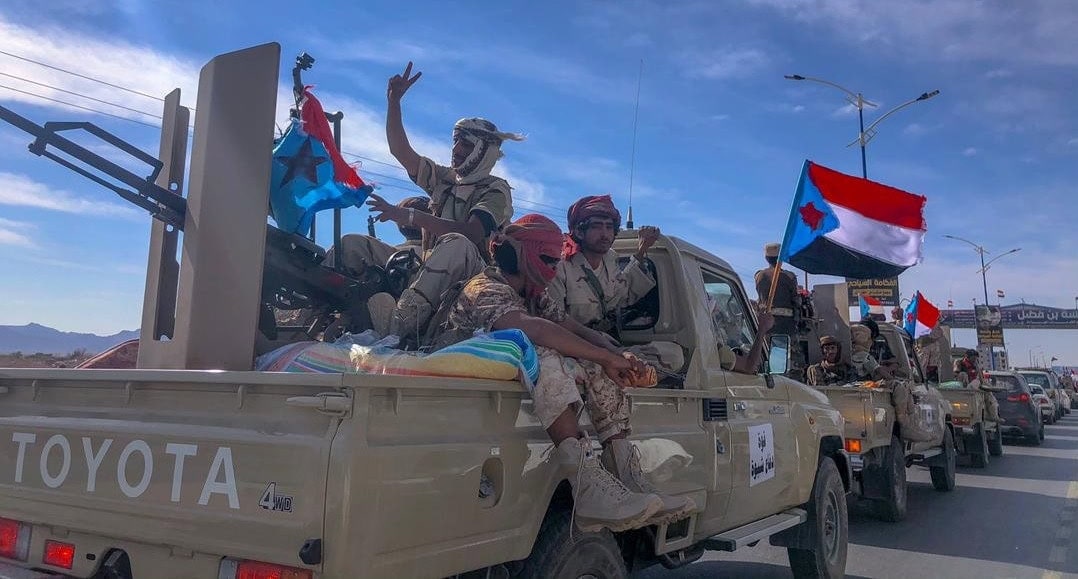
The Southern Armed Forces (Deraa Aljanoob)
Last updated on: 12-01-2026 at 4 PM Aden Time

“Southern Government forces viewed AQAP as an existential threat to territory and social stability. By contrast, the replacement forces, regionally backed or tied to northern party loyalties, appear less inclined or prepared to wage an uncompromising, zero-sum campaign against the group.”
Ibrahim Ali (South24 Center)
South Yemen is entering a highly complex security phase following recent developments marked by the deployment of Saudi-backed “Nation Shield” forces in Hadramout and Al-Mahra, alongside the withdrawal of Southern Government forces from these governorates.
This shift has not been routine or temporary, nor has it occurred quietly, particularly from the perspective of Al-Qaeda in the Arabian Peninsula (AQAP). The group has treated the change as a pivotal moment, responding with an unprecedented wave of political and media celebrations by its leadership and supporters.
This reaction cannot be understood merely as satisfaction at the removal of a powerful adversary. Rather, it reflects a calculated assessment by AQAP that the region is entering a new phase offering a genuine opportunity to regain influence it has steadily lost over recent years. The group does not view the withdrawal of Southern Government forces from Hadramout and Al-Mahra as a tactical pause, but as a strategic shift that could reopen doors it believed had been permanently closed.
These implications were evident in the rhetoric adopted by AQAP leader Saad Atef Al-Awlaqi in his most recent appearance, where he described the withdrawal of Southern and Emirati forces as the “breaking of idols.” This framing was not merely religious or emotive but conveyed a clear political and security message: the forces that had constituted the primary obstacle to AQAP’s territorial, operational, and ideological expansion had been removed.
AQAP’s sense of victory is closely linked to the reality that Southern Government forces, particularly the Hadramout Elite Forces, Security Belt units, and brigades such as Barasheid, had pursued a proactive, offensive counterterrorism strategy. These forces did not wait to be attacked; they systematically targeted AQAP strongholds, dismantled funding networks, and disrupted recruitment and mobilization channels. As a result, AQAP’s presence in Hadramout, Al-Mahra, Abyan, and Shabwa became increasingly costly and dangerous.
With the withdrawal of these forces, AQAP likely perceives the collapse of what it considered the first line of defense protecting the strategic depth of these governorates. The security environment, from the group’s perspective, has become less restrictive and more permissive, allowing dormant cells to gradually resume activity with reduced pressure.
The most significant gain AQAP anticipates from this military reconfiguration lies in exploiting the security vacuum created by replacing highly experienced counterinsurgency forces with units that lack the same combat doctrine, local knowledge, and operational experience. Southern forces viewed AQAP as an existential threat to territory and social stability. By contrast, the replacement forces, regionally backed or tied to northern party loyalties, appear less inclined or prepared to wage an uncompromising, zero-sum campaign against the group.
AQAP’s reading of the situation suggests it is betting on a period of heightened “security fragility” following the transition. In such conditions, the group does not require direct confrontation; it needs freedom of movement. This is likely to manifest through efforts to reestablish training camps in the remote valleys and rugged terrain of Hadramout and Al-Mahra, areas that are rugged and geographically complex.
The exit of the United Arab Emirates from the scene further reinforces AQAP’s calculations. Emirati support had provided critical air cover, logistical backing, and high-quality intelligence, enabling targeted strikes against senior AQAP figures over the past several years. The absence of this capability significantly reduces the risk of precision air operations, granting the group greater operational flexibility at lower cost.
AQAP is also aware that the incoming forces, often viewed locally as external or northern, may struggle to gain the trust of local communities. This lack of social legitimacy presents an ideal opening for the group, which will likely attempt to portray itself as a “defender” of local populations, employing religious and emotional rhetoric while promoting narratives of resistance to “foreign projects.” Such messaging is aimed at attracting segments of society that may feel marginalized following the withdrawal of local forces that once represented the region’s social fabric.
Compounding AQAP’s confidence is the ideological background of some replacement forces, which may overlap in certain aspects with the group’s own religious discourse. This overlap raises the possibility of tacit coexistence or mutual avoidance. Such dynamics are not new: former AQAP leader Qassem Al-Raymi openly acknowledged in the past that AQAP fighters had operated alongside other religious factions against the Houthis.
Based on previous experience, AQAP appears convinced that these forces will not adopt the same eradication-focused combat doctrine that defined Southern counterterrorism operations, instead allowing the group room to maneuver and regroup.
Shifting Counterterrorism Dynamics
Since 2016, field experience has demonstrated that Southern Government forces formed the backbone of counterterrorism efforts in South Yemen. They achieved notable successes in areas long considered AQAP strongholds, including Wadi al-Masini, the al-Kawr mountains, al-Mahfad, and Wadi Omran.
Their contribution extended beyond military deployment to encompass an integrated security framework involving control of key transit routes and the activation of local intelligence networks rooted in tribal and regional ties. This approach placed AQAP under sustained pressure, forcing it to operate in a persistently hostile environment that prevented consolidation or expansion.
From this perspective, AQAP views the removal of Southern Government forces from Wadi Hadramout and Al-Mahra as a strategic windfall, interpreting it as a forced retreat of its most effective adversary and a development aligned with its long-term objective of rebuilding influence lost since 2016.
The group’s lack of fear toward the replacement forces stems from its belief that these units suffer from fragmented loyalties, multiple command centers, and insufficient experience in countering AQAP’s core tactics, including bombings, assassinations, and ambushes.
AQAP’s media celebration, along with its earlier amplification of campaigns accusing Southern forces of abuses, serves a strategic purpose: discrediting the most effective opponent and justifying its removal, paving the way for a new phase aimed at entrenchment in two of Yemen’s most economically and strategically vital governorates.
The Future of Counterterrorism
The significance of AQAP’s reaction extends beyond the military domain into the political sphere. The group views the apparent shift in Saudi Arabia’s stance toward Southern forces as an opportunity to fracture the united front opposing it. When figures like Saad Al-Awlaqi publicly endorse these developments, they are sending a clear signal to followers that patience has begun to pay off.
The experience of Shabwa in 2022 reinforces this pattern. As Southern forces expanded, AQAP retreated and relied on statements and threats. When those forces withdrew, AQAP resurfaced with public celebration and began reorganizing. Regardless of logistical support, replacement forces will face a local population that perceives the absence of the Hadramout Elite and Southern units as a loss of self-security, precisely the trust vacuum in which extremism thrives.
Looting as a Catalyst for AQAP’s Return
AQAP’s celebratory stance cannot be separated from concurrent developments involving widespread looting of military camps and weapons depots in Hadramout, including al-Rayyan base, Barsaheid Brigade facilities, and the al-Ghayda military axis headquarters. For a group long constrained by arms shortages and disrupted supply lines, this chaos represents a low-cost opportunity to rebuild military capacity without direct confrontation.
Reports suggesting AQAP is seeking to purchase looted weapons through tribal intermediaries reflect a well-established strategy: exploiting moments of security breakdown to convert disorder into strategic gain. Rather than bearing the cost of seizure or attack, the group capitalizes on weak oversight and fragmented armed actors, transforming looting from random criminality into an indirect resource stream that facilitates repositioning and resurgence.
AQAP today finds itself in its most favorable position in years, not due to its inherent strength, but because the force that inflicted its greatest losses has been removed from the battlefield through a controversial political and military decision.
This reality places Hadramout and Al-Mahra before a severe security test that risks reproducing the chaos AQAP exploited in 2015 to seize Mukalla. It also raises urgent questions about the future of stability in the region in the absence of the only force that demonstrably proved capable of confronting violent extremism on the ground.