SOUTH24 CENTER FOR NEWS & STUDIES
SOUTH24 CENTER FOR NEWS & STUDIES


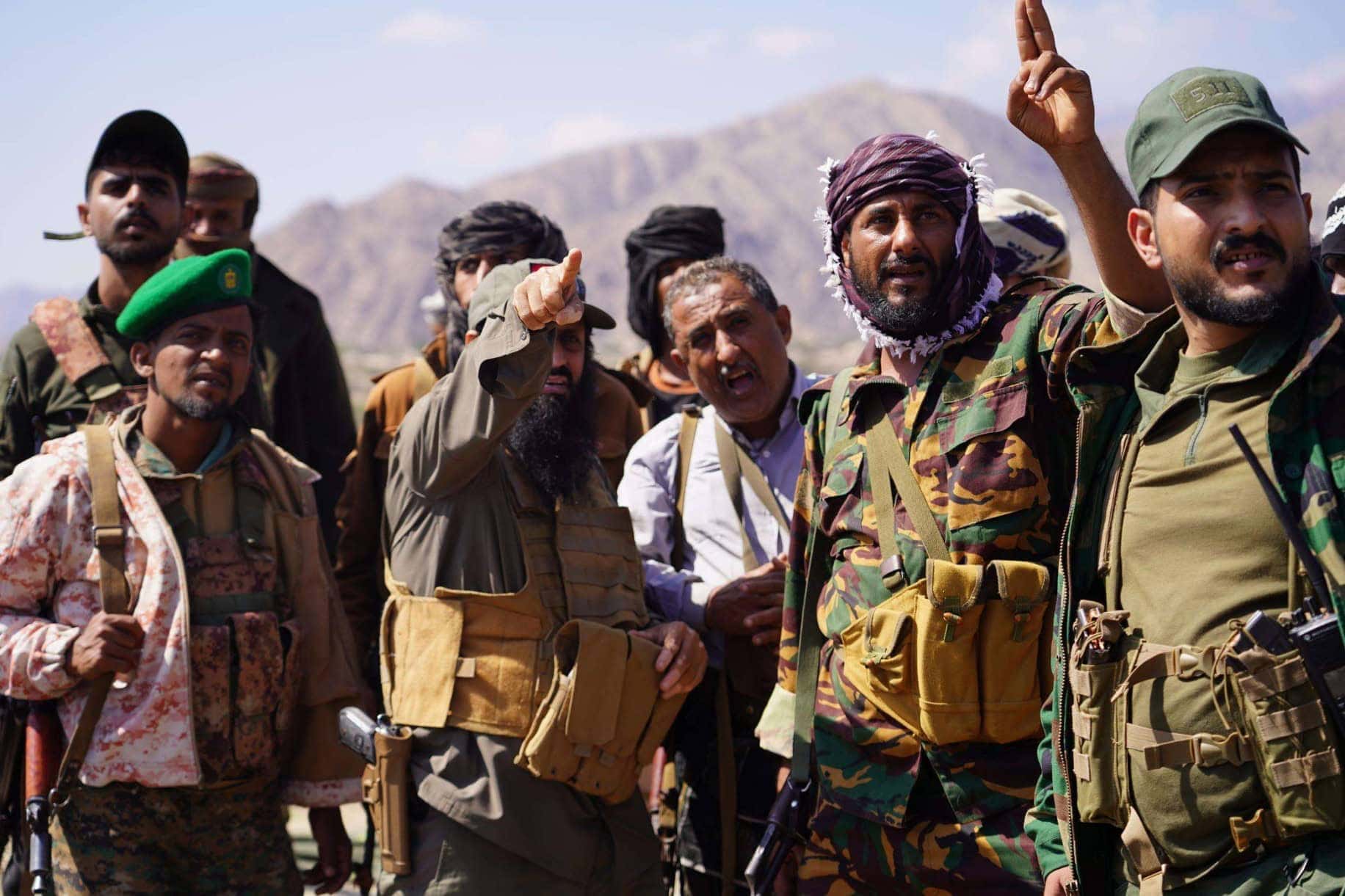
Members and commanders of the Southern Forces in the mountains of Mudiyah District, Abyan Governorate, during the launch of the decisive operation, 15 December 2025 (Southern Forces).
Last updated on: 27-12-2025 at 5 PM Aden Time

The security landscape in South Yemen today represents a historic turning point that goes beyond mere force redeployment or conventional military control. It marks a completely new articulation of the “war on terrorism” within an extraordinarily complex geographic and tribal environment.
Ibrahim Ali (South24 Center)
There is no doubt that what the Southern Forces have achieved over recent years extended well beyond isolated battlefield victories. What has occurred is a fundamental shift in “combat doctrine,” one that has succeeded where decades of prior efforts failed to decisively defeat Al-Qaeda in the Arabian Peninsula. Whereas earlier regular forces relied on a strategy of merely “expelling militants from urban centers”, an approach that repeatedly proved ineffective by allowing fighters to withdraw into mountainous terrain and later regroup, the Southern Forces adopted a strategy centered on “pursuit and clearance within rugged strongholds.”
In retrospect, the contrast between the two approaches is stark. In 2011 and 2012, when Al-Qaeda seized control of Abyan and parts of Shabwa, government forces at the time succeeded in expelling the group out of urban centers but committed a strategic error by stopping there. This partial victory allowed militants to retreat into mountainous hideouts to reorganize. The consequences became evident in the alarming figures of 2013 and 2014, when the group carried out more terrorist attacks, both in scale and sophistication, than at any time since its founding, exploiting the absence of sustained pursuit in “rugged terrain.”
The situation changed fundamentally between 2015 and 2019 with the entry of the Southern Forces into the confrontation. Operations no longer ended at the boundaries of liberated cities but extended deep into mountainous hideouts. This determination to push the fight into AQAP’s “defensive depth” broke the cycle of resurgence and deprived the group of the ability to return and retake areas it had lost, turning the mountains from so-called “safe havens” into zones of constant pressure and attrition.
Identity Advantage and the Collapse of the Support Base
For decades, tribal dynamics formed the “corner stone” for Al-Qaeda’s survival in Yemen. The group effectively exploited long-standing tribal suspicion toward centralized forces deployed from outside the South’s governorates. In earlier conflicts, tribes often functioned as a passive buffer or provided reluctant shelter for militants, not out of ideological alignment, but as a response to forces perceived as “occupying” or external forces.
This is where the Southern Forces hold a decisive strategic advantage: they are composed of the sons of these same governorates and tribes. The reliance on “local recruits” in counterterrorism operations has deprived Al-Qaeda of one of its most critical assets, its “tribal support” environment. When Southern soldiers deploy to districts such as “Al-Mahfad” in Abyan or “Kor Al-Awaliq” in Shabwa, they do not arrive as outsiders but as a son of the tribe or a neighbor to it, effectively closing the trust gap between armed forces and local society.
This transformation has reshaped the role of tribal communities from a reluctant shelter into an active security partner. Increasingly, tribes recognize that removing Al-Qaeda elements from their areas serves their own interests in stability and development, rather than advancing an externally imposed security agenda.
As a result, the close bond between Southern fighters and their tribal base enabled forces to penetrate strongholds that had long resisted intervention, including Wadi Al-Maseeni on the Hadramout coast, Markhah and Al-Sa’eed in Shabwa, and Al-Mahfad and Mudiyah in Abyan. In these areas, Al-Qaeda was unable to withstand forces that possessed detailed knowledge of the terrain and enjoyed popular support that denied militants the ability to blend into local communities.
Al-Qaeda appears to have realized, albeit belatedly, that the rules of engagement had changed. The conflict was no longer between a militant group and conventional forces confined to their barracks, but a hybrid “popular–military” campaign that pursued it into mountain caves and rugged valleys. As a result, the long-standing strategy of “withdraw and return” collapsed, as militants found themselves, for the first time, hunted deep inside what were once their safest sanctuaries, unable to use mountainous stronghold as platforms from which to reassert control over cities.
Transferring the Model and Closing the Gaps
With the Southern Forces recently securing Wadi Hadramout and Desert and Al-Mahra governorate, the campaign to clear South Yemen appears to be entering its final chapter. For years, Wadi Hadramout functioned as a “gray zone” exploited by Al-Qaeda due to the presence of government forces that lacked either the will or the popular mandate to pursue militants into surrounding mountains. On the ground, this fostered a perception that such forces were not neutral, but that their silence and inaction effectively provided indirect cover that allowed militants to move and operate freely. This unspoken complicity made the replacement of those units with Southern Forces not a political choice, but an urgent security necessity, to break the cycle that prolonged terrorism’s presence and activity in the eastern region of the country.
Similarly, Al-Mahra long functioned as a rear gateway and a critical smuggling and supply corridor, benefiting from porous borders and weak security oversight. Extending the “Abyan and Shabwa model” to these areas signals the end of “forced coexistence” between military forces and extremist groups across these vast territories.
As the Southern Forces extend control eastward, they are not merely deploying weapons and equipment; they are exporting a “proven model of success” that has systematically dismantled Al-Qaeda’s infrastructure. This expansion closes geographic gaps that once allowed militants to maneuver freely. Once the battlefield is unified under a single Southern command from Bab al-Mandab to the furthest point in Al-Mahra, the group loses its ability to escape pressure in one governorate by relocating to another perceived as “quieter.”
Securing Al-Mahra and the Hadramout Wadi and Desert provides the Southern Forces with what could be described as a “golden triangle of control”: “land, people, and intelligence.” Despite the terrain’s vastness and difficulty, these areas will now be governed by a doctrine of “pursuit and clearance,” rather than “deliberate neglect.”
Closing this “eastern gap” effectively cuts off Al-Qaeda’s most important arms-smuggling routes and channels for foreign operatives, shrinking its operational space from an open geography into “isolated pockets” that are easier to monitor and dismantle. The Southern Forces’ strategy emphasizes permanent presence rather than temporary campaigns, eliminating the conditions necessary for regrouping.
The End of Al-Qaeda’s “Golden Era”
The impact of this field transformation is not confined to the domestic arena, but extends regionally and internationally. Securing the Wadi Hadramout and Al-Mahra directly contributes to safeguarding international energy routes, and oil and gas infrastructure, while depriving Al-Qaeda of long-standing smuggling-based revenue streams. Based on prior outcomes in Abyan and Shabwa, AQAP is approaching the end of its most powerful phase, when it could administer entire territories outside state control.
The group’s position has shifted dramatically. Once capable of seizing entire cities, as seen in Al-Mukalla in 2015 and Abyan in 2012, now it has become scattered, hunted cells lacking safe havens and the local support that once sustained its existence and expansion.
The Southern Forces’ operations reflect a practical strategy focused on eliminating security vacuums and preventing militant re-infiltration. Rather than reactive operations, the emphasis now is on consolidating control and preventing reconstitution, restoring the military’s role in protecting territory, and ensuring long-term stability.
In summary, transferring the pursuit-and-clearance model from Abyan and Shabwa to Wadi Hadramout and Al-Mahra tightens pressure on the last areas Al-Qaeda relied upon for maneuver and fallback, dismantling the equation that allowed it to survive despite repeated strikes.
The success of this approach will not be measured by the number of statements issued or clashes reported, but by the Southern Forces’ ability to establish lasting stability and integrate land, tribes, and intelligence into a unified system that counters terrorism rather than enabling it. If this approach is pursued realistically and patiently, South Yemen stands before a rare opportunity to close a long chapter of armed violence and impose a new security reality in which extremist groups are left with only two options: retreat or disappear.