SOUTH24 CENTER FOR NEWS & STUDIES
SOUTH24 CENTER FOR NEWS & STUDIES


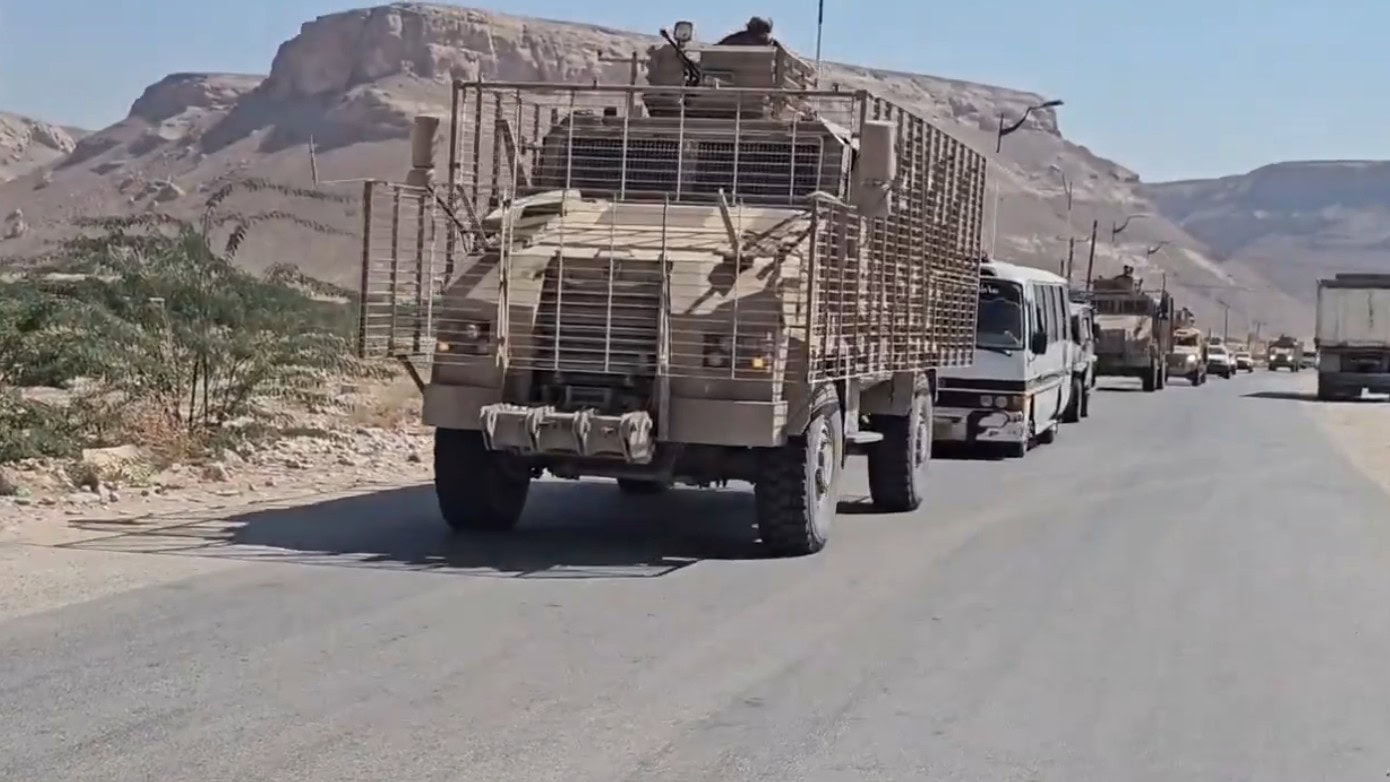
Armored vehicles and troop carriers belonging to the Southern forces en route to Wadi Hadramout, Tuesday, December 2, 2025 (cropped: South24 Center).
Last updated on: 02-12-2025 at 11 PM Aden Time

|
|
Seiyun (South24)
On December 2, large units of the Southern Armed Forces — including Hadrami troops — advanced into several areas and towns in Wadi Hadramout, including Sah District, as part of a broad military operation aimed at reaching the positions of the First Military District in Seiyun, according to AIC TV, which is affiliated with the Southern Transitional Council (STC).
This deployment follows mounting public demands - some documented by South24 - calling for the deployment of Southern and Hadrami forces across the Wadi and Desert regions amid escalating security turmoil and accusations that armed groups have been obstructing economic facilities, expanding smuggling activities, and enabling the spread of “terrorist” and armed groups.
Verified videos reviewed by South24 showed residents in multiple districts welcoming the advancing forces, gathering along the roads and chanting, “Liberating the Wadi is a duty.”
Despite the tense security climate, no clashes or armed confrontations have so far been recorded with fighters loyal to Amr bin Habrish or any other groups, according to field sources who spoke to South24.
A South24 correspondent reported that a significant number of soldiers from the Hadramout Battalion within the First Military District announced their defection and declared their alignment with the Southern Transitional Council (STC), in a development that adds to the growing fragmentation within the District’s units in recent days.
Local sources said the advancing forces include various Southern formations — among them armored vehicles and counterterrorism units, as well as Hadrami contingents — moving in an organized manner toward areas controlled by the First Military District.
Eyewitnesses told South24 that the forces are now only tens of kilometers away from the city of Seiyun.
The STC accuses the First Military District of being loyal to the Muslim Brotherhood and alleges that some of its members have colluded with the Houthis and AQAP. Multiple consistent sources indicate that the region has long been under the influence of former Vice President Ali Mohsen al-Ahmar, and that most of its personnel originate from North Yemen.
For years, the First Military District served as a protective shield for powerful northern figures involved in Hadramout’s oil and gas sector. It also has witnessed a series of assassinations and large-scale armed attacks, some of which targeted members and commanders of the Saudi forces stationed there.
For its part, the media office of the First Military District said that its commander, Maj. Gen. Saleh Mohammed Abdulrab al-Ja'milani, inspected frontline positions on Tuesday and directed units to raise combat readiness in anticipation of any developments.
The commander of the First Military District issued orders to all units to carry out the closure and security plan across the entire operational area."
Earlier, Presidential Leadership Council member Maj. Gen. Faraj al-Bahsani condemned what he described as “assaults” by First Military District forces against civilians in Seiyun and attempts to prevent people from exercising their political rights.
A South24 correspondent reported that forces from the region opened fire on peaceful protesters on Monday in Al-Sittin Street in Seiyun, while other media outlets said several demonstrators were also arrested.
Agreement with Bin Habrish as Jihadist Elements Enter the Crisis
Meanwhile, the Hadramout Governor told Yemen TV that an agreement had been reached with Amr bin Habrish to withdraw his armed men from the PetroMasila company’s facilities. However, bin Habrish has not issued any official statement confirming this so far.
In an interview with the BBC on Tuesday, bin Habrish said that the takeover of PetroMasila facilities by his fighters was intended to “protect” them. He reaffirmed his rejection of the “South Arabia” project — a proposed independent state in South Yemen supported by the STC — and accused the UAE of backing STC forces, while calling on Saudi Arabia to support him.
On Monday, PetroMasila announced a complete halt to production and refining operations at its facilities and fields in Sector 14, effective November 29, due to the deteriorating security situation around the oil installations. The company said the decision was made in accordance with industry safety standards and to protect workers and nearby communities, following armed attacks posing “catastrophic” risks to petroleum and gas materials.
In a related development, former AQAP leader Riyadh al-Nahdi launched an attack on Maj. Gen. al-Bahsani after the latter labeled bin Habrish’s fighters as “rebels.” Al-Nahdi — who has split from AQAP in recent years and founded a group called “Change and Freedom” in Wadi Hadramout, whose establishment in March 2025 was attended by members of the organization — accused al-Bahsani of being a “traitor.”
These developments come as Wadi Hadramout experiences rapid security shifts, amid anticipation over how far the Southern Forces will advance toward the First Military District’s strongholds and whether this movement will pave the way for a major restructuring of the Valley’s security landscape.
At the same time, AQAP launched an attack on Southern Forces positions in Wadi Omran in Mudiya District of Abyan. The Southern Forces said they repelled the attack, inflicted “heavy losses” on the militants, and confirmed that one soldier was injured.
In the Al-Hadd front in Yafa, on the border with Al-Bayda, the Southern Forces reported that Houthi militias shelled civilian homes with heavy and medium weapons, causing damage to windows, roofs, and walls.