SOUTH24 CENTER FOR NEWS & STUDIES
SOUTH24 CENTER FOR NEWS & STUDIES


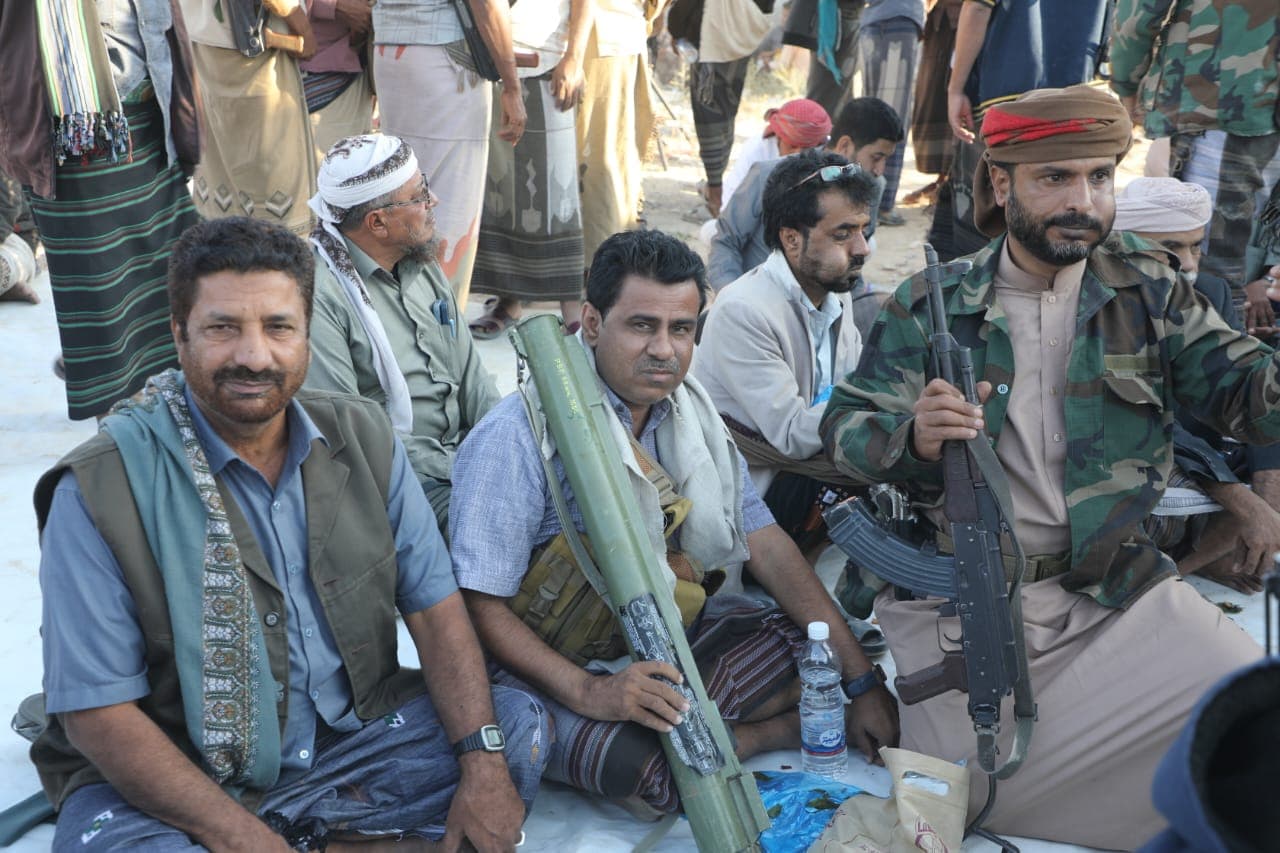
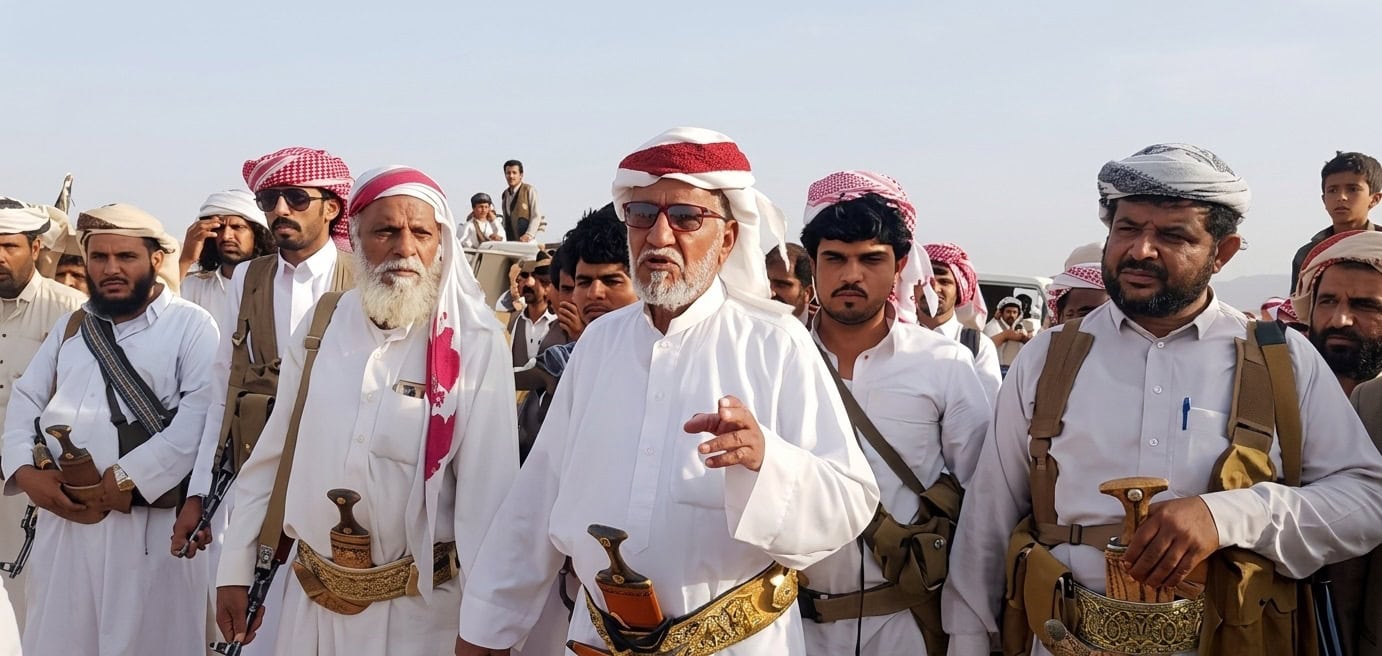
A photo of tribal gunmen during a meeting called for by Sheikh Amr bin Habrish in Wadi Hadramawt, November 27, 2025
Last updated on: 30-11-2025 at 1 PM Aden Time

|
|
"In Hadramout, a loud coastal conflict is diverting attention from the silent, unresolved war in the valley."
Abdullah Al-Shadli (South24 Center)
Hadramout Governorate in South Yemen is experiencing one of its most complex political and security periods in years, with escalating tribal and military mobilization coupled with incendiary rhetoric, coinciding with an impasse in decision-making within the state’s governing apparatus.
While recent public debate has centered on the limited rhetorical confrontations and escalatory statements issued by the Hadramout Tribal Alliance (HTA) led by Sheikh Amr bin Habrish, a broader picture is emerging -- that reflects a clear deviation of the crisis away from its traditional center in Wadi Hadramout, where northern forces are positioned and cells linked to the Houthis operate, alongside older and more entrenched networks of influence.
The HTA’s announcement on Thursday (November 27) of the formation of what it called the “Hadrami Resistance,” and its call to confront Southern Forces within the Hadrami Elite Forces (HEF) stationed in Mukalla and along Hadramout’s coast, represents a dangerous turn that revives a central question: Who stands to benefit from opening a front on the coast, while the Wadi file, with its profound security and political implications—remains outside the circle of priorities?
This development also signals a shift toward the military and security trajectory for the HTA affiliated with Amr bin Habrish, away from the political, service, and economic tracks it had adopted in recent years.
These developments raise concerns that multiple actors are working to re-distribute the theaters of conflict in Hadramout—the jewel of the South—that is caught in the pulls of regional and international ambitions, by opening alternative battles aimed to exhaust local capacities and divert focus away from the burning issues and most sensitive files in the governorate.
Topping these issues are of the First Military Region, and the protection of ports and oil facilities that the Houthis targeted with drones in October-November 2022, in addition to the dire economic and service conditions in the governorate.
The Postponed Wadi Battle
Wadi Hadramout has for years constituted the most complex focal point in the map of security and military influence within the governorate, as it is the area where northern forces maintain their strongest presence, despite the major transformations the country has witnessed since 2015.
The Wadi files have remained pending, unresolved, and without a clear pathway to this day, in spite of the popular and official consensus in Hadramout on the need to remove the northern forces -- that have been stationed there for more than a decade, especially after the painful experience the Hadramis lived through in 2015 when these forces handed over the city of Mukalla and Hadramout’s coast to the AQAP terror outfit.
Unlike the coast, which the HEF has managed to secure since the liberation of Mukalla in 2016 with Emirati support, the Wadi has retained its old military configuration, with the continued presence of units of the First Military Region and the absence of any substantial changes in its structure or areas of deployment—aside from the limited entry of the Nation Shield Forces (NSF), recently established by Saudi Arabia, which have been deployed at the Al-Wadiah crossing and the Al-Abr area.
This security and military reality in Wadi Hadramout has afforded the anti-South players wide latitude to reposition themselves, along with a permissive environment for the movements of extremist groups and cells linked to the Houthis and the terrorist organization AQAP (Al-Qaeda in the Arabia Peninsula), according to local sources and informed security reports.
Moreover, the launch of the ‘Current of Change and Liberation’, a political movement announced in April 2025 in a desert area of Wadi Hadramout by defected AQAP leader known as Abu Omar al-Nahdi, stands as one of the most prominent examples of the escalation of security threats in this area. Al-Nahdi is known to be close to key Turkish decision-makers, with the group openly-embracing a pro-Turkish stance – further complicating matters in the oil-rich Hadramout region.
The Recent Escalation Wave
In recent weeks, Hadramout has witnessed a series of rapid developments that shifted the scene from a state of latent tension to open confrontation, with the emergence of field movements and security incidents along the coast, accompanied by intensifying tribal and political rhetoric. This turn began with a sequence of security incidents that served as early indicators of the crisis moving from political sparring to the stage of field action.
The most notable of these developments was the armed ambush targeting a patrol of the HEF on November 12 by groups affiliated with the influential tribal figure Salem al-Gharabi. This was preceded by the spiking of tension in the Rasb area after tribal gunmen intercepted fuel tankers destined for the coastal electricity stations.
Although these incidents were not directly attributed to the HTA led by bin Habrish, armed tribal checkpoints affiliated with HTA have carried out fuel blockades in recent periods, leading to an electricity crisis in Hadramout’s coast. These armed checkpoints also prevented fuel trucks from passing for delivering fuel to power stations in Aden several times.
On November 24, the commander of the Security Support Brigade within the HEF, Saleh bin al-Sheikh Abu Bakr, known as Abu Ali al-Hadrami,—a prominent officer known for his role within the Southern Resistance and the Southern Movement over the past two decades, gave a speech criticizing Amr bin Habrish and his group.
In what appeared to be a speech or lecture before other officers, bin al-Sheikh criticized the practices of Amr bin Habrish and his group “of forming gangs, blocking roads, and manipulating public funds,” warning that Hadramout “is in urgent need of security and stability before any talk of development.”
On November 26, the Hadramout Inclusive Conference, an important political and tribal entity in Hadramout also chaired by Amr bin Habrish, issued a statement condemning bin al-Sheikh’s remarks, and holding Yemen’s Presidential Leadership Council (PLC) responsible for the current situation.
The Al-Mahra Sit-in Committee, a tribal grouping led by Ali Salem al-Huraizi, opposed to the Saudi-led Coalition and accused of links to the Houthis, issued a statement the previous day (November 25) also attacking the top Hadrami security official.
Member of the PLC and former Hadramout governor Faraj al-Bahsani, in a statement on November 16, directly accused the Chairman of the Council, Rashad al-Alimi, for the crisis situation in Hadramout, saying he had caused the disruption of the economic and service response plan for Hadramout that the PLC announced in January 2025.
Al-Bahsani said in his statement: “If this deliberate disruption continues, we will be forced to take unilateral decisions in consultation and coordination with our brothers in the Presidential Leadership Council, to normalize the situation and approve what the Council members unanimously agreed upon in accordance with the Transfer of Power Declaration.”
In a statement of November 27, al-Bahsani—who is also Vice President of the Southern Transitional Council (STC)—said Hadramout today “is going through the most dangerous phase in decades, a phase that does not tolerate tampering, and will not forgive those who place their own interests above the interests of Hadramout and its people,” calling for dialogue to overcome the crisis.
In a separate statement , the local authority in Hadramout has called for dialogue and adherence to the legitimate institutions that represent the state, warning against sliding into the square of violence.
On Thursday (November 27), bin Habrish held a meeting with his supporters among tribal sheikhs and citizens in the Al-Aleeb area on Hadramout’s plateau. The final statement of the meeting announced what it called the “Hadrami Resistance,” with a direct call to confront Southern forces under the HEF, and a broad mobilization of tribal members.
In this statement, the HTA spoke of “forces coming from outside Hadramout” that seek—according to its phrasing—to entrench themselves in vital sites within the governorate, control oil repositories, take over some camps, and sideline their commanders. The statement did not include any stand regarding the northern forces present in Wadi Hadramout.
The statement’s call for members and commanders of the HEF to join their “people,” and not allow themselves to be used as a tool to implement what it described as “schemes targeting Hadramout,” reflected an explicit tendency to create a tribal alignment versus an institutional alignment—something that threatens to cause a split within the security apparatus and threatens the HEF themselves.
This step coincided with reports circulated by individuals close to bin Habrish regarding the arrival of military forces dispatched by the STC to Mukalla over the past two days. South24 Center could not independently verify these claims.
Nearly three years ago, the HTA adopted an escalatory program that included restrictions on fuel movement to pressure the central government and the PLC to meet primarily economic and service demands, with the political demands evolving from including its group in the political process and decision-making to seeking self-rule and forming teams to organize its regulations.
However, bin Habrish’s legitimacy as leader of the HTA has been under continuous doubt. The spark of discord within the HTA ignited in November 2023 after a statement by bin Habrish described as “reckless,” in which he attacked the HEF, the local authority of the governorate, and the United Arab Emirates.
On March 22, 2025, founding members of the HTA announced, during a meeting in the Al-Ayoon area, the withdrawal of confidence in bin Habrish and his removal from the HTA’s leadership, and the forming of a preparatory committee to select a new chairman.
But bin Habrish pressed on with his activities, led by an illegal militia called the Hadramout Protection Forces. In July 2025, bin Habrish attended the graduation ceremony of the first batch of recruits in the basic training course of the First Brigade of the Hadramout Protection Forces, amid ongoing warnings from the Second Military Region against any such formations outside the law.
He also attended the graduation ceremony of the second batch on October 12.
On November 27, the preparatory committee for completing the restructuring and rotation of the leadership of the HTA announced the convening of an exceptional tribal meeting on Saturday November 29, confirming it had completed all arrangements necessary to reconstitute the HTA’s leadership by consensus in accordance with the bylaws.
The committee called on sheikhs, tribes, dignitaries, and various segments of the Hadrami spectrum to attend the expanded meeting to be held in the Ras Hawaira area on Hadramout’s plateau, with the aim of “correcting the HTA’s course” following the removal of Amr bin Habrish in the Al-Ayoon meeting. At the meeting held on November 29, the sheikhs and notables unanimously inaugurated Sheikh Khalid al‑Kathiri as the new head of the alliance, succeeding Amr bin Habrish.
The expanded meeting also approved the establishment of a Hadramout Tribal Council, composed of 101 tribal chiefs and sheikhs, with HTA members to be selected in consultation with the tribal notables over the next two months.
Attendees also authorized the alliance’s presidential council to elect 22 members to run its affairs, form specialized committees, and redraft the bylaws after reviewing members’ remarks.
The final statement sets the presidency’s term at two years, renewable for a similar period, with an annual performance evaluation of the body.
The statement stressed the continuation of Hadramout’s rights demands “until they are fully implemented,” calling for commitment to the implementation of all legitimate demands of the governorate’s sons.
Who Benefits?
Dr. Omar Bajardana, head of the Knowledge Center for Studies, believes that “internal conflict serves Hadramout’s traditional enemies (the Muslim Brotherhood and the Houthis), who seek to reposition themselves after losing their presence on the coast.”
He told South24 Center: “This focus is not sudden; it stems from a sustained effort by certain forces to sow chaos and undermine security and stability along Hadramout’s coast. These forces—foremost among them the Muslim Brotherhood—lost their political and military presence since Mukalla’s liberation from AQAP, and they are attempting to exploit the weakness of the local authority and the sharp division within the PLC to reposition themselves.”
Political analyst Salem al-Marshadi believes that “there are attempts to drag the HTA into political positions larger than its tribal weight, and perhaps to leverage it by parties seeking to create new balances.”
He told South24 Center: “The scenario of the HTA imposing self-rule by force of arms is unrealistic; the HTA does not possess the components to wage an armed confrontation that reshapes authority, and any such move would drag Hadramout into chaos.”
For his part, political analyst Nasser al-Tamimi sees that “the HTA’s media discourse confirms the existence of agendas supported by hostile Yemeni forces.” He added to South24 Center: “The HTA’s practices on the ground contradict its claims about protecting services or stability. They were preventing diesel from reaching power stations.”
In sum, Hadramout appears to be deliberately being steered toward side battles that keep the real center of gravity of the crisis—Wadi Hadramout—out of the spotlight. The louder the noise along the coast, the more the most pressing questions recede regarding the structure of military influence in the Wadi, the smuggling and arms networks, the positioning of northern forces and extremist groups, as well as the deterioration in service, economic, and resource files.
With turmoil persisting, the governorate’s future becomes contingent on the ability of local forces to overcome wars of attrition and restore the compass of the conflict toward the core issue that will determine its fate.
All eyes are turning to Seiyun, the capital of Wadi Hadramout, which is expected to witness a mass rally on November 30 to mark the anniversary of the South’s independence from Britain that day in 1967. This is the second demonstration called by the Southern Transitional Council (STC), following a large rally held on the anniversary of the October 14 Revolution in the city of Shibam in Wadi Hadramout.
In a related move, on Thursday, November 27, the Presidential Leadership Council (PLC) issued a decision appointing Salem Ahmed al-Khanbashi as Governor of Hadramout, replacing Mabkhout bin Madi, according to a report published by the Saba news agency.
Previous article