SOUTH24 CENTER FOR NEWS & STUDIES
SOUTH24 CENTER FOR NEWS & STUDIES


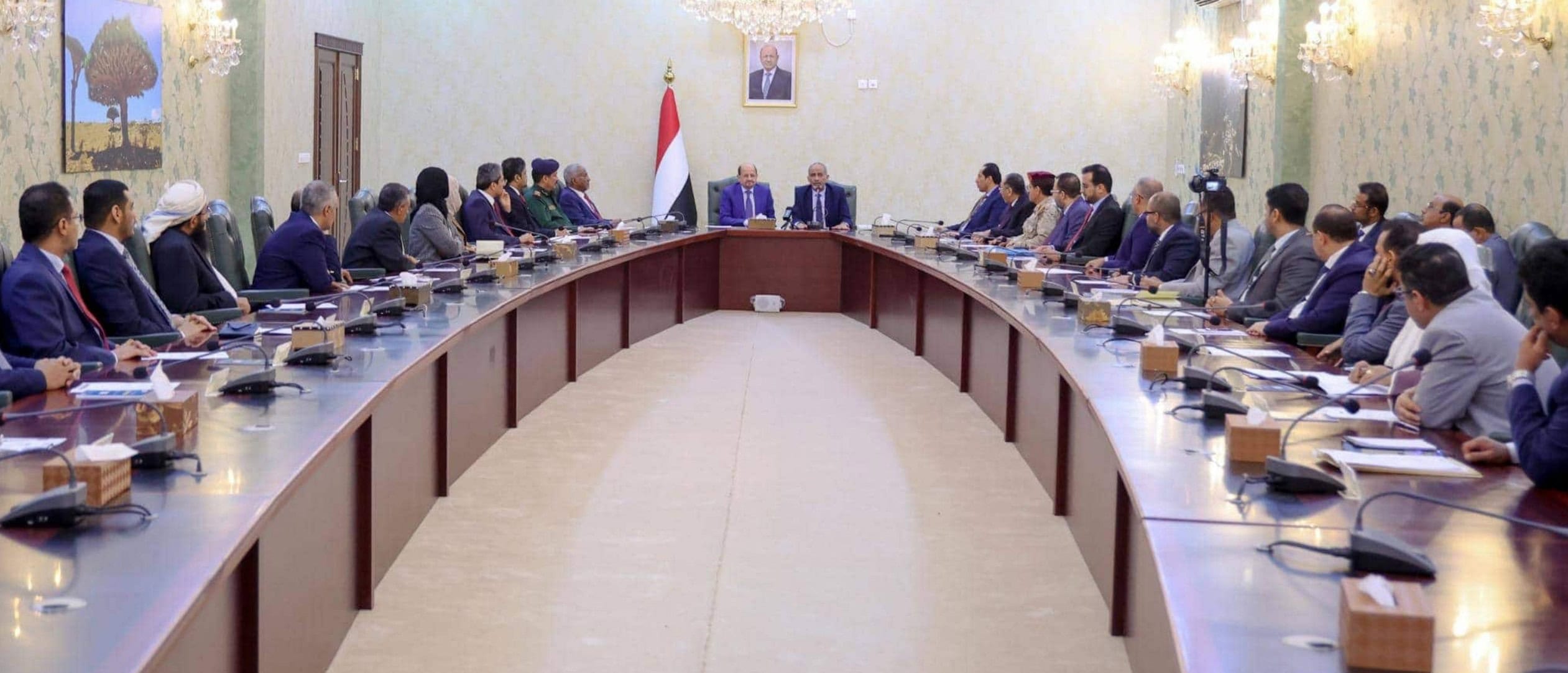
Meeting of the new Yemeni government in Aden, February 19, 2026 (official).
Last updated on: 01-03-2026 at 6 PM Aden Time

Abdullah Al-Shadli (South24 Center)
The new Yemeni government, headed by Shaya Al-Zindani, was announced on February 6 amid sharply divergent reactions: broad international welcome contrasted with strong rejection and criticism in South. The formation comes at a moment when political, military, and economic complexities intersect with unprecedented developments that have shaken South Yemen.
At its core lies a fundamental paradox between the narrative presented by the Presidential Leadership Council as a step toward “reform and stability,” and a blunt question raised in public debate over its true nature: are we witnessing a “technocratic government,” or a reconfiguration of quota-based power-sharing in a new form that redefines Yemen’s internationally recognized camp through a Saudi-centric lens following recent developments?
Structurally, the government reflects unprecedented expansion: 35 ministers instead of 25 in the previous cabinet. New state ministries have been created, including eight Ministers of State, four of whom appear to hold no clearly defined executive portfolios, while earlier decisions to merge ministries and reduce the size of government have effectively been reversed.
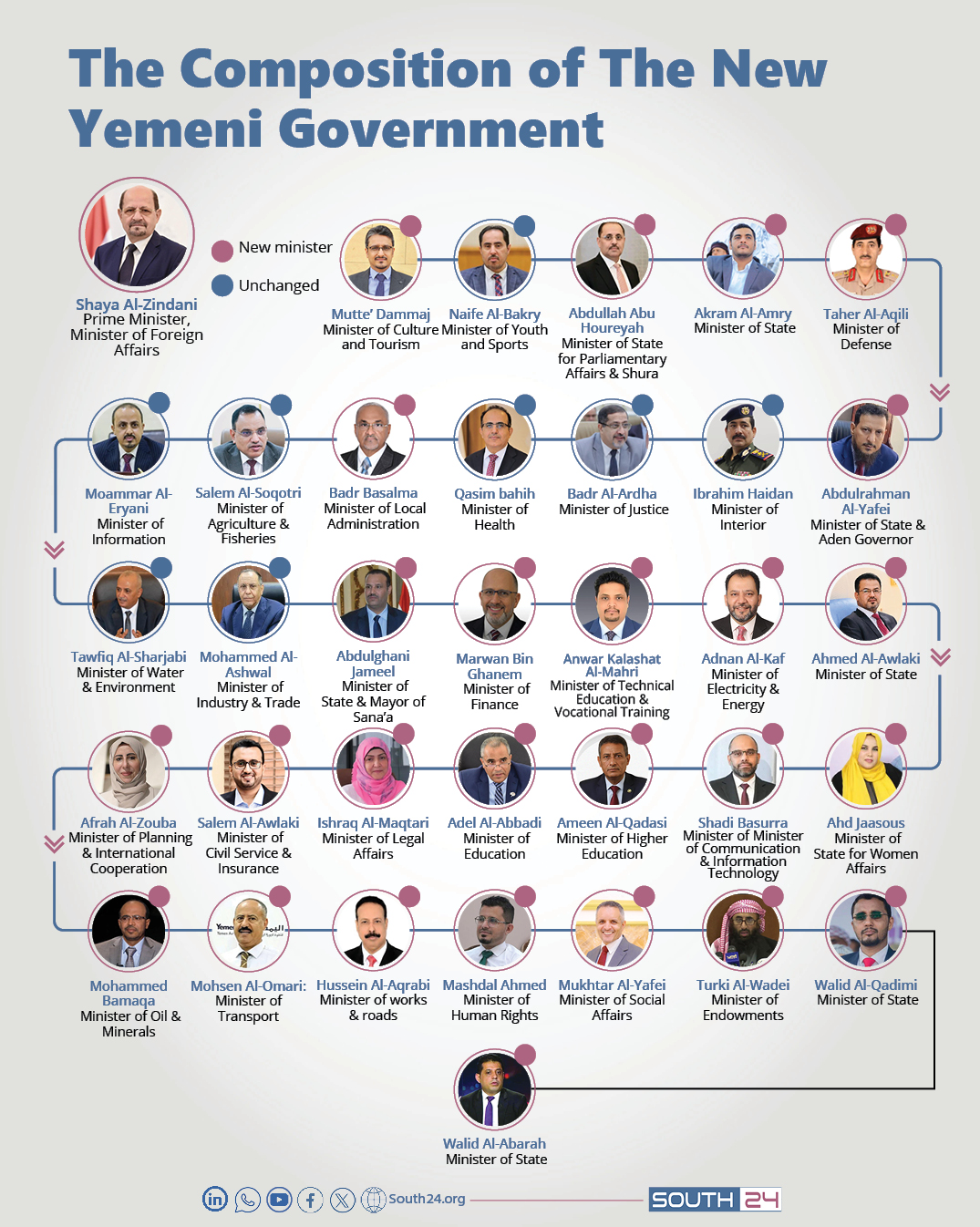
In terms of political composition, the cabinet appears less like a cohesive executive team and more like a reflection of internal power balances within the so-called “legitimacy” camp. Traditional Yemeni political parties maintain a prominent presence.
The Islah Party (affiliated with the Muslim Brotherhood) secured 12 ministerial portfolios (34.3%), including sovereign ministries. Figures previously associated with the Southern Transitional Council (STC) received 7 portfolios (20%), while the General People’s Congress obtained 5 (14.3%), and the Yemeni Socialist Party 4 (11.4%). Other portfolios were distributed among additional political components, including the Hadramout National Council. Notably absent was direct representation of the Hadrami Tribal Alliance led by Amr bin Habrish, which criticized the selection process and reaffirmed its commitment to self-rule.
Debate intensifies around the issue of South Yemen’s representation. The Southern Transitional Council formally rejected the government and withheld political recognition, while simultaneously describing it as a de facto authority obligated to provide public services.
Public opposition in South Yemen escalated further when northern ministers arrived in Aden, including Defense Minister Taher Al-Aqili, who is perceived as aligned with Islah. Protests erupted in Aden and were met with lethal force.
A Government of Rewards
From the very first moment the new cabinet was announced under Prime Minister Shaya Al-Zindani, debate did not focus solely on the names included, but on the very nature of the government itself, does it represent a genuine shift toward a technocratic model suited to a phase requiring sound governance and difficult decisions, or is it a rebranding of political quota-sharing under the banner of consensus?
In this context, journalist Ammar Ahmed Ali argues that describing the new cabinet as a “government of technocrats” is inaccurate, particularly given that it includes 35 ministers, one of the largest cabinets in Yemen’s history, making it closer to a government of rewards and appeasement than one built on merit.
Ali further notes the expansion of state minister positions, stating that the cabinet includes eight ministers of state, four of whom hold no specific portfolio or defined responsibilities. This, he suggests, reflects a tendency to accommodate as many political actors and figures as possible.
He told the South24 Center for News and Studies that this move effectively reversed one of the few positive decisions previously made within the framework of the internationally recognized government, “namely, the merger of certain ministries to reduce the size of the state apparatus.”
Regarding internal political balances, Ali offers a sharper assessment, arguing that “nearly half of the cabinet members either belong to or fall within the sphere of influence of the Muslim Brotherhood. He contends that this presence was facilitated through geographic and political representation quotas, adding that the Brotherhood, as an organized force, has proven adept at advancing through such channels.”
For his part, Dr. Abdullah Al-Maasala, an academic at the University of Aden, said “the new government doesn’t have technocratic label, while some portfolios were assigned to individuals with clear professional qualifications,” he explains that “the overall composition reflects partisan distribution closer to political quota-sharing.”
Dr. Jaklin Al-Batani, head of the Ruaa Center for Studies, concurs from a different angle. She argues that “partisan and regional quotas remain strongly embedded in the allocation of portfolios, even with the inclusion of some experienced professional figures. The presence of several qualified individuals,” she says, “is not sufficient to alter the broader picture.”
Southern Representation
If the debate over the cabinet’s structure began with questions of merit and quota-sharing, the issue of Southern representation has proven far more sensitive. It is directly tied to the nature of the political partnership established since the 2019 Riyadh Agreement and the 2022 Riyadh consultations, and to South Yemen’s position within the internationally recognized government after years of tension and intermittent understandings. In South Yemen, the new cabinet has not been viewed merely as a redistribution of portfolios, but as a political indicator that could redraw the boundaries of the partnership itself.
One of the most contentious elements was the exclusion of the Southern Transitional Council as a political entity, while selecting individuals affiliated with the council who had participated in announcing its dissolution from Riyadh. This move was met with clear rejection domestically and triggered widespread public protests.
In a post on X, Amr Al-Bidh, a member of the STC’s Presidency, described the exclusion of what he called “the political representative of the cause of the people of the South” as an explicit declaration ending Southern partnership. He argued that the cabinet “represents a clear deviation from the 2019 Riyadh Agreement and does not represent the Southern national movement.” This position reflects the view that the issue is not about ministerial shares, but about political recognition and representation.
Similarly, the Administrative Board of the Southern National Assembly declared that the government “does not express the cause of the people of the South and lacks Southern legitimacy,” considering the sidelining of the South’s political representative a departure from the Riyadh Agreement.
From an analytical standpoint, Dr. Al-Maasala argues that the issue goes beyond formal exclusion. He states that “the South’s share of ministerial positions largely went to Northern political parties, noting that sovereign ministries such as defense and interior were assigned to figures affiliated with Islah, while other Southern individuals within the cabinet align with partisan loyalties that do not reflect the Southern political position.”
Al-Maasala links this composition to the context in which the government was announced, pointing out that “it was unable to take the constitutional oath in Aden or any city in South Yemen, instead doing so at the Yemeni embassy in Riyadh”, a move he says “reflects clear concerns over public reaction in the South.”
He adds that “the participation of certain Southern figures in the current cabinet occurred in an unhealthy political climate, following significant blows to the Southern project. As a result, such participation has been met with public suspicion,” and the Southern voice within the government is likely to “remain weak given this imbalance.”
Dr. Jaklin Al-Batani similarly views the exclusion of the Southern Transitional Council as “part of a broader dismantling of political partnership and a practical reversal of previous agreements.” She warns that this trajectory “could lead to further tensions in the South if not addressed within a comprehensive political framework.”
Inclusivity and Prospects
On the issue of women’s representation, the appointment of three female ministers marks notable, yet insufficient, progress.
The European Union welcomed the cabinet’s formation, stating that the inclusion of women and youth reflects a commitment to inclusivity and diversity. However, this praise has not ended debate over the scale and substance of representation. Dr. Al-Batani notes that “women’s representation stands at roughly 10 %, a figure she argues falls short of meaningful participation by international standards.”
She further points out that “women remain absent from sovereign and key economic ministries,” and that Southern female representation is limited to a minister of state position without an executive portfolio, which she describes as “a double marginalization in terms of both number and influence.”
Internationally, the government has received clear diplomatic support. UN Special Envoy Hans Grundberg stated that its formation comes at a time “when renewed efforts are urgently needed to advance a comprehensive political process.” The U.S. Embassy also welcomed the move, calling it “an opportunity to enhance stability,” and the Secretary-General of the Arab League similarly expressed support.
Yet such diplomatic backing, while providing important political cover, does not automatically resolve questions of performance or the government’s ability to shift the military and political balance, particularly amid the ongoing conflict with the Houthis and the transformation of the Yemeni file into an arena of regional understandings rather than domestic resolution.
In this context, journalist Ammar Ahmed Ali downplays the significance of changes in the defense portfolio, arguing that appointing a defense minister affiliated with Islah is “unlikely to produce meaningful impact.” He notes that the defense ministry has long been held by Northern military figures without tangible progress.
He further contends that “Riyadh, which now largely manages the Yemeni file following the UAE’s departure, has for nearly five years been pursuing a political settlement track with the Houthi group”, rendering a military option unlikely.
Domestically, Dr. Al-Maasala links the government’s announcement to a turbulent environment, noting that it came after “military confrontations targeting Southern forces and amid widespread public protests,” making its political viability contingent upon public acceptance.
He goes further, asserting that “the government’s ability to endure or succeed ultimately hinges on the reaction of the Southern street, which is the primary determinant of the political trajectory in the coming phase.”
Dr. Al-Batani warns that continued reliance on” fragile consensus arrangements” without substantive reform risks further eroding public trust in the government’s capacity to address mounting crises.
In light of these factors, the new cabinet appears to be more than an expanded executive formation. It represents a pivotal moment in the reshaping of the “legitimacy camp” itself, and in redefining the balance of power within South Yemen in an unprecedented manner. The government was born in a regional context led by Saudi Arabia toward a political settlement with the Houthis, and at a tense Southern moment marked by attempts to dismantle the Southern Transitional Council and public rejection of Northern ministers arriving in Aden.