مركز سوث24 للأخبار والدراسات
مركز سوث24 للأخبار والدراسات


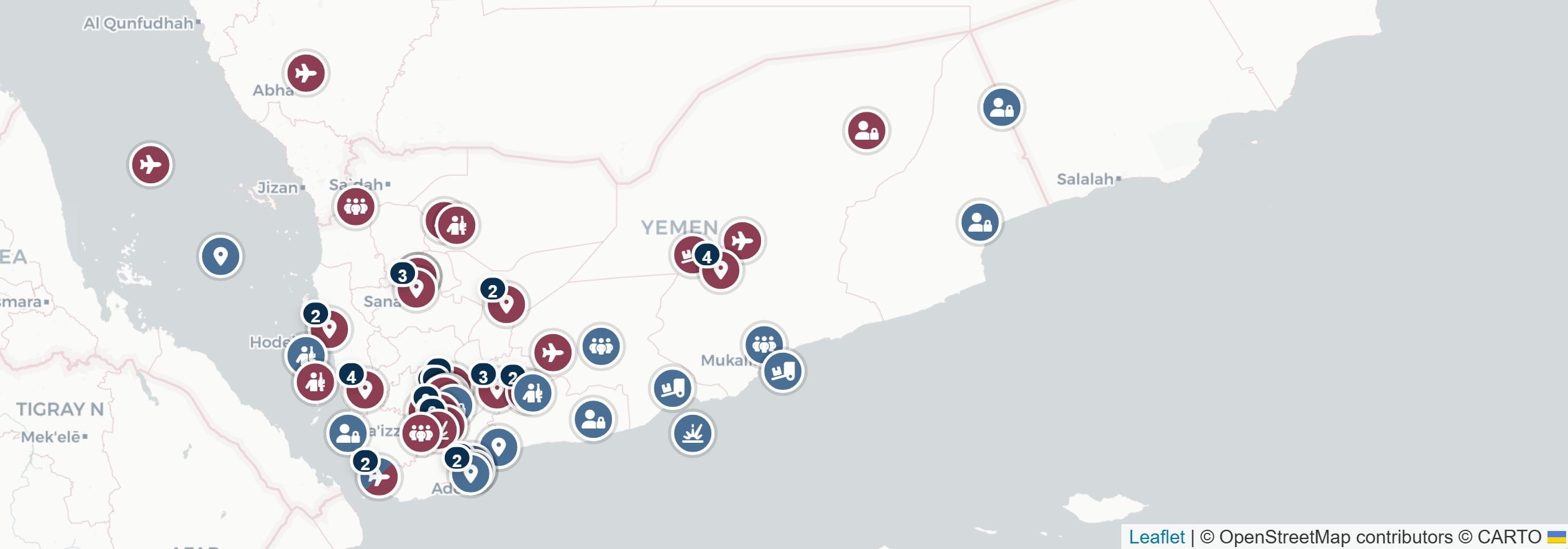
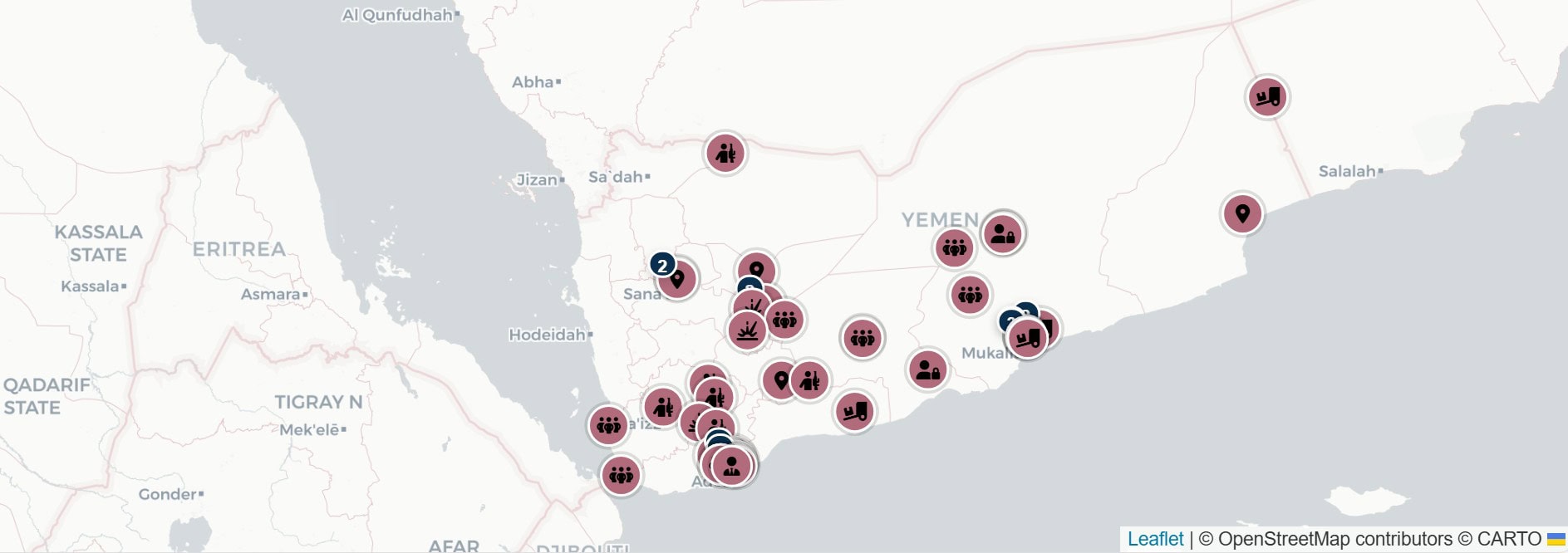
Interactive Map – By South24 Center © OpenStreetMap
24-07-2026 الساعة 5 مساءً بتوقيت عدن
Aden (South24 Center)
Monitoring conducted by South24 Center of security and military developments related to Yemen between June 27 and July 24, 2026, documented a notable escalation between Saudi Arabia and the Iran-aligned Houthi militia. The escalation coincided with intensified Houthi attacks and military movements across South Yemen, particularly in Al-Dhalea, Lahj, Abyan and Shabwa.
South24 recorded 89 incidents during the period, including 67 military events and 22 security-related incidents. Events inside Yemen for which specific casualty figures were available resulted in 43 people killed and 25 wounded, most of them military personnel.
The toll included 42 members of military, security and armed groups killed and 24 others wounded across the different parties, in addition to one civilian killed and another wounded. The figures do not include incidents in Hodeidah and Lahj in which the number of Houthi casualties was not disclosed.
Of the 42 military and security personnel and armed actors killed, 14 were members of Southern forces, 18 belonged to government-aligned forces, six were members of the Nation’s Shield Forces, and four were Houthi fighters. Other Houthi members were also reported wounded.
The regional escalation began amid attempts to operate direct Iranian flights to Houthi-controlled areas. On July 3, the Houthi military spokesman said Saudi aircraft had attempted to prevent an Iranian plane carrying approximately 200 Yemenis from landing at Sanaa Airport. He claimed the group had confronted the aircraft and threatened a broad response to any attack on airports or vital facilities.
The following day, Saudi Arabia said it would respond “firmly and decisively” to any attempt to target its territory or citizens, marking the first public indication that the undeclared de-escalation between the two sides, in place since 2022, was beginning to unravel.
Tensions reached a turning point on July 13, when the runway at Sanaa Airport was struck shortly before the expected arrival of an Iranian aircraft carrying a Houthi delegation returning from Tehran.
Presidential Leadership Council Chairman Rashad Al-Alimi said the measures taken were defensive and intended to protect Yemen’s sovereignty and prevent the imposition of an unlawful fait accompli. The Houthis accused Saudi Arabia of carrying out the attack and said it had brought the de-escalation phase to an end.
The Iranian aircraft, operated by Mahan Air, later landed at Hodeidah Airport before departing. Meanwhile, the Saudi Ministry of Defense announced that it had intercepted ballistic missiles launched by the Houthis toward the Kingdom’s southern region.
The Houthis subsequently claimed attacks on Abha International Airport using missiles and drones and warned airlines against using Saudi airspace. The development marked the return of cross-border attacks between the two sides following several years of relative calm.
The escalation later extended into the maritime domain. On July 20, the Houthis announced a ban on vessels linked to Saudi Arabia under what they described as a “blockade for blockade” equation. They also threatened a comprehensive escalation in response to any Saudi action.
Saudi Arabia said it would protect its vessels in the Bab Al-Mandab Strait “with full force,” while the Houthis warned shipping companies against loading or unloading cargo at Saudi ports.
The European Union’s Aspides naval mission also advised vessels linked to Saudi Arabia, the United States and Israel to temporarily avoid the Red Sea and the Gulf of Aden because of the increased risk of attacks.
On July 23, the Houthis announced that they had targeted the Saudi oil tankers ENCELIA and LAYLA in the Red Sea using missiles and drones. They claimed that both vessels were hit and that a major fire broke out aboard them, while threatening to carry out wider operations inside Saudi Arabia.
These developments coincided with information reported by Reuters indicating that Iran had transferred commanders and advisers from the Islamic Revolutionary Guard Corps, along with missile and drone equipment, to the Houthis aboard the Mahan Air flight that landed in Hodeidah on July 13.
According to the information, between 10 and 21 personnel were aboard the aircraft, including senior military figures.
Alongside the Saudi-Houthi escalation, South Yemen witnessed increased military activity along its frontlines. Al-Dhalea recorded the highest number of security and military incidents, with 21 cases, including 20 directly connected to confrontations with the Houthis.
Lahj followed with 14 incidents, almost all of which were linked to Houthi military movements, shelling and attacks along the frontlines.
In Al-Dhalea, attacks were reported across the Muris, Bab Ghalq, Tursa in Al-Azariq, Battar, Al-Fakher, Al-Thawkhab and Al-Jub fronts. The Houthis used artillery, mortar shells and sniper fire to target Southern forces’ positions, as well as villages and farms near the frontlines.
Seven Southern soldiers were killed and 12 others wounded in Houthi attacks and clashes in the governorate.
The fiercest confrontations occurred on July 22, when the Houthis launched an attack on the Al-Fakher and Al-Jub fronts, killing four Southern soldiers and wounding ten others.
Southern forces later announced that they had repelled the attack, forced the assailants to retreat and killed four Houthi fighters.
A civilian was also seriously wounded after more than five Houthi mortar shells struck villages and farms in northern Al-Dhalea. Civilian areas in Al-Fakher were targeted with more than 15 shells on the same day.
In Lahj, confrontations were concentrated along the Al-Hadd front in Yafa, Qarin in Al-Musaymir, Karsh and areas bordering Mawiyah and Hayfan districts in Taiz.
According to the figures recorded by South24, Houthi attacks in Lahj killed three Southern soldiers and wounded three others.
All three soldiers were killed in separate incidents on the Al-Hadd front in Yafa, including a drone attack on July 12 that also wounded another soldier.
In Al-Musaymir, two soldiers were wounded by Houthi mortar fire on the Qarin front amid repeated clashes and movements aimed at reinforcing the group’s positions near the Lahj border.
The Tharah fronts in Abyan were subjected to repeated Houthi shelling targeting Southern forces’ positions on July 18 and 19. Shabwa Defense Forces also intercepted a Houthi drone over a military camp in Markha Al-Sufla district.
Overall, the monitoring data attributed the deaths of 12 soldiers and the wounding of 18 others to Houthi attacks against Southern forces in Al-Dhalea, Lahj and Shabwa.
Across all security and military incidents inside Yemen, the toll also included 14 government-aligned soldiers killed while repelling a Houthi attack in Hays, southern Hodeidah, and four soldiers killed in a Houthi drone attack in Harib district, Marib.
A civilian was killed in Hays when a Houthi drone struck the courtyard of his home. Four Houthi fighters were killed during confrontations in Al-Dhalea, according to Southern forces.
Away from the confrontations with the Houthis, six members of the Nation’s Shield Forces were killed and six others wounded in an armed ambush in the Ramah area of the Hadramout desert.
Sources said tribal gunmen carried out the attack in retaliation for the death of one of their members during a security operation targeting drug trafficking.
In Abyan, two members of the National Security Forces, formerly known as the Security Belt Forces, were killed when Al-Qaeda militants attacked a security headquarters in Lawdar district. The attackers fled following clashes with the force assigned to protect the facility.
Maritime security threats also emerged during the monitoring period. Somali pirates seized the oil tanker ASANA more than 26 nautical miles off the coast of Hadramout.
In a separate incident, a vessel off Balhaf in Shabwa was struck with a rocket-propelled grenade before armed men boarded it.
In the Bab Al-Mandab Strait, the Southern Giants Forces announced the seizure of a boat carrying advanced equipment and materials suspected of being intended for the manufacture of drones, missiles and explosive-laden boats.
The vessel was reportedly heading toward Houthi-controlled areas in Hodeidah, and its crew members were detained.
Other prominent security developments included the discovery of explosives, suicide belts and highly explosive materials in Aden’s Dar Saad district, the seizure of quantities of crystal methamphetamine in Al-Mahra, and the interception of a truck carrying smuggled medicines and narcotics in Al-Dhalea.
Controversy also continued over the proposed prisoner exchange between the internationally recognized Yemeni government and the Houthis.
Southern parties objected to the inclusion of individuals accused or convicted of assassinations, terrorism, and the smuggling of Iranian weapons, drones and military equipment into Houthi-controlled areas.
Taken together, the developments documented during the period indicate a rapid erosion of the Saudi-Houthi de-escalation, alongside an expansion of Houthi activities in the Red Sea and intensified attacks along South Yemen’s frontlines.
At the same time, southern governorates continued to face security challenges related to terrorism, smuggling, piracy and local armed tensions, in addition to the continuing Houthi threat.
Explore South24 Center’s interactive map below:


قبل 3 أشهر

قبل 1 شهر