مركز سوث24 للأخبار والدراسات
مركز سوث24 للأخبار والدراسات


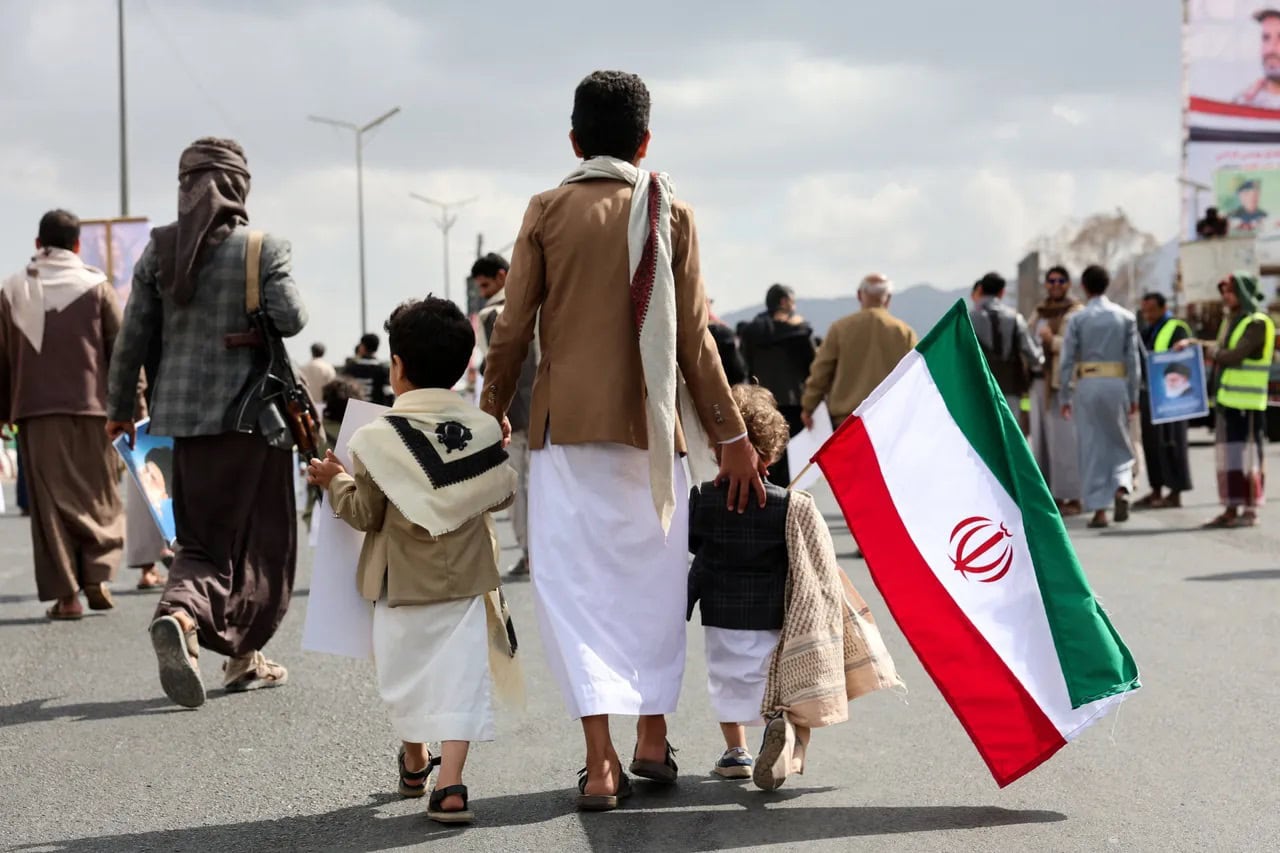
A man walks alongside two children, with one of them holding the Iranian flag and the other a placard, as Houthi supporters hold a rally in solidarity with Iran and Lebanon, amid the U.S.-Israeli war against Tehran, in Sanaa, March 6, 2026. / Reuters
07-04-2026 الساعة 4 مساءً بتوقيت عدن
“Any expansion of the conflict will place the Houthis before the possibility of a wide-scale ground battle, supported from the air by regional and American forces, and perhaps with the tacit approval of the international community.”
South24 Center | Farida Ahmed
Throughout the first month of the military confrontation that broke out between Iran and the Israeli-American alliance in late February, the Houthis remained silent, following a different path from other Tehran allies, such as Lebanese Hezbollah and the Popular Mobilization Forces in Iraq, who engaged in the conflict immediately. It appears that Iran chose to delay the "Houthi card" -- to use it at the appropriate time and gain greater negotiating conditions, especially if coupled with the possibility of impacting navigation in the key Bab al-Mandab strait, in parallel with the closing of the Strait of Hormuz, and amid talk of a potential American-Iranian dialogue to end the war.
After weeks of repeated Houthi threats that did not go beyond media rhetoric, the Houthis broke the barrier of hesitation under pressure from Tehran and formally entered the war. They announced their entry with the launch of a missile toward Israel on the morning of March 28, moving them from the category of "threat" to active participation in the conflict.
However, it does not appear that the Houthis had a genuine desire to engage alongside Iran in the war. Before unleashing their missile – the only one launched so far, a speech was anticipated in which they were expected to announce their entry into the conflict. However, it came within a threatening framework, no different from their previous statements. It seems subsequent Iranian pressure pushed the Houthis to carry out their limited attack. This clearly indicates that the Houthi group is avoiding the exhaustion of its remaining military capabilities, especially after the heavy losses incurred over the past year due to American and Israeli strikes on Houthi territory. These strikes were not limited to targeting their military infrastructure and killing political and military leaders but also extended to vital economic infrastructure in the religious group's areas of control in northern Yemen.
In the same context, Iran continues to signal the option of escalation if a ceasefire agreement is not reached, pointing to the possibility of taking steps aimed at closing another major maritime route via the Houthis: the Red Sea and the Bab al-Mandab Strait, which constitutes an important alternative route for exporting part of the Gulf’s oil. In contrast, U.S. President Donald Trump presented a 15-point plan to Iran through a Pakistani mediator. The plan has not been published, and the U.S. administration refused to disclose its details, but according to multiple sources, it includes ending Iran's uranium enrichment program, imposing restrictions on its ballistic missile program, and ending Iran's support for its regional proxies.
Conflicting Iranian-Houthi Interests
In recent years, Iran has succeeded in utilizing its regional proxies under the pretext of "supporting Gaza," enabling it to manage a calculated level of escalation to distract the region and the United States, and to delay a direct strike against itself. However, the occurrence of such a strike has changed the equation, as the strategic returns from operating these proxies in the previous manner have declined. It appears that the Houthis view the situation from a different angle now. As Iran itself comes under fire, an existential question arises for the Houthis regarding the viability of a path that might lead them to a fate similar to that of Hezbollah or Hamas.
From this point, a sharp divergence in interests between the two parties emerges. While Tehran seeks to push the Houthis toward escalation, affecting international navigation in the Red Sea, which could cause economic disruption and reinforce its narrative of resoluteness and superiority, the cost of this choice falls primarily on the Houthis. Iran appears ready to endure the loss of this "proxy," or even sacrifice it, for the sake of maximizing its gains in the war or at least reducing its losses and inflicting the greatest possible damage on its opponents.
The Houthis understand that any broad involvement could lead to their downfall, which explains the limited nature of their intervention so far. They treat every missile launched as a direct depletion of their remaining military capacity at a time when they need this stockpile in anticipation of a more dangerous scenario: the outbreak of a ground confrontation in their areas of control, which could mean the total collapse of their project after years of development. From this perspective, they may view expanding their operations in the Red Sea as an existential risk, as their last effective assets, missiles and drones, still represent a primary deterrent against their local rivals. Furthermore, retaining their firepower gives them leverage for regional pressure, particularly by brandishing the threat against Saudi Arabia, which might push the Kingdom to exert pressure on local forces to avoid a military resolution against them.
In any case, Iran seems more prepared to use the Houthi card, even if it results in the group’s destruction. This divergence is likely to affect the cohesion of the Houthi leadership itself, as internal divisions may emerge between a wing whose loyalty to Tehran is absolute, and another that is guided by calculations of survival and the consequences of potential defeat. Accordingly, the Houthis may seek a degree of self-restraint to absorb the Iranian pressure, but the question remains as to their ability to withstand it. This issue will become more complex in light of the potential terms requiring Iran to abandon its proxies in any future settlement, meaning Tehran may be forced to rearrange its priorities and relinquish some of its tools if its interests so dictate. Additionally, regardless of the outcome of such terms, Iran will emerge from the confrontation burdened with losses and may later turn toward reconstruction, which could significantly limit its ability to continue supporting its proxies.
Houthi Survival Calculations
Given the expected absence of direct Iranian support, the Houthis may be forced to make quicker decisions, including accepting any settlement put on the table. In practice, they may no longer enjoy the same level of political support, even from regional mediators such as Oman, which could reconsider its position toward the group. Oman had primarily hosted them for Tehran’s benefit, but now its own exposure to potential attacks among the Gulf states reduces its willingness to provide support as it once did. Moreover, Muscat may seek to reshape its image among other Yemeni forces opposed to the Houthis, in light of the previous impression that it had backed the group as the party most likely to dominate power in the next phase. As the only regional state that had opened clear channels of rapprochement with the Houthi group, the shifting dynamics may push Oman to review this position and rebuild trust with other Yemeni parties whose relations were strained as a result.
Based on this potential shift among regional actors, the Houthis may resort to any agreement that allows them to preserve what they can. They might attempt to distance themselves from Iranian decision-making as a survival strategy, but this option depends on the strength of Iranian influence within the group’s leadership structure, and whether Tehran might still push them into an expanded war that could lead to their end.
If the Houthis decide to escalate the conflict and support Iran by launching attacks in the Red Sea, they will not be able to close the Bab al-Mandab Strait, as it lies beyond their direct control. However, such attacks could still threaten maritime traffic and energy markets, increasing insurance and shipping costs, and adding to the global energy crisis. In contrast, Iran has the capacity to control and potentially close the narrow Strait of Hormuz due to its ability to deploy naval assets from its coasts. Consequently, any Houthi escalation in the Red Sea would cost them a significant portion of their missile stockpile, which cannot be easily replenished.
Furthermore, any expansion of the conflict will place the Houthis before the possibility of a wide-scale ground battle, supported from the air by regional and American forces, and perhaps with the tacit approval of the international community. In practice, the Houthis have not achieved decisive victories in conventional ground battles Their initial expansion and control over provinces occurred with limited resistance at the outset of the conflict, while they lost most subsequent engagements, except where gains resulted from withdrawals or alleged complicity among factions within the internationally recognized government, particularly in areas such as Nihm and Al-Jawf. In major battles along the West Coast and in southern Yemen, the group suffered clear defeat.
Notably, Saudi Arabia has benefited from American and Israeli strikes against the Houthis since 2024, particularly through the destruction of the Houthis’ oil storage facilities, which could make any future ground confrontation especially devastating for the group. However, their remaining missile capabilities continue to deter Riyadh from pursuing a full-scale military resolution alongside local force. As such, the Houthis seek to preserve these assets as leverage, holding them in reserve for a decisive moment rather than allowing Iran to exhaust them prematurely.
Nevertheless, all options currently available to the Houthis appear to be zero-sum, even those involving a negotiated settlement. Accepting an agreement could ultimately lead to their political decline, which explains their strategy of buying time over recent years. The movement has been for more than a decade, and, indeed, since its founding in 2004, building an ideological framework centered on the concept of "Wilayah" (Guardianship) and the authority of "The Sayyid" (the Leader). Any agreement that introduces shared governance or electoral participation would undermine the ideological foundation upon which the group has mobilized its supporters. In turn, this could threaten the movement’s long-term cohesion and legitimacy.
In light of these dynamics, the Houthis appear trapped between two existential choices: escalation, which risks depleting their military capabilities and accelerating their downfall, or acceptance of a political settlement that could erode their ideological foundation. This dilemma underscores the fragility of their position and makes the group’s future dependent on its ability to balance Iranian pressure with regional realities while preserving its remaining deterrent capabilities. All available options remain fraught with risk and pose direct threats to the group’s survival.


قبل 3 أشهر
قبل شهرين
قبل 3 أشهر