SOUTH24 CENTER FOR NEWS & STUDIES
SOUTH24 CENTER FOR NEWS & STUDIES


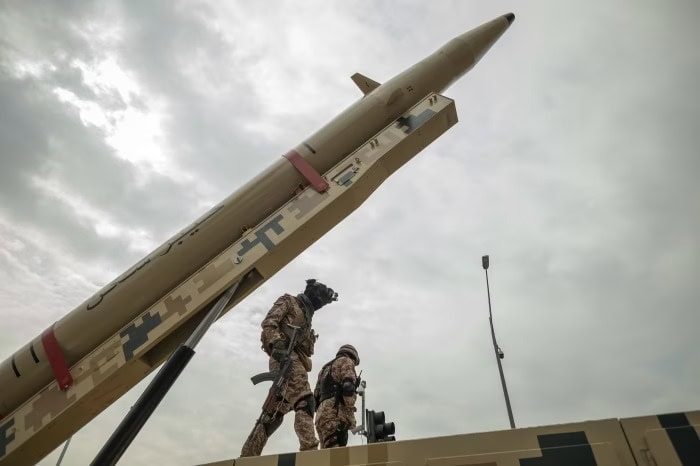
Two members of Iran’s Islamic Revolutionary Guard Corps stand beside a Kheibar Shekan ballistic missile during a rally in Tehran, April 29, 2022. (Morteza Nikoubazl/NurPhoto/Getty Images)
Last updated on: 28-10-2026 at 11 AM Aden Time

Radwa Al-Sharif (South24)
In recent years, Houthis’ military program has evolved in the ways the group acquires and produces weapons, alongside the expansion of its missile attacks and military operations beyond Yemen’s borders. Iranian support has helped build the group’s missile capabilities, while increased imports of industrial components and materials from multiple international markets have enabled it to expand assembly and manufacturing activities in areas under its control, despite sanctions and restrictions on arms supplies.
On October 14, 2026, Conflict Armament Research (CAR) revealed efforts by Houthis to manufacture components for a medium-range missile system modeled on Iran’s Kheibar Shekan missile, following an examination of shipments from China containing specialized components and industrial equipment. The investigation once again drew attention to Chinese supply networks that have previously been linked to allegations and US sanctions, as well as their potential role in advancing the group’s military capabilities.
The findings are particularly significant given Beijing’s denial of allegations that it has supplied weapons to Houthis, alongside reports of direct contacts with the group to secure safe passage for Chinese-flagged vessels through the Red Sea. Against this backdrop, the article examines the nature of the shift in Houthis’ missile program, the extent of the role played by Chinese supply networks, the implications of Beijing’s official position, and the potential consequences for security in Yemen and the wider region.
Investigation Findings: Progress in Manufacturing or Assembly?
An investigation by Conflict Armament Research (CAR) was based on an examination of four containers intercepted by Yemeni authorities while en route to the Houthi-controlled port of Hodeida. Their contents were documented in July 2026. Shipping documents showed that the containers arrived at the Aden Free Zone in June and October 2025 aboard two vessels carrying goods from China. The shipments contained seven components associated with the Kheibar Shekan missile system, including structural parts and a solid-fuel motor, as well as industrial materials and equipment for inspection and production.
The seized items also included specialized parts used to stabilize the missile and operate its motor, a resinous material used to manufacture thermal protection layers, and industrial machinery and equipment that could be used for manufacturing and inspection. The organization’s investigators linked the presence of these materials and missile components to the group’s efforts to expand local production activities. They also identified technical similarities with Iran’s Kheibar Shekan missile, unveiled by Tehran in 2022, which has a declared range of 1,450 kilometers and belongs to the family of solid-fuel, medium-range ballistic missiles.
The investigation found that some metal parts appeared to have been manufactured to specific specifications, while shipping documents pointed to a Chinese company specializing in precision metal parts. However, the organization said it had been unable to independently verify the supplier’s details or trace the components to the company in question. Its direct responsibility for manufacturing the seized parts therefore requires further evidence.
The findings build on an earlier development in Houthi capabilities. In November 2024, the organization documented components associated with the Badr short-range missile system in a shipment that also contained other components linked to companies operating from China. The main new finding in the October investigation is that manufacturing efforts appear to have extended to parts designed for a more advanced ballistic missile system, although the extent to which production has been completed and operational testing conducted remains unclear based on the available evidence.
Chinese Supply Networks and Previous US Sanctions
Tracing the sources of the seized equipment reveals the growing role of Chinese markets and companies in supplying components used by Houthis. In this context, “the Century Foundation” published a study on February 9, 2026, titled “From Smugglers to Supply Chains,” examining Houthis’ growing reliance on imports of weapons components and manufacturing equipment. The study drew on a database of more than 370 items seized in approximately 140 land and maritime interdictions. It found that materials intended for weapons manufacturing accounted for more than 80% of the items seized in 2024 and 2025, compared with completed military systems.
According to the same database, Chinese-origin materials accounted for 35% of all documented items between 2021 and 2025, compared with 21% for Iranian-origin materials. These figures reflect the distribution of seized items covered by the study, including raw materials and industrial components, rather than an estimate of the total volume of military supplies actually obtained by Houthis.
These findings are consistent with previous US sanctions actions. On June 17, 2024, the US Treasury Department accused a Houthi-linked procurement network of obtaining military components from Chinese suppliers through companies operating in other countries. The statement noted that components purchased from a Chinese supplier by International Smart Digital Interface, a company based in Oman, were used in a Quds-type missile that targeted a Saudi Aramco facility in 2020.
On October 2, 2024, Washington imposed sanctions on Shenzhen Jinghong Electronics and Shenzhen Rion Technology, accusing them of supplying components linked to the development of Houthi missiles and drones. The latter company had previously been placed on a US sanctions list in July of the same year for providing, or attempting to provide, support to Iran’s Ministry of Defense. This points to its links to allegations involving both Iranian and Houthi weapons programs.
Measures continued in 2025. Sanctions announced on September 11targeted Yiwu Wan Shun Trading, a company operating from China that the US Treasury accused of coordinating purchases and shipments of drone components and dual-use materials for Houthis since at least 2021. The measures also targeted logistics companies accused of facilitating the transfer of these materials to Yemen.
These cases point to the reach of Houthi procurement networks across commercial suppliers, shipping companies, and intermediaries operating in different countries. The Century Foundation study explains that some purchasing and shipping operations are handled by Yemeni businessmen operating from China, while supply routes may involve trading companies in other countries. These details are important when determining responsibility for the shipments, particularly given the different roles played by manufacturers, suppliers, intermediaries, and end users.
China’s Position and the Dimensions of Its Relationship with Houthis
China has rejected allegations that it supplied military components to Houthis, emphasizing its commitment to international export controls. This position was evident during a UN Security Council session on July 14, 2026, when Chinese representative Sun Lei rejected US allegations against his country, stressing that exports of military equipment and dual-use materials are subject to strict oversight under Chinese law and international obligations. He also criticized US military operations in Yemen, arguing that they had contributed to rising tensions and complicated settlement efforts, and called for respect for Yemen’s sovereignty and the protection of international shipping.
Meanwhile, Reuters reported on July 28 that Beijing had held direct talks with Houthis to secure guarantees for its vessels to pass through the southern Red Sea and the Bab Al-Mandeb Strait, following the group’s announcement that it would impose restrictions on ships heading to Saudi ports. According to the report, the talks included arrangements for individual vessels to transit. When asked about the information on July 29, Chinese Foreign Ministry spokesperson Mao Ning declined to confirm the details, calling instead for the protection of international shipping lanes and de-escalation through dialogue.
China’s diplomatic efforts also extended to Iran. On September 17, Reuters reported that Beijing had asked Tehran to use its influence to curb Houthi escalation, following a Saudi move linked to the group’s advance near the western coast and the Bab Al-Mandeb Strait. The Chinese Foreign Ministry did not confirm the details of the request but stressed that the spread of tensions to Yemen and the Red Sea ran counter to the interests of the parties concerned. It also called for respect for state sovereignty and the protection of critical infrastructure.
Interest in China’s position intensified following the October investigation. On October 14, Yemeni Foreign Minister Afrah Al-Zouba announced that she had discussed information concerning Houthis’ use of Chinese components with officials in Beijing. She said the Chinese side was interested in obtaining details of the case for investigation and affirmed China’s continued support for the Yemeni government.
On October 17, Chinese Ambassador to Saudi Arabia Zhang Hua denied claims that Houthis had used Chinese parts to manufacture missiles, describing them as “sheer fabrication and disinformation.” He reaffirmed China’s commitment to export controls on military equipment and dual-use materials, as well as its opposition to attacks targeting Gulf countries and civilian infrastructure. He also expressed support for the legitimate security concerns of Saudi Arabia and the Gulf Cooperation Council states.
The Limits of Local Manufacturing and Its Security Implications
The significance of the revelations concerning the Kheibar Shekan project lies in the possibility that Houthis are moving toward a more advanced stage of missile-system assembly and the production of some components inside Yemen. This could strengthen their ability to replace losses resulting from military operations and the interception of shipments. Relying on imported components rather than complete missiles could also allow procurement to be distributed among multiple commercial suppliers, reducing the military program’s vulnerability to disruptions along any single supply route. However, the arrival of metal parts manufactured to specific specifications from China indicates continued reliance on foreign industrial capabilities and does not necessarily prove that those parts are being manufactured in Houthi-controlled areas.
The success of this approach depends on Houthis’ ability to overcome technical challenges involving missile-component integration, motor performance, guidance and control systems, production quality, and the testing required before deployment. These requirements are considerably more complex than assembly using ready-made parts, particularly given the continued need for Iranian expertise and technology. Accordingly, possession of the seized equipment and components reflects the group’s growing industrial ambitions but does not provide sufficient evidence that it can independently and consistently produce medium-range missiles.
From a security perspective, success in these efforts could strengthen Houthis’ ability to sustain their missile threat against Saudi Arabia and other countries in the region, while reducing the long-term effectiveness of military strikes aimed at diminishing their arsenal. This risk would increase if the group managed to secure sensitive components on a regular basis, enabling it to maintain the pace of its attacks or resume them after periods of reduced activity. Such developments could also affect the course of the conflict in Yemen by enhancing Houthis’ ability to exert military pressure and improve their negotiating position. In the Red Sea, a sustained missile threat could increase risks to ports and coastal infrastructure.
This shift poses a challenge for counter-smuggling efforts, particularly because growing reliance on industrial materials and dual-use equipment makes procurement networks more difficult to track than shipments of complete weapons. The use of multiple intermediaries and transport routes also allows the group to seek alternatives when certain supply channels are disrupted. Against this backdrop, efforts to expand partial manufacturing and local assembly are likely to continue. However, the transition to independent production of advanced missiles will depend on the availability of expertise and sensitive components, as well as the success of operational testing. Credible evidence of repeated production and successful tests would provide a stronger indication of the program’s progress than the seizure of additional equipment or components alone.
Conclusion
The Kheibar Shekan project highlights Houthis’ expanding efforts to develop their missile capabilities by combining Iranian expertise and designs with industrial components imported from international markets, particularly China. Although the seized items point to growing ambitions for local manufacturing, they do not establish that the group has achieved independent production of medium-range missiles. The main concern is that these efforts could enhance Houthis’ ability to replace military losses and sustain threats to security in Yemen and neighboring countries.
At the same time, the case puts Beijing’s oversight of sensitive exports to the test, although there is no evidence establishing official Chinese involvement in arming Houthis. The scale of the threat in the coming period will likely depend on the group’s ability to turn imported components into a consistent production capability, as well as the effectiveness of Yemeni, regional, and international efforts to disrupt its supply networks.