SOUTH24 CENTER FOR NEWS & STUDIES
SOUTH24 CENTER FOR NEWS & STUDIES


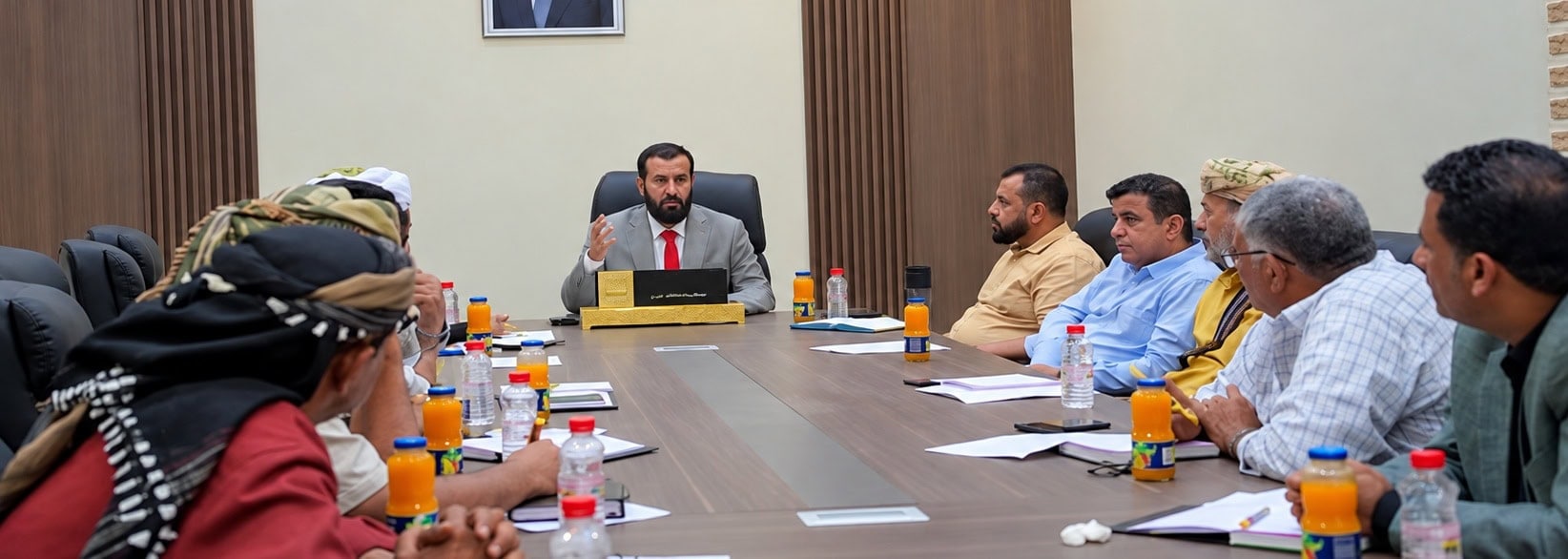
Abyan Governor Mukhtar al-Rabbash chairs a meeting of the preparatory committee for the Consensus Coordination Council in Abyan Governorate, South Yemen, in June 2026. (Abyan Time)
Last updated on: 01-10-2026 at 2 PM Aden Time

Farida Ahmed (South24 Center)
Over the past three months, several coordination councils have been formed in South Yemen governorates, particularly Hadramout, Shabwa, Al-Mahra, Socotra, and Abyan, with Saudi sponsorship and support. These developments have unfolded within a political and security context that followed the events in Hadramout in early 2026, as well as subsequent Saudi steps aimed at dissolving the Southern Transitional Council (STC).
The establishment of these councils comes amid a political vacuum that Riyadh has sought to address by creating new local frameworks, alongside efforts to weaken the presence of the Southern Transitional Council and limit its role in the southern political equation. Over the past several years, the STC has remained one of the most prominent political, military, and security actors, enjoying a broad popular base as well as an organizational presence across several South Yemen governorates. It has also brought together a range of southern figures and political currents, including representatives of various political parties and forces.
The formation process, however, has not been limited to Saudi sponsorship. A notable presence has also emerged from political parties with significant influence in northern Yemen, through southern members affiliated with those parties who participate in these councils in an independent capacity. This gives those parties an undeclared influence over the councils’ decision-making. These developments raise questions about the nature of these councils, the objectives behind their establishment, and their ability to build local political and societal legitimacy. This is particularly relevant given, on the one hand, their origins in Saudi sponsorship and northern influence, and, on the other, the absence so far of clear indications that they possess a popular base comparable to those that other southern forces have managed to build over the past several years.
Motives and Objectives Behind Formation
Following the events in Hadramout in January 2026, Riyadh moved to reorganize the issue of southern political representation by engaging with multiple southern components with the aim of preparing for a Southern-Southern dialogue conference, following a unilateral decision to dissolve the Southern Transitional Council. However, this approach encountered political complexities and internal divisions that prevented the emergence of a clear consensus on the nature of the next phase and the form of the South representation within it. One of the most prominent points of contention is the disagreement over the political reference framework and the ceiling under which the southern dialogue conference would be held. According to private sources in Riyadh who spoke to South24 Center, Chairman of the Presidential Leadership Council Rashad Al Alimi insists that the conference be held under the framework of preserving Yemen’s unity, while southern forces and figures believe that the dialogue should remain open to political options that go beyond this framework.
This disagreement is particularly significant in light of previous positions by Saudi officials supporting the right of southerners to reach a comprehensive political solution without imposing preconditions or political ceilings, while ensuring the right of the people of the South to determine their political future and exercise self-determination, including the “restoration of a fully sovereign South Yemen state.” Accordingly, the disagreement over the conference’s ceiling goes beyond a formal issue to the core of the southern question raising a central question: Should the course and outcomes of the political settlement be determined by the southern forces themselves, or within a broader framework in which other Yemeni parties participate and intervene?
Against this backdrop, and amid efforts to weaken the political role of the Southern Transitional Council and its declared position on establishing the independent South State, signs have begun to emerge on the ground of the formation of new coordinating frameworks and local councils in several southern governorates. These frameworks have received support and backing from some components and figures affiliated with the presidency, in a context viewed by southern parties as part of an attempt to rearrange the political landscape according to a Saudi approach, with the backing of forces, figures, and parties from North Yemen. Other southern forces and currents inside the country, meanwhile, reject these formations and regard them as an attempt to “proliferate components” and redistribute southern political representation, which, in their view, could deepen divisions and weaken the unity of the southern political position rather than build broad consensus around the future of the southern question.
One of the most significant challenges is that the proliferation of southern political councils and frameworks, in the absence of a unified political center and a cohesive entity capable of formulating a common vision, may not necessarily broaden southern representation as much as it could fragment the center of political decision-making. This issue becomes particularly important if the political process resumes or progress is made toward a settlement with the Houthis, as the central question will then be: Who holds the mandate to represent the South cause and negotiate on its behalf? The absence of a clear political entity with sufficient popular legitimacy and the ability to bring southern positions together could turn political pluralism from an element that enriches representation into a factor weakening negotiating capacity.
An even more serious problem is that a large number of members of the coordinating councils belong to political parties subject to northern dominance, even if they are southerners and present themselves as independents. This means that these councils will ultimately remain subject to the direction of those parties, including the General People’s Congress and the Yemeni Congregation for Reform, as well as the Socialist Party, whose centers of influence have become northern. Accordingly, members of these parties will play roles that serve their parties’ agendas under a southern guise, without the party appearing as an official party to the process. As a result, decision-making within these councils will remain beholden to northern party centralism and will effectively be made from the center rather than from the South.
Ultimately, this reality benefits two parties: individuals affiliated with these political parties and the parties themselves. At the individual level, their involvement in coordinating councils enhances their presence and influence within their parties, which in turn strengthens the party itself. At the party level, the parties can impose their vision on the course and outcomes of the southern dialogue without being officially represented as participants. This is attributable to the high organizational capacity these parties possess compared with smaller southern components with limited influence. These parties are therefore capable of surrounding and containing those components within the coordinating council, even where representation is formally equal, because organizational superiority gives them weight beyond their numerical representation. Consequently, the center of control over decision-making within the southern dialogue process will shift into northern hands.
A precedent for this can be seen in the formation of “Hadramout National Council” in 2023 under Saudi sponsorship. Parties with significant northern weight, particularly “the Reform and General People’s Congress parties”, dominated much of its composition, providing a practical indication of the likely outcome of any coordinating council built on the same foundations.
The essence of Southern-Southern dialogue lies in the participation of southern political components with a national character that transcends regional and local divisions and represents the South as a whole. Although these components differ in their organizational structures, they share common ground in their political vision, making consensus among them possible when they meet around the same table. By contrast, establishing coordinating councils on a regional and geographical basis, that is, at the governorate level, will lead to disparate and incoherent entities lacking a unified position or an agreed-upon political project, in which each member’s loyalty to their party will outweigh their representation of the South. This reality places the southern dialogue before two outcomes, with no third. If these councils reach agreement, their agreement will be on accepting a formula of unity with the North, whether federal or otherwise. If they disagree, the southern position itself will fragment, and the country will move toward the division of the South. In both cases, the substance of the Saudi-sponsored southern dialogue project will be emptied out.
This equation, namely unity with the North or the fragmentation of the South, is not merely a theoretical possibility. It has manifested itself in practice at previous points. In 2022, some political parties, most notably the Yemeni Congregation for Reform, began promoting the idea of an “independent Hadramout state,” and the flags of the Kathiri State were raised at their events. Notably, these activities were promoted by forces that were fundamentally advocates of unity, a paradox revealing that fragmentation remains a ready alternative for these forces whenever they are unable to impose unity with the North. Accordingly, forming coordinating councils according to the proposed mechanism could reproduce the same trajectory.
No Popular Base
Many southern forces, foremost among them the Southern Transitional Council, emphasize that the coordinating councils lack a popular base. This is supported by the scale of the large public demonstrations witnessed in the capital, Aden, and across the South governorates since January, which reflect the continued support of the popular base in most governorates for the political project adopted by the STC. This means that any dialogue process built around these councils will remain detached from the will of the southern public and, consequently, lack the legitimacy necessary to implement its outcomes.
The timing of the announcement of these councils does not reflect a need arising from the streets as much as it forms part of arrangements imposed from above, aimed at reshaping the political will in the South and influencing the independence of its decision-making. These councils emerged in an environment linked to de facto authority and Saudi regional support, and their formation comes as an attempt to rearrange the political landscape amid the absence of political components with significant influence on the streets, and without a clear popular base to ensure their survival outside the institutions of power. Consequently, the continued existence of these councils will remain contingent on party and regional support rather than popular acceptance, weakening their ability to represent the South or committing to any dialogue outcomes.
Conclusion and Prospects
An examination of the formation of coordinating councils in South Yemen shows that they did not emerge in response to a political or societal need, but rather as an alternative tool to the Southern Transitional Council for managing the next phase and filling the vacuum it left with locally based frameworks that can be directed. These councils share three main characteristics: regional sponsorship that gives Saudi Arabia influence over their trajectories, party penetration by parties with significant northern weight that directs their decision-making; and a regionalized structure lacking a unified southern vision. In the absence of a popular base, these councils appear to be top-down entities whose survival depends on external support rather than on the streets they are supposed to represent.
Accordingly, pursuing this course will likely lead to several outcomes:
First, at the level of South-South dialogue: A dialogue in which these councils serve as the foundation will not be Southern-Southern dialogue in the true sense, but rather a dialogue whose outcomes are formulated in advance outside the southern will. Its results will be confined to two possible outcomes: a unity formula imposed under a predetermined framework, or fragmentation of the southern position, opening the door to projects aimed at dividing the South.
Second, at the level of legitimacy: Any outcomes emerging from this process will lack the popular legitimacy necessary to implement them. This means they will remain merely on paper as long as the popular base remains rallied around a different political project.
Third, at the level of a comprehensive settlement: Fragmenting southern representation will weaken the South’s negotiating position in any future political process, particularly in the settlement process with the Houthis. There will be multiple voices speaking on behalf of the South while the actual mandate to represent it remains absent, leaving its cause to be decided at tables where it has no unified voice.
Fourth, at the level of stability: The widening gap between top-down frameworks and the popular will on the ground could fuel a state of tension and polarization within the South. This would further weaken the political landscape and place the sponsoring party (Saudi Arabia) before a high political and security cost.
Ultimately, the coordinating councils in their current form will not represent a solution to the problem of the South representation so much as reproduce it in a more complex form. Any approach that does not proceed from forces with a genuine popular base, and that does not leave southerners the right to determine the ceiling and outcomes of their dialogue, will remain incapable of producing a sustainable settlement and will merely defer the crisis rather than address it.
Previous article