SOUTH24 CENTER FOR NEWS & STUDIES
SOUTH24 CENTER FOR NEWS & STUDIES


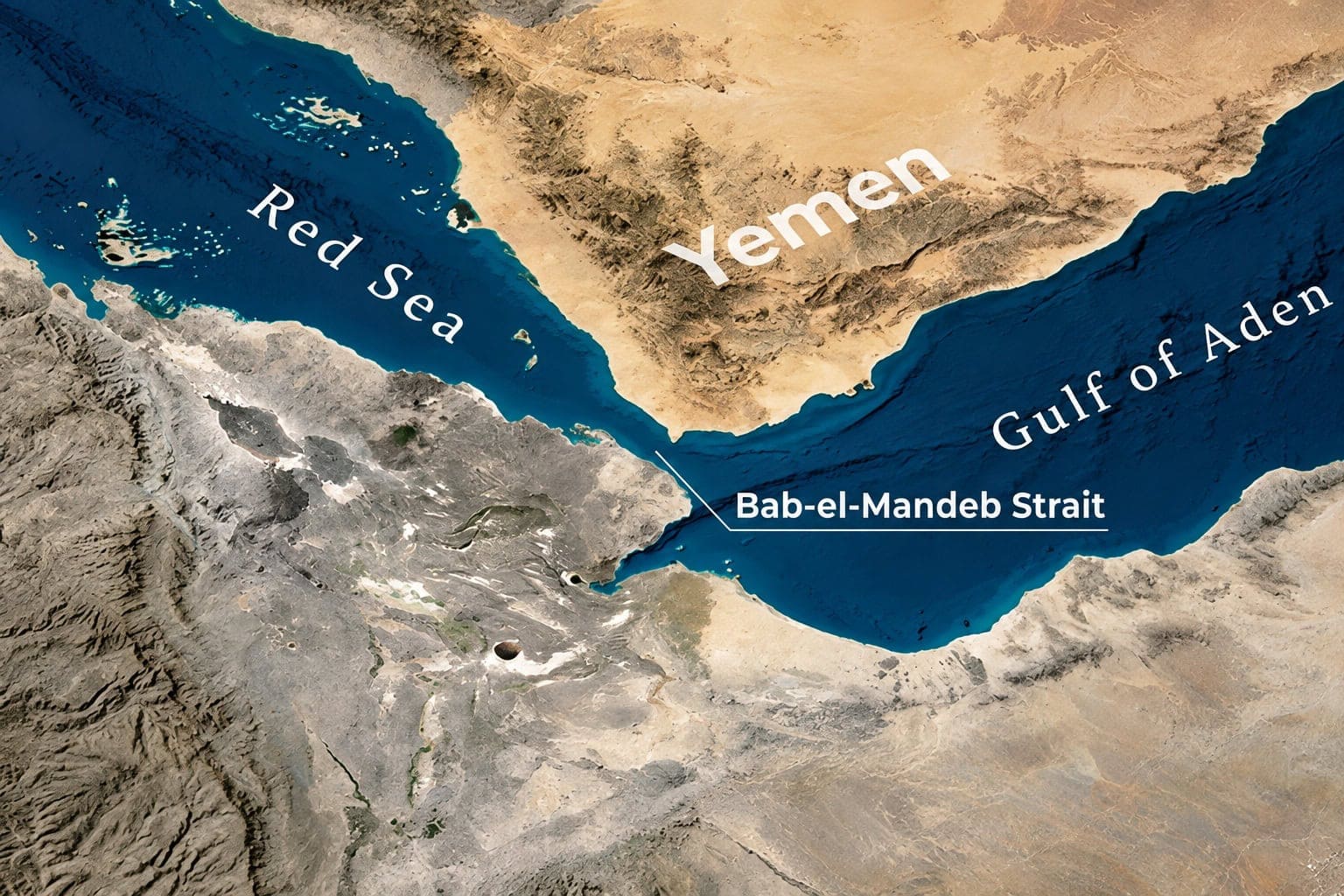
Bab Al-Mandeb Strait. (Photo/Internet)
28-09-2026 at 2 PM Aden Time

Mohammed Fawzi (South24 Center)
The rapidly unfolding developments in Yemen have had a significant impact on the regional landscape. The Houthi advance along the western coast, their arrival in areas near Bab Al-Mandeb, and their seizure of strategic sites and islands have raised questions about the implications of changes in the map of military control and the positions of regional states affected by and involved in these developments, particularly Egypt and Saudi Arabia. This paper also examines the reasons behind the declining effectiveness of the approaches adopted by Saudi Arabia, as well as new alliances in the Red Sea, in weakening the Houthi militia and preventing its advance.
First: Implications of the Houthis’ Recent Moves
Since the beginning of September, the Yemeni arena has witnessed the biggest shift in the map of military control since the relative calm and stalemate that had prevailed following the 2022 truce. The Houthis launched a large-scale offensive along the western coast, during which they moved south from their traditional areas of control in and around Hodeidah toward Bab Al-Mandeb. According to the latest information, the Houthis seized the city and port of Al-Mokha on September 10, then advanced to Dhubab and reached Mayyun (Perim) Island, located at the heart of the Bab Al-Mandeb Strait. They also moved toward the Hanish and Zuqar islands. The significance of this development lies in the fact that the Houthis no longer control only the northern and eastern shores of the Red Sea and the port of Hodeidah but now have an almost contiguous geographic extension across a large part of the western coast, reaching the gateway to Bab Al-Mandeb. These developments, linked to the Houthis’ redeployment and expansion of their control over numerous areas overlooking Bab Al-Mandeb, carry several serious implications, as follows:
1- Increased Houthi threats to Bab Al-Mandeb: The most serious operational implication of the Houthi militia’s recent advance in Yemen is the Houthis’ shift from having the ability to threaten ships remotely with missiles and drones to possessing coastal and island positions much closer to shipping lanes. This expands the range of options available to them, so that they are no longer limited to missiles and drones, but could also include coastal surveillance, speedboats, short-range threats, and potentially the imposition of security or economic arrangements on maritime traffic in the future.
2- Reshaping the balance of power in the Yemeni landscape: The Houthis’ recent moves have represented a qualitative shift in the balance of power in Yemen, given that the Houthi militia has moved from controlling Sanaa, Hodeidah, and the northern and western areas to penetrating areas that constituted one of the most important lines of defense for the southwestern coast. This is a highly significant and dangerous shift in Yemen’s balance of power. It also reveals that the stalemate that prevailed after 2022 did not necessarily mean that Houthi capabilities were eroding, as the Houthis used the period of calm to reorganize, recruit, develop their missile and drone capabilities, and expand domestic weapons production.
3- Turning territorial control into negotiating leverage: One of the main implications and challenges that the anti-Houthi camps will face in the future as a result of the recent developments is the Houthis’ replication of their behavior throughout the years of the Yemeni conflict, seeking to turn the military reality on the ground into political and negotiating gains in any future talks with the parties involved in the Yemeni file. This is particularly significant given the Houthis’ control of strategic areas on Bab Al-Mandeb and their resulting ability to link the Yemeni file to issues of maritime navigation, energy security, and regional security.
4- Humanitarian implications of the Houthis’ recent moves: Estimates by the Yemeni government indicated that the number of people displaced as a result of the Houthi militia’s recent attacks had reached around 100,000. The ongoing developments and fighting are also expected to affect multiple humanitarian conditions, including civilian casualties, placing additional pressure on Yemen’s healthcare system, threatening food security and supply chains, reducing the ability of humanitarian organizations to reach those in need, and causing economic and social damage to citizens.
5- A strategic gain for Iran: Iran has strongly celebrated what it described as the “victories achieved by the Houthis in Yemen.” Iranian Revolutionary Guard spokesman Hossein Mohebi described what happened as a “divine victory,” in his words. This is understandable in light of several key considerations. First, there are indications that the Houthis’ current battle has been conducted with significant Iranian oversight and support. Second, Houthi control, to one degree or another, of Bab Al-Mandeb gives Tehran a new maritime front alongside the Strait of Hormuz that can be used as a pressure tool. Third, this situation gives Iran a greater ability to link developments in the Strait of Hormuz to developments in Bab Al-Mandeb, creating a strategic conception based on the possibility of influencing energy and trade routes from the Gulf to the Red Sea.
Second: How Does Cairo View Recent Developments?
Egypt’s position toward the recent developments in Bab Al-Mandeb has been based primarily on calls for de-escalation and an end to escalation, while warning of the dangers of any actions that could fuel tensions in Bab Al-Mandeb. In general, and in light of official Egyptian positions, as well as the visit by Saudi Crown Prince Mohammed bin Salman to Cairo, where he met with Egyptian President Abdel Fattah Al-Sisi and the two sides jointly stressed the need to protect freedom of navigation in the Red Sea and Bab Al-Mandeb, it can be said that Egypt’s position rests on several key pillars:
Egyptian official statements have focused heavily on linking developments in Yemen to the issue of Bab Al-Mandeb. This reflects Cairo’s assessment of the significant and dangerous difference between the Houthis’ ability to launch missiles and drones at ships and their possession of a physical foothold near Bab Al-Mandeb. The latest development creates a new reality in which an armed group is in direct proximity to one of the world’s most important maritime chokepoints.
For Egypt, the security of Bab Al-Mandeb is part of Egyptian national security and the security of the Suez Canal. Therefore, any change in the balance of power around the strait could ultimately put pressure on the Egyptian economy.
Cairo has clearly announced its support for Saudi measures to protect the security and stability of the Kingdom and has also affirmed that the security of Saudi Arabia and the Gulf states is part of Egyptian national security. At the same time, Cairo has stressed the need to reach a comprehensive and sustainable political solution to the Yemeni crisis. This reflects a delicate balance between the requirements of supporting brotherly and friendly states and Egypt’s longstanding position on the Yemeni file, which rejects military solutions and primarily supports comprehensive political approaches.
In light of the previous point, Cairo’s positions over the years indicate that it sees a major distinction between logistical and intelligence security arrangements aimed at protecting maritime security in the Red Sea and becoming involved in military alliances to confront and defeat the Houthis, on the grounds that the latter option contributes significantly to reproducing the war and gives the Houthis greater justification for escalation.
In light of these broader considerations regarding Egypt’s overall position on the developments, the nature of Cairo’s position toward the latest developments related to Yemen and Bab Al-Mandeb can be understood as resting on several key pillars: prioritizing comprehensive peaceful political solutions, protecting Egypt’s national and economic security, avoiding involvement in foreign military operations, standing in solidarity with Arab states and pursuing a diplomatic mediation role, and rejecting the internationalization and militarization of maritime routes.
Third: Why Did the Saudi-Led Coalition Fail to Weaken the Houthis?
The latest developments concerning the movements of the Houthi militia in Yemen indicate that there is a major flaw in the approach adopted by the Yemeni government and, behind it, Saudi Arabia in dealing with the Houthis. This flaw was rooted in several important structural factors, as follows:
1- Miscalculations: Some studies examining the challenges faced by the coalition formed by Saudi Arabia to confront the Houthis have concluded that one of the main issues was that the coalition initially lacked a key element that should precede any war: “pre-war intelligence.” Although the Houthis had fought numerous wars in Yemen that could have provided a substantial informational, analytical, and intelligence base regarding the militia, its tools, strategies, tribal and social networks, and capabilities, all available evidence indicates that this did not happen in practice and that there was a persistent failure in situational assessments.
Even with regard to the latest escalation in Yemen, the initial assessment appears to have interpreted the Houthi attack as a tactical offensive linked to the Taiz and Hodeidah fronts, while the Houthis were developing an operation with broader objectives, including eliminating threats to their coastal areas, overrunning government defenses along the western coast, seizing Al-Mokha, and then pushing south toward Dhubab, Bab Al-Mandeb, and the strategic islands.
2- The dilemma of air superiority and ground control: The Saudi-led coalition enjoyed significant air superiority in confronting the Houthis. However, evidence from modern warfare indicates the difficulty of achieving decisive victories through reliance on air superiority alone, particularly amid the prevalence of asymmetric warfare. The Houthis, meanwhile, relied on a combination of decentralized deployment, fortifications and tunnels, concealment of missile and drone capabilities, and exploitation of Yemen’s complex mountainous geography, alongside light, highly mobile ground forces capable of repositioning, absorbing strikes, and quickly resuming operations.
This enabled them to turn the coalition’s air superiority from an instrument of decisive victory into one of attrition. Airstrikes were capable of inflicting material and human losses, but they were not sufficient to dismantle the Houthi command-and-control structure or prevent it from regenerating its strength. The airstrikes also imposed high costs on the coalition and Saudi Arabia at all levels.
3- Fragmentation within the Yemeni government camp: The fragmentation of the government camp represents one of the main structural reasons why the Saudi-led coalition’s military superiority failed to translate into a decisive victory over the Houthis. The problem was not a lack of forces, weapons, or funding, but rather that what had been referred to for years as the “government forces” was not, in reality, a unified Yemeni army so much as an umbrella encompassing multiple military, political, and tribal forces with differing loyalties, objectives, sources of support, and priorities.
The problem becomes clearer when examining the actual map of forces within the government camp. These include the Islah Party and its forces and networks, forces affiliated with the Presidential Leadership Council, the National Resistance Forces led by Tariq Saleh, the Giants Brigades, local forces in Taiz, Marib, Hadramout, and Shabwa, as well as Southern forces of various political orientations and formations. In contrast, the Houthis enjoyed a greater degree of unity in command and control and greater cohesion in political and military decision-making compared with the government camp.
4- Saudi Arabia’s recent escalation against the Southern Transitional Council: The developments surrounding the escalation recently led by Saudi Arabia against the Southern Transitional Council, and the tensions that followed in Saudi-Emirati relations, represent one of the important factors in explaining the gains made by the Houthis recently. This is because the escalation, at a highly sensitive juncture, weakened one of the main components that had been built up over years of war to confront the Houthis and plunged the anti-Houthi camp into a significant state of division and reconfiguration that remains incomplete. This is particularly significant given that the Southern Transitional Council and the formations and units under its control had been an important part of the anti-Houthi forces in the south and along the coast.
In addition to all the factors above, there are other reasons that contributed to the declining effectiveness of the Saudi-led coalition in confronting the Houthis, particularly the heavy reliance on purely military approaches, as well as the inability of either the coalition or the international community to dismantle the Houthis’ sources of strength and their financing, support, smuggling, and logistical networks, alongside the continuation of Iranian support for the Houthis.
Fourth: The Reality of the Military Alliances Formed to Secure the Red Sea
The European Union announced that it was raising the alert level for its Aspides naval mission, which escorts ships in the Red Sea. Following talks between EU foreign policy chief Kaja Kallas and Saudi Foreign Minister Faisal bin Farhan, the European official said that “Europe is helping protect maritime traffic in the Red Sea from Houthi attacks,” raising questions about the effectiveness of the security arrangements established to deal with the Houthis. In this context, there are several key observations:
The European Aspides mission: The European Aspides mission faces a combination of challenges in dealing with threats in the Red Sea, particularly following the Houthi militia’s recent seizure of several strategic islands around Bab Al-Mandeb. Chief among these challenges is the gap between the size of the area of operations and the available force. The mission does not operate in Bab Al-Mandeb alone. Its area of operations covers the Red Sea, the Gulf of Aden, the Arabian Sea, and the Gulf of Oman, with an operational extension to the Strait of Hormuz. This problem is evident in the call made by Italian Foreign Minister Guido Crosetto on September 18 to increase the number of ships participating in Aspides.
The nature of the Aspides force itself is also defensive. The EU mandate explicitly states that the mission is defensive and that it escorts and protects ships against multidomain attacks at sea. This creates a dilemma: if the Houthis possess missile and drone launch platforms along the coast or use islands and coastal positions to monitor and threaten maritime traffic, Aspides can intercept threats directed at ships, but its mandate does not provide it with the tools necessary to destroy the infrastructure generating those threats.
At another level, the latest developments in Yemen pose an additional challenge for Aspides related to raising the alert level of the European force. On September 18, Kaja Kallas announced that the alert level for Aspides vessels had been raised following the deterioration of the security situation. This is significant because a mission whose primary purpose was to provide defensive protection for maritime traffic has been forced to increase the readiness of units already deployed amid the Houthi escalation.
Another issue is the uneven level of European commitment. The Italian defense minister stated that Italy and Greece were the two most active European countries in supporting security efforts in the region, criticizing what he described as delays caused by “European bureaucracy.” Rome also called on other countries to increase their contributions of ships, revealing a significant gap in commitments and differences in the willingness of member states to bear the costs and risks of long-term deployment in the Red Sea and the threats it entails.
Challenges facing the Saudi-announced coalition: In late July 2026, Saudi Arabia announced that 14 countries, including Egypt, Türkiye, Pakistan, Qatar, and Jordan, had issued a joint statement supporting a project to establish a multinational defensive maritime coalition aimed at enhancing maritime security and protecting international waterways.
However, the plan currently faces significant challenges. The transition from political participation to actual military commitment represents the first and most important challenge. The participation of a large number of countries under one umbrella does not necessarily mean they are prepared to provide naval vessels, troops, or intelligence capabilities, or to engage in operations that could entail direct confrontation with the Houthis. This challenge is compounded by differences in the priorities of participating countries. Some view Red Sea security primarily as an issue related to trade and navigation, while others approach it from the perspective of their national security or their relations with Iran or the United States. This could make agreement on a common level of military engagement difficult.
The second challenge is defining the relationship between the Saudi coalition and existing maritime frameworks such as “Aspides” and “Operation Prosperity Guardian”, at a time when confronting the Houthis requires a high degree of speed in information sharing and decision-making. A third challenge relates to regional disputes and the divergent interests of powers involved in Red Sea security. In recent years, the region has witnessed competition among various regional powers over Yemen, the coast, islands, and ports.
There is also the logistical and financial challenge. Sustained operations in the Red Sea and Gulf of Aden require naval vessels capable of remaining deployed for extended periods, reconnaissance aircraft, drones, command-and-control and communications systems, maintenance and supply capabilities, as well as bases and ports capable of supporting operations. Therefore, the continuation of the coalition depends not only on a political decision to establish it, but also on the ability of participating countries to bear the material and human costs of a long-term naval presence.
In conclusion, the latest developments in Yemen and Bab Al-Mandeb do not represent merely another round in the Yemeni conflict. Rather, they reflect a broader shift in the nature of the security equation in the Red Sea. The Houthis’ transition from possessing the ability to target maritime traffic remotely to establishing a physical presence near the coast, islands, and positions overlooking Bab Al-Mandeb creates a new strategic reality that is difficult to address using the tools employed in previous years.
At the same time, these developments have demonstrated that military superiority and heavy spending on operations do not guarantee decisive outcomes without accurate intelligence assessments, cohesive ground forces, a unified chain of command and control, and a political vision capable of addressing the sources of strength on which the adversary relies. This was evident in the contrast between the cohesion of Houthi decision-making and the division and reconfiguration experienced by the anti-Houthi camp. The developments have also shown that the proliferation of maritime coalitions, from “Operation Prosperity Guardian” to “Aspides” and the maritime coalition Saudi Arabia is seeking to establish, has not yet evolved into an integrated security system capable of addressing the threat at its source, as some of these arrangements remain defensive in nature and limited in mandate.
Previous article