SOUTH24 CENTER FOR NEWS & STUDIES
SOUTH24 CENTER FOR NEWS & STUDIES


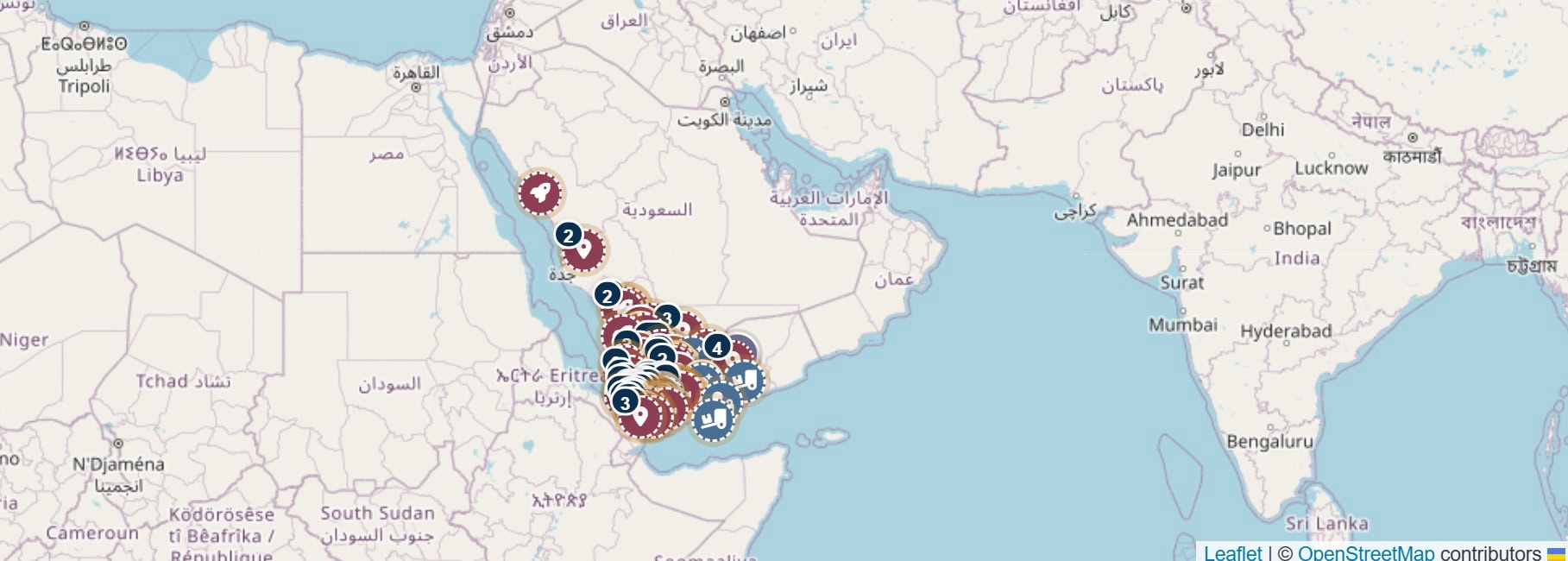
Interactive Map – By South24 Center © OpenStreetMap
19-09-2026 at 11 AM Aden Time

Aden (South24 Center)
Military clashes in Yemen expanded between September 5 and 17, shifting from fronts in Taiz and the West Coast toward Bab al-Mandab and South Yemen’s border areas between Taiz and Lahj, alongside an unprecedented escalation in airstrikes, missile attacks and drone operations, according to data compiled by South24 Center.
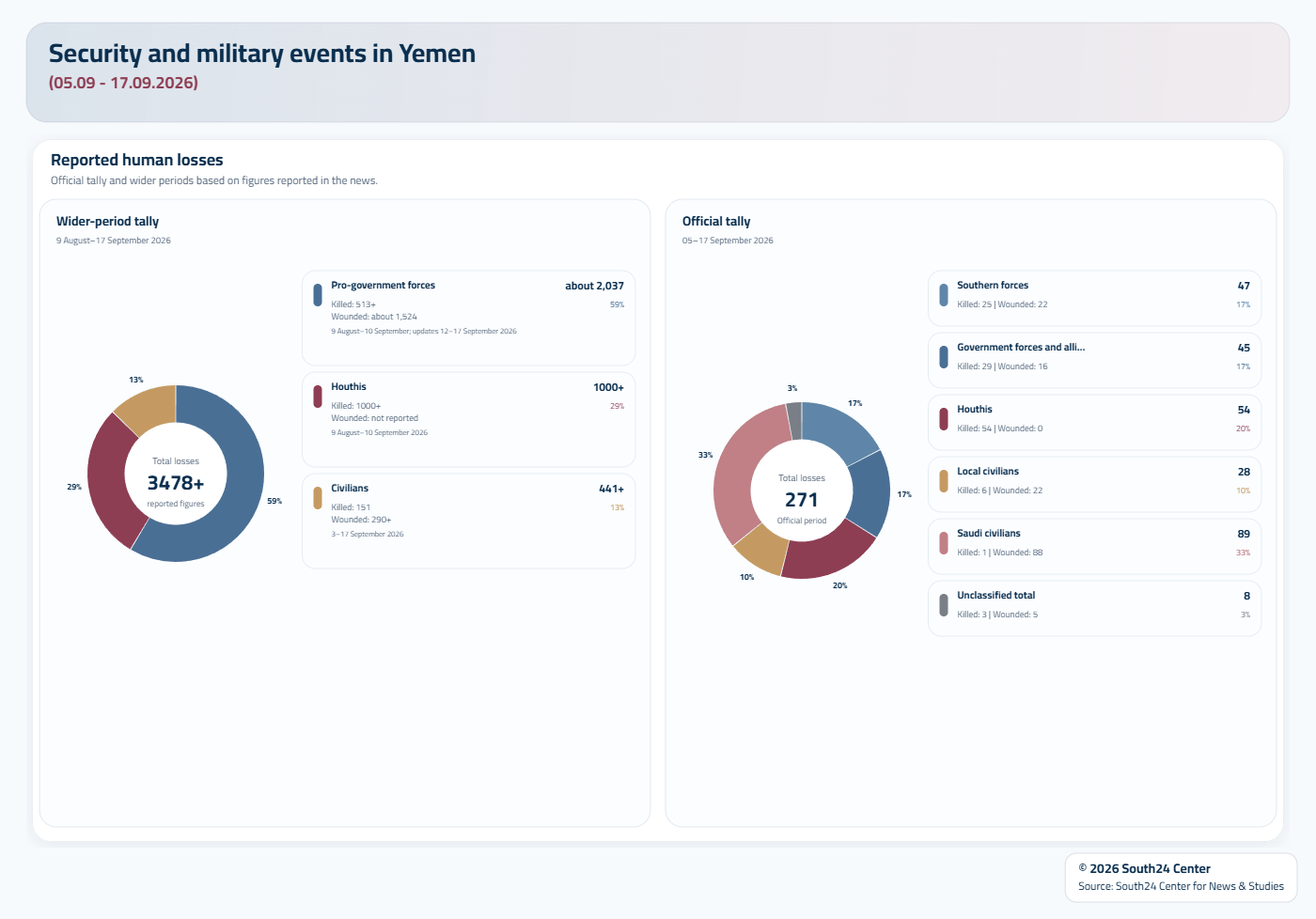
The broader reported toll covering August 9 to September 17 indicates that at least 3,478 people were killed or wounded in Yemen, including more than 1,664 killed and around 1,814 wounded, in addition to thousands of wounded Houthi fighters whose numbers were not precisely specified. The figures include more than 513 pro-government personnel killed and approximately 1,524 wounded, over 1,000 Houthis killed, and 151 local civilians killed and more than 290 wounded. South24 Center has not independently verified these figures, which may also be incomplete given the rapid pace of developments.
The toll does not include the dozens of Saudi civilians wounded in Houthi attacks, according to figures announced by the kingdom.
The monitoring recorded 151 incidents between September 5 and 17, including 138 military incidents and 13 security incidents. Taiz Governorate accounted for the largest share, with 49 incidents, followed by Lahj with 17, Al-Dhalea with 16, Marib with 14, Al-Jawf with 11, and Hodeidah with eight, alongside five major incidents in the Bab al-Mandab area.
The period began with extensive clashes in Maqbana, Jabal Habashi, Al-Kadha and Al-Barh in western Taiz, alongside counterattacks by pro-government forces south of Al-Jarrahi and in Hays, and other operations in Al-Jawf, Al-Bayda and Marib. On September 7, the Southern Giants Brigades launched an operation from the Al-Hadd front in Yafa toward Al-Zahir District in Al-Bayda, saying they had seized several positions and advanced to the outskirts of Dhi Na’im.
The course of the fighting shifted sharply on September 10, as units of the pro-government National Resistance and some reinforcements from the Southern Giants Brigades and National Shield Forces rapidly withdrew from parts of the West Coast, and the Houthis seized the city of Mokha. In a further tragic turn, Houthi control extended to Dhubab and the islands of Zuqar and Hanish, before the group’s fighters occupied the Southern island of Mayun (Perim), in the heart of the Bab al-Mandab shipping strait.
These developments initially prompted government forces and their allies to regroup south of Mokha, amid intensive airstrikes on Houthi positions and reinforcements in Mokha, Dhubab, Al-Wazi’iyah, Al-Kadha and Al-Barh. From September 13, fighting gradually shifted toward the fronts of Bab al-Mandab, Al-Mudaribah, Ras Al-Ara and Al-Aghabirah in northern and western Lahj, following the withdrawal of National Resistance personnel to Southern areas and the departure of their commander, Tariq Saleh, for Riyadh.
During the final days of the monitoring period, the Kahboub, Ras Al-Ara, Al-Mashbak and Al-Mansoura fronts in Lahj saw clashes and missile and drone attacks. Southern forces and Al-Subaiha tribesmen said they had repelled Houthi attempts to advance and captured positions in the Al-Aghabirah sector, while the Houthis sent reinforcements from Al-Wazi’iyah toward the front lines.
The data showed that airstrikes were the most frequently recorded type of operation, accounting for 40 incidents, followed by clashes and ground attacks with 29, other military activities with 17, and drone attacks with 15. The monitoring also recorded 13 missile operations, 13 incidents of artillery shelling, seven naval operations, and four combined missile and drone attacks.
These developments marked a strategic military setback for the Saudi-backed government, which had been mobilizing for several months for a battle with the Houthis.
Their significance lies not only in the rising human toll, but also in the shift of fighting from scattered inland fronts to a continuous geographical corridor stretching from Hodeidah, Mokha and Dhubab to Bab al-Mandab and northern Lahj. This shift brings international shipping routes and overland supply lines leading to Aden and Southern areas closer to military operations and under the influence of an Iran-aligned group.
The fighting inside Yemen coincided with four major waves of Houthi ballistic missile and drone attacks inside Saudi Arabia, striking Abha, Khamis Mushait, Jazan, Najran, Taif and Yanbu. According to Saudi authorities, the attacks killed one civilian and wounded 88 others, damaged homes and vehicles, and caused fires and temporary operational disruptions at energy facilities in the kingdom’s south.
The Houthis said their attacks targeted Aramco facilities, the Economic City and King Khalid Air Base in Khamis Mushait with dozens of missiles and drones. They also claimed to have shot down five Saudi aircraft over Yemen, including an F-15 fighter jet in Marib and four armed reconnaissance drones: two Wing Loong II drones in Al-Bayda and Marib, a CH-4 in Al-Jawf, and a fourth of an unspecified type in Hajjah. Saudi Arabia has not confirmed these claims.
Meanwhile, Saudi airstrikes expanded to Taiz, Lahj, Hodeidah, Marib, Al-Jawf, Al-Bayda, Saada and Hajjah, with the Houthis reporting overlapping figures for dozens of strikes over several days.
Explore the interactive map directly below:
Previous article