SOUTH24 CENTER FOR NEWS & STUDIES
SOUTH24 CENTER FOR NEWS & STUDIES


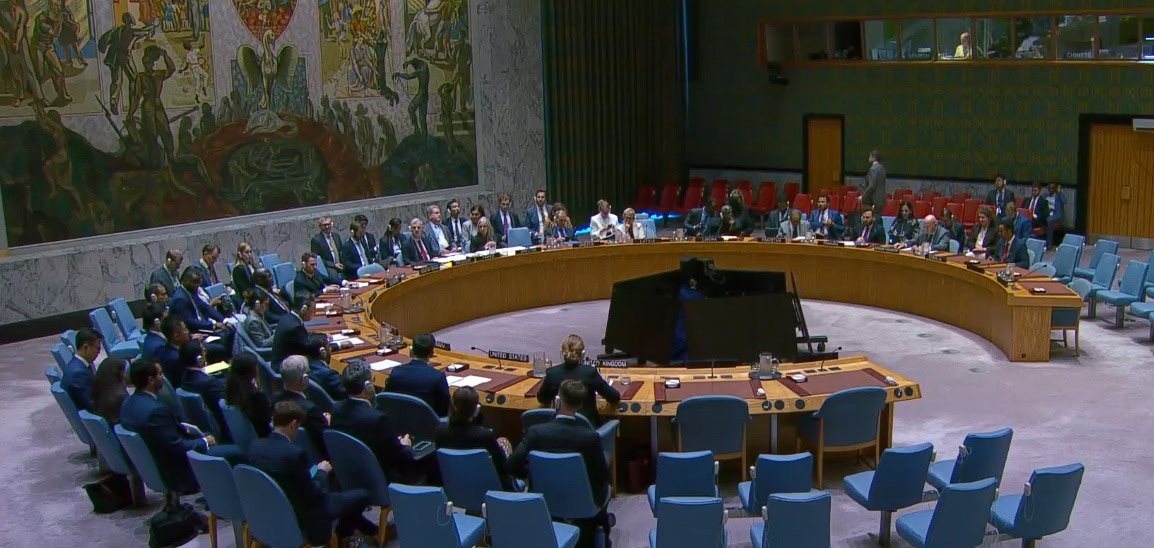
A general view of the United Nations Security Council during an emergency meeting on Yemen at UN headquarters in New York, United States, September 15, 2026. (Screenshot/UN Web TV)
16-09-2026 at 11 AM Aden Time

Aden (South24 Center)
The United Nations Security Council held its second emergency meeting on Yemen in five days on Tuesday (September 15), amid growing concern that the Houthi militia’s advance along the Western Coast could threaten navigation through the Bab Al-Mandeb Strait and widen the regional conflict.
The meeting, requested by Bahrain, Britain, Denmark, France, Greece and Latvia, included representatives of Yemen and Saudi Arabia. It ended without a new resolution, presidential statement or other binding measure.
Khaled Khiari, the UN Assistant Secretary-General for Political and Peacebuilding Affairs, said the situation around Bab Al-Mandeb had become “increasingly volatile”, as the Iran-aligned Houthis advanced along Yemen’s Western Coast and reportedly seized several islands in the southern Red Sea.
The session came five days after UN Special Envoy Hans Grundberg said warnings of Yemen returning to large-scale war had become a “harsh reality”, ending the relative calm that followed the 2022 UN-mediated truce.
According to the official UN briefing, maritime tracking websites indicated that commercial shipping through the Red Sea had not been significantly affected so far. However, Khiari said the Houthi advance had added to market concerns amid severe disruption to shipping through the Strait of Hormuz.
He said Yemen’s internationally recognized government had launched a counteroffensive involving extensive airstrikes, alongside clashes in Marib, Lahj, Al-Jawf, Hajjah, Al-Bayda, Saada and Taiz. Unconfirmed estimates suggested that hundreds of combatants had been killed.
The fighting has displaced at least 125,000 people across Yemen since the beginning of September, according to the UN. Eight civilians were killed and 32 wounded, with women and children accounting for half of those killed and more than half of the injured.
About 2,300 people fleeing Yemen had reached northern Djibouti by September 14, while UN agencies expected further arrivals if the conflict continued.
Several Council members also demanded the release of UN and humanitarian personnel detained by the Houthis. Greece said 73 UN employees remained in the group’s custody.
The African Council members — the Democratic Republic of Congo, Liberia and Somalia — said more than 18 million Yemenis required life-saving assistance and over 2.2 million children suffered from acute malnutrition.
Speaking for the African group, Liberia warned that disruption to Red Sea shipping would raise freight, insurance and the prices of grain, fuel and fertilizer across Africa. The group called for reopening vital roads, paying public-sector salaries and establishing a permanent nationwide ceasefire.
Khiari said the escalation had spread beyond Yemen, citing Houthi missile and drone attacks on Abha, Khamis Mushait and Taif that Saudi authorities said wounded 13 civilians and damaged seven homes.
He also referred to a September 12 drone attack on Saudi Arabia’s East-West Pipeline. Riyadh said the drones had been launched from inside Iraq. The strike temporarily shut the pipeline, an important route for transporting Saudi oil to the Red Sea while avoiding the Strait of Hormuz.
According to the UN, Saudi Arabia decided against immediate retaliation following a request from Iraq’s prime minister. Baghdad opened an investigation and said it would not allow its territory or airspace to be used to attack other states.
Khiari also cited the Houthis’ claim that they attacked King Khalid Air Base in Khamis Mushait on September 14 in response to what the group described as more than 300 Saudi airstrikes over five days.
Yemen’s UN Ambassador Abdullah Al-Saadi said government forces were regrouping to prevent the Houthis from turning their coastal presence into a permanent platform for threatening Bab Al-Mandeb.
“Yemen is not asking the world to defend it. Yemen is already defending the interests of the world,” he told the Council.
Al-Saadi urged the Council to condemn the Houthi escalation, enforce the arms embargo under resolutions 2140 and 2216, disrupt weapons and financing networks and strengthen the Yemeni government’s naval and coastguard capabilities.
The United States, Britain, France and several other Council members blamed the Houthis for the escalation and called for stricter enforcement of the arms embargo.
Washington said about 12% of global trade passes through Bab Al-Mandeb and accused Iran of arming, financing and directing the Houthis. France also called on Tehran to stop supplying the group with weapons.
Russia condemned attacks on civilian vessels but warned against “rash” measures, arguing that the maritime crisis could not be separated from Yemen’s unresolved war. It called for negotiations involving all relevant parties, including the Houthis.
China similarly condemned attacks on ships and civilian infrastructure but said securing Bab Al-Mandeb required ending the fighting on land and returning to negotiations.
Saudi Arabia’s UN Ambassador Abdulaziz Al-Wasel accused the Houthis of “militarizing international straits to blackmail the global economy”.
He said maritime security was a collective international responsibility and that Riyadh would continue supporting political efforts while reserving the right to protect its territory, citizens and national infrastructure under international law.
Previous article