SOUTH24 CENTER FOR NEWS & STUDIES
SOUTH24 CENTER FOR NEWS & STUDIES


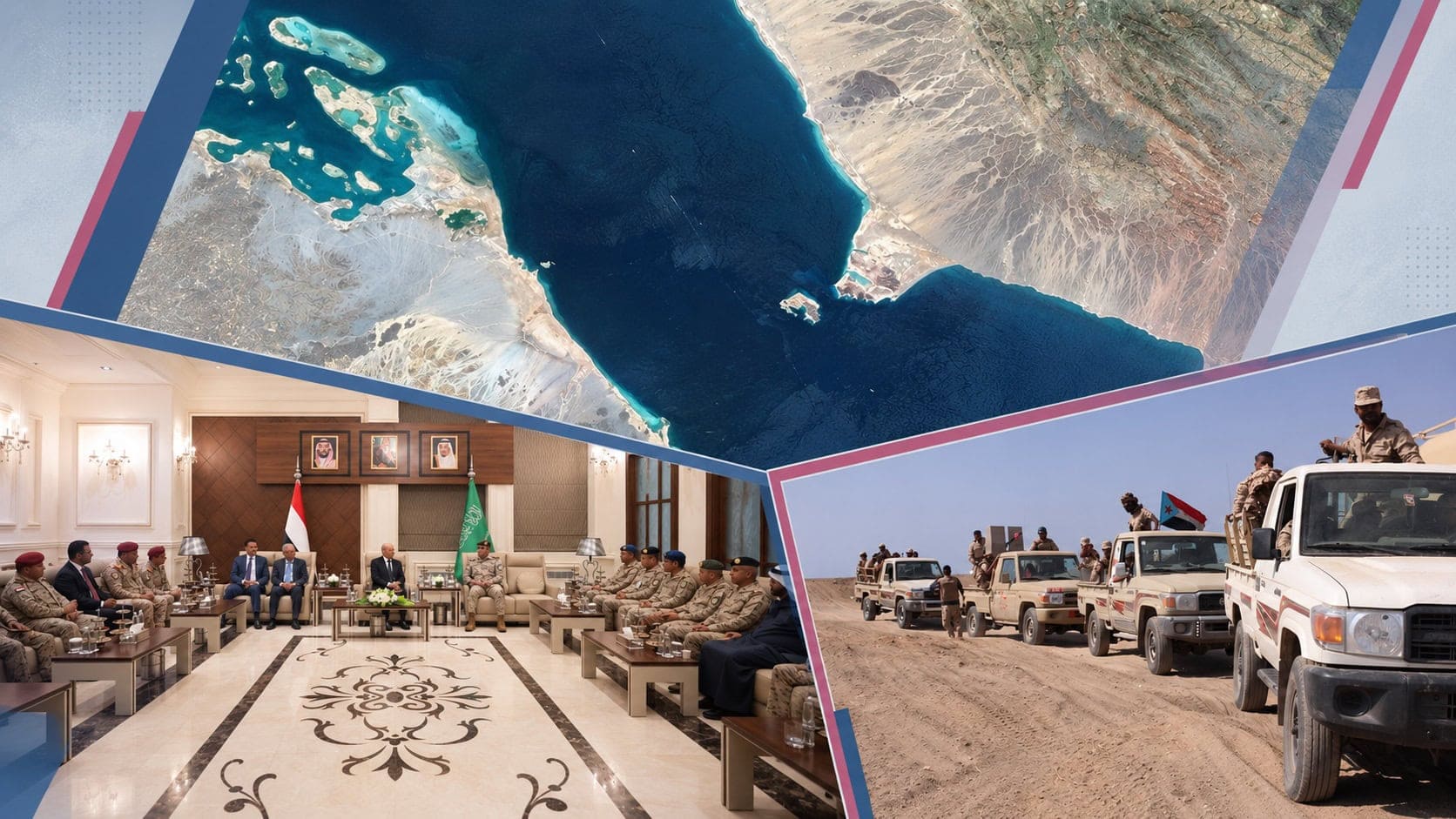
Composite image - South24 Center
16-09-2026 at 3 PM Aden Time

South24 Center Editorial
Recent developments on the ground in Yemen have exposed clear shortcomings in the performance of Riyadh-backed forces along the western coast and around the Bab al-Mandab Strait, and, more broadly, in Saudi Arabia’s overall management of the Yemen file. This comes as Iran-backed factions intensify attacks targeting facilities inside the Kingdom and threaten its economic and security interests. At such a critical moment, Saudi Arabia’s priority should be to reassess the causes of these failures and the structural weaknesses in its management of the Yemeni landscape, rather than widen its disputes with local forces that have significant political and military influence in South Yemen.
The problem extends beyond individual writers or media accounts. It points to a deeper flaw in the mindset that has managed large parts of the Yemen file, one that has at various stages assumed that money can buy loyalties, media campaigns can alter realities on the ground, and weakening local allies can automatically translate into greater strength and influence. In many cases, the outcome has been precisely the opposite: buying support without any real political weight, creating new adversaries, weakening forces with an established presence on the ground, and then discovering that the spaces left by weakened allies do not remain empty. Instead, they are filled by forces that are more costly for Saudi Arabia to contain and more capable of exploiting the resulting disorder.
In this sense, the mindset of “buying political performers” and “creating adversaries” is not merely a sarcastic description of media behavior. It reflects a broader political problem: the absence of a clear standard for distinguishing between an ally with a genuine social base, military strength, and shared interests, and elites whose only tools of influence are their proximity to funding networks or their ability to echo the desired narrative at the right moment.
More than ever, Saudi Arabia needs to reassess the effectiveness of the political, military, and media tools it has relied on in Yemen. After years of direct and indirect intervention, it is difficult to treat what has happened as merely a battlefield setback that can be overcome by replacing a commander, redeploying some units, or repeating familiar narratives. What is unfolding is closer to a crisis of the entire model for managing the Yemen file, a model that has produced yet another strategic failure and left Riyadh increasingly boxed in, with its room for maneuver narrowing as the crisis drags on and its available options diminish.
More concerningly, this failure does not merely create a vacuum. It creates valuable opportunities for political Islamist forces, extremist groups, networks of vested interests, and local and sectarian divisions, as well as outside powers seeking influence in the region. It has also contributed to the emergence of a broad Yemeni elite heavily dependent on external funding but with limited capacity to generate effective political or military action. Some of these elites have demonstrated in recent years that their loyalties are not necessarily rooted in a consistent political project but are instead shaped by shifting balances of power and sources of funding. Assuming that these forces will remain in the same camp if circumstances change is therefore a risky proposition.
The danger of this issue has become apparent even in statements coming from within the Yemeni government itself. A senior official at Yemen’s Foreign Ministry, which is aligned with the internationally recognized government, said on Saudi Arabia’s leading television network, Al Arabiya, that under certain circumstances it could find itself closer to reaching an understanding with the Houthis to confront what he described as “separatists” in South Yemen. This is not a marginal issue. It raises a fundamental question that should concern Saudi decision makers: What is the value of investing politically and militarily in a force that, when interests or the balance of power shift, could move to the opposing camp?
Saudi Arabia knows this reality better than anyone. It also knows that much of the environment surrounding the war in northern Yemen is fluid, with deep social, tribal, and geographic ties to areas under Houthi control. It is difficult to build a cohesive fighting front when a fighter is expected to confront the Houthis while his family or relatives live in areas under their influence and his social and economic interests remain tied to those areas. This is not merely a temporary military concern. It is one of the fundamental factors determining whether any force can sustain its fight when circumstances change.
This is where the fundamental difference between the realities of the north and the south becomes apparent. In South Yemen, local forces have an independent political and national cause, an identity and direct interest in preventing the Houthis from advancing into their areas, as well as a more cohesive social and geographic base and a record of security and military successes. Ignoring these factors or treating these forces as a problem whose influence should be curtailed, has been one of the most costly strategic mistakes in the management of Yemen’s conflict.
For this reason, Riyadh should also reassess what could be described as the disastrous mistakes of January in its handling of South Yemen and its regional ally, the UAE, and correct the “hostile” approach it adopted at the time, which resulted in the deaths and injuries of hundreds of members of the Southern forces and civilians. The consequences of that period went far beyond a political dispute. They reshaped the balance of power on the ground and weakened a system that, despite all its differences with Riyadh, had constituted a major barrier to Houthi expansion toward the western coast and the Bab al-Mandab Strait.
Correcting these mistakes cannot be achieved with the same tools or by the same people who helped create them, nor even under the same legitimacy framework. If Riyadh genuinely wants to reassess its Yemen policy, it would be logical to begin by reviewing the performance of the Saudi officials and circles that have managed the file in recent months and questioning the assumptions behind their decisions: Who is the ally? Who is the adversary? Which forces have real weight? And which exist only in hotels, television studios, and on social media platforms?
Saudi Arabia also urgently needs to explore options beyond the traditional “Special Committee” framework and the networks of relationships that have shaped its approach to Yemen for decades. The Yemen Riyadh is dealing with today is not the Yemen it knew in the 1980s or 1990s. Centers of power have shifted, the social and political landscape has changed, and South Yemen has politically and militarily reconstituted itself. Meanwhile, the war in the north has produced a reality far more complex than one that can be managed through tribal sheikhs, intermediaries, and lists of financial allocations alone.
This is why the debate over the connection between what has happened along the western coast and around the Bab al-Mandab Strait and what previously unfolded in Hadramout and South Yemen is not merely a media dispute. It is the unfortunate consequence of flawed assessments made by Riyadh. The questions are straightforward: Did weakening Southern forces and reshaping the balance of power against them weaken the anti-Houthi front as a whole? And was pressuring partners with a genuine interest in confronting the Houthis part of a chain of decisions that ultimately created more favorable conditions for the group’s advance toward the heart of the Bab al-Mandab Strait and a vital international shipping artery?
These questions cannot be answered through media campaigns against the Southern Transitional Council, nor by portraying every Southern voice critical of Saudi policy as an adversary of the Kingdom. On the contrary, Saudi interests today require distinguishing between political disagreement and strategic hostility. Riyadh can disagree with the Southern Transitional Council over the future of South Yemen, state arrangements, and the shape of a final settlement. But turning that disagreement into a policy of weakening Southern forces while the Houthis are waging a direct war against Saudi Arabia is a dangerous conflation of priorities.
The Presidential Leadership Council, in its current form, also requires a fundamental reassessment. A formula that brings together forces with conflicting visions, interests, and geographic bases under a single framework has produced neither a cohesive war leadership nor an effective political authority. The more intense the fighting becomes, the more clearly these contradictions emerge, turning decision-making into a process of internal bargaining rather than an instrument for managing an existential confrontation.
It may therefore be necessary to think beyond the existing formula itself, including suspending the Presidential Leadership Council in its current form and moving toward more realistic arrangements that recognize the political and military distinctions between the north and the south. This could include a government dedicated to South Yemen, responsible for administering its affairs, institutions, and security, alongside a northern war government with a clear and specific mandate to manage the confrontation with the Houthis and unify the forces genuinely willing to fight the Houthis.
Such an option would not resolve all of Yemen’s complexities. But at the very least, it would shift the approach from denying realities on the ground to organizing around them. The central problem in recent years has been the insistence on managing Yemen through political structures that do not reflect the actual balance of power on the ground, while expecting different results each time.
Saudi Arabia does not need more cheerleaders, more media campaigns against potential partners, or another repetition of failed approaches. It needs a bold strategic reassessment that acknowledges its mistakes before looking for those responsible outside its own ranks, and that resets its priorities around a simple question: Who actually threatens the Kingdom’s security, and who on the ground has both the capacity and the interest to confront that threat?
If the answer to that question is clear, then rebuilding relations with South Yemen, correcting the rift with Southern forces, particularly the Southern Transitional Council, repairing relations with the UAE at the regional level, and redefining the nature of the war in the north are no longer tactical options that can be postponed. They may instead be essential conditions for preventing the current failure from becoming a permanent strategic reality that will be increasingly difficult to reverse.
Previous article