SOUTH24 CENTER FOR NEWS & STUDIES
SOUTH24 CENTER FOR NEWS & STUDIES


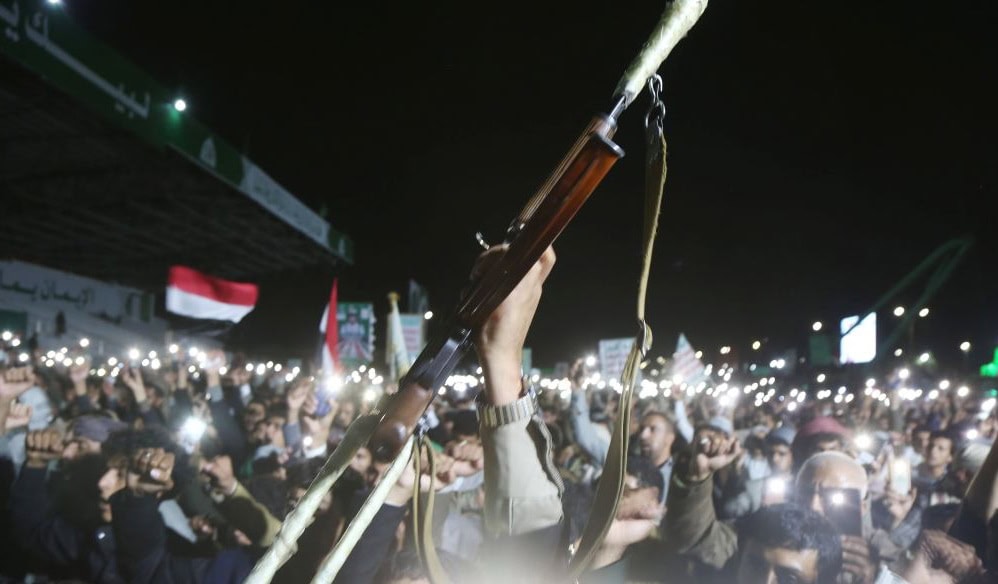
Supporters of the Houthi group chant slogans during a nighttime rally at Al-Sabeen Square in Sanaa, Yemen, on September 11, 2026, celebrating the group’s capture of the Mocha port area. (Xinhua)
Last updated on: 12-09-2026 at 4 PM Aden Time
Aden (South24 Center)
Military pressure from the Houthi militia has expanded toward the southern fronts following the group’s rapid advance and capture of the city of Al-Mokha, the Dhubab area, and the strategic Mayun Island near the Bab Al-Mandeb Strait. This has coincided with missile and drone attacks targeting Southern forces’ positions in Lahj and Yafa, as well as infiltration attempts on the Harib front near Shabwa.
These developments mark a significant shift in the course of the fighting, which began farther north along the Western Coast. Houthi forces are now in direct contact with areas leading toward Lahj, Aden, and northwestern Shabwa, following the collapse of government-aligned positions around Al-Mokha and Bab Al-Mandeb.
Military sources told South24 Center that the Houthi militia launched ballistic missiles and drones on Friday, September 11, toward the Ras Al-Ara area in Lahj Governorate.
Circulating footage showed the aftermath of Houthi shelling targeting Southern forces’ positions in Khor Omirah, Lahj, amid reports of injuries.
On the Al-Hadd front in Yafa, other footage showed the aftermath of drone strikes launched by the Houthi militia that targeted a mosque in the Al-Mahaji area, indicating an expansion of Houthi attacks along contact lines close to the southern governorates.
South24 Center sources also said on Saturday, September 12, that the Shabwa Defense Forces thwarted nighttime Houthi infiltration attempts on the Harib front in southern Marib.
Harib borders Bayhan District in Shabwa and represents one of the sensitive contact points linking the Marib, Al-Bayda, and Shabwa fronts. During the years of war, it has witnessed repeated rounds of fighting that affected movement routes and roads between Harib and Bayhan.
The growing Houthi pressure followed the group’s capture of Al-Mokha on Thursday, before it continued advancing south toward Dhubab and Mayun Island, located in the heart of Bab Al-Mandeb.
Yemeni government sources had said that government-aligned forces withdrew from the island, while the Houthis also seized the coastal area of Dhubab opposite it, marking the most significant field shift around Bab Al-Mandeb in years.
The Houthis also announced that the offensive they launched on September 3 had forced opposing forces to withdraw from six districts in the governorates of Taiz and Al-Hodeidah in western Yemen, covering an area they said amounted to around 5,400 square kilometers. These figures remain part of the Houthi account.
The advance represents a major strategic shift in the Bab Al-Mandeb area. Mayun Island lies inside the strait and divides it into two shipping channels, while Dhubab directly overlooks the maritime passage from the mainland.
The Houthi presence in these positions gives the group greater ability to exert pressure on maritime traffic from short distances without relying entirely on long-range missiles and drones.
The Red Sea route has gained increasing importance in recent months as Saudi Arabia has relied on it more heavily to transport some of its exports amid disruptions in the Strait of Hormuz linked to the broader regional conflict between Iran and the United States.
How Did the Western Coast Front Collapse?
New information published by CNN provides further details about the rapid collapse of government-aligned positions along the Western Coast.
A senior Yemeni source linked to the military told the network that urgent requests for air cover began on Thursday morning as the Houthi advance toward Al-Mokha accelerated.
The source said he contacted the US Central Command, CENTCOM, and was assured that the United States was closely monitoring the situation and that Saudi air support was on the way.
However, he said the support “never came” before Al-Mokha fell to the Houthis.
CNN also cited a Western source familiar with the operations as saying that the battalions responsible for defending Al-Mokha were severely depleted in terms of their actual manpower.
According to the source, force rosters included large numbers of “ghost names” receiving salaries, while the actual number of troops on the ground amounted to only around 20% of the strength listed on paper.
This provides an important factor in explaining the speed with which the Houthis were able to penetrate Western Coast lines and reach Al-Mokha and Bab Al-Mandeb.
CNN also said the Saudi military had been placed on high alert around three weeks earlier, but key personnel within the air command structure had not been moved into the positions required to manage and direct combat aircraft in the event of a major attack.
US Central Command chief Admiral Brad Cooper was in Saudi Arabia on Thursday for coordination meetings, according to two sources who spoke to the network.
CNN had also revealed in a separate report that more than 100 US military advisers had been deployed to Saudi Arabia to provide intelligence support and targeting assistance as part of a newly established joint command. A US official estimated the overall number of US military personnel associated with the mission in Saudi Arabia at around 200.
Divisions Within the Anti-Houthi Camp
In this context, Amr Al-Bidh, Head of Foreign Affairs at the Southern Transitional Council, said that part of the current crisis stems from Saudi-backed forces focusing on confronting STC forces following their expansion last year, rather than maintaining a unified front against the Houthis.
Al-Bidh told CNN that STC forces and Saudi-backed forces had previously fought the Houthis together in northern Yemen before that front collapsed as a result of internal conflict between the two sides.
He added: “We are also concerned about the situation because they might head south, and we will have to defend the south against them.”
In separate remarks to The Guardian, Al-Bidh said he had repeatedly warned Western diplomats of the need for a comprehensive national, regional, and international strategy to defeat the Houthis, arguing that sporadic airstrikes are not enough.
He accused Saudi Arabia of what he described as “strategic incompetence” and of weakening and marginalizing Southern forces, which he described as a key element in confronting the Houthis.
He said the Houthi presence in the strait means the group is now capable of threatening maritime routes without needing to use sophisticated weapons, allowing it to direct those weapons toward other fronts.
Al-Bidh also told CNN that removing the party that had been the principal backer of a number of forces on the ground, without putting an alternative in place to fill the resulting vacuum, reflected a lack of strategy and poor management.
The Iranian Role
In another dimension of the conflict, Reuters reported, citing Yemeni, Iranian, and regional sources, that the Houthi advance along the Western Coast was supported and directed by Iran’s Islamic Revolutionary Guard Corps.
Yemeni military sources said IRGC officers had helped direct the operation, while Iranian sources said Tehran had pushed the Houthis to escalate their attacks against Saudi Arabia and had pledged additional funding and weapons.
Yemeni sources also linked the operation to commanders in the Quds Force.
Iran, however, officially denies directing Houthi military operations and says the group is an ally rather than a proxy.
An Iranian official said the decision to advance toward Al-Mokha had been made by the Houthis themselves, but acknowledged that the operation provided strategic gains for Tehran by increasing pressure on Saudi Arabia, the United States, and energy markets.
Humanitarian Pressure
The impact of the developments has not been limited to the military dimension, as fighting along the Western Coast has rapidly worsened the humanitarian situation.
The UN Office for the Coordination of Humanitarian Affairs, OCHA, said eight vehicles belonging to its humanitarian hub in Al-Mokha were confiscated following the Houthi capture of the city. It called on the parties to the conflict to protect humanitarian personnel and property and allow relief operations to continue.
Recent humanitarian estimates also indicate that tens of thousands of civilians have been displaced from fighting areas in Taiz and Al-Hodeidah toward safer areas, including Aden, Lahj, and Abyan.
The new displacement is adding further pressure on southern governorates that have already hosted large numbers of displaced people throughout the years of war, amid deteriorating public services and limited humanitarian response capacity.
This comes alongside damage to facilities and infrastructure at Al-Mokha port, disruption to some humanitarian activities, and the closure or obstruction of several main roads as a result of military operations.
The Yemeni Ministry of Defense announced on Friday the start of airstrikes in areas surrounding Al-Mokha as part of what it called a “kill box,” warning civilians against using the Taiz-Al-Mokha and Al-Mokha-Dhubab roads.
Military sources said the strikes targeted Houthi reinforcements, vehicles, and positions in Al-Mokha and Dhubab.
Yemeni Defense Ministry spokesman Majid Al-Nuzaili also said on Saturday that forces had destroyed vehicles and weapons and killed Houthi fighters near Al-Mokha port, in addition to targeting Houthi gatherings on the city’s northern ring road.
The Ministry of Defense published footage that it said showed strikes against Houthi gatherings and equipment in Dhubab, west of Taiz, an area overlooking Bab Al-Mandeb and Mayun Island.
The latest developments place the battle for the Western Coast in direct connection with the security of the South and the broader regional competition surrounding the Red Sea and Bab Al-Mandeb.
Yemen’s Foreign Minister had warned that the danger posed by Houthi movements is growing given the group’s record of targeting vessels in the Red Sea and Gulf of Aden, calling for a clear position toward the escalation and the risks it poses to Yemen, the region, the Red Sea, and Bab Al-Mandeb.
The next direction of the Houthi offensive remains uncertain.
The question is no longer limited to whether anti-Houthi forces are capable of retaking the Western Coast.
It now extends to whether the collapse of that front has opened the way for the Houthis to gradually shift pressure from the Red Sea and Bab Al-Mandeb toward Lahj, Yafa, and the approaches to Shabwa, at a time when the anti-Houthi camp continues to suffer from divisions, the absence of unified command, and heavy dependence on external air and logistical support.