SOUTH24 CENTER FOR NEWS & STUDIES
SOUTH24 CENTER FOR NEWS & STUDIES


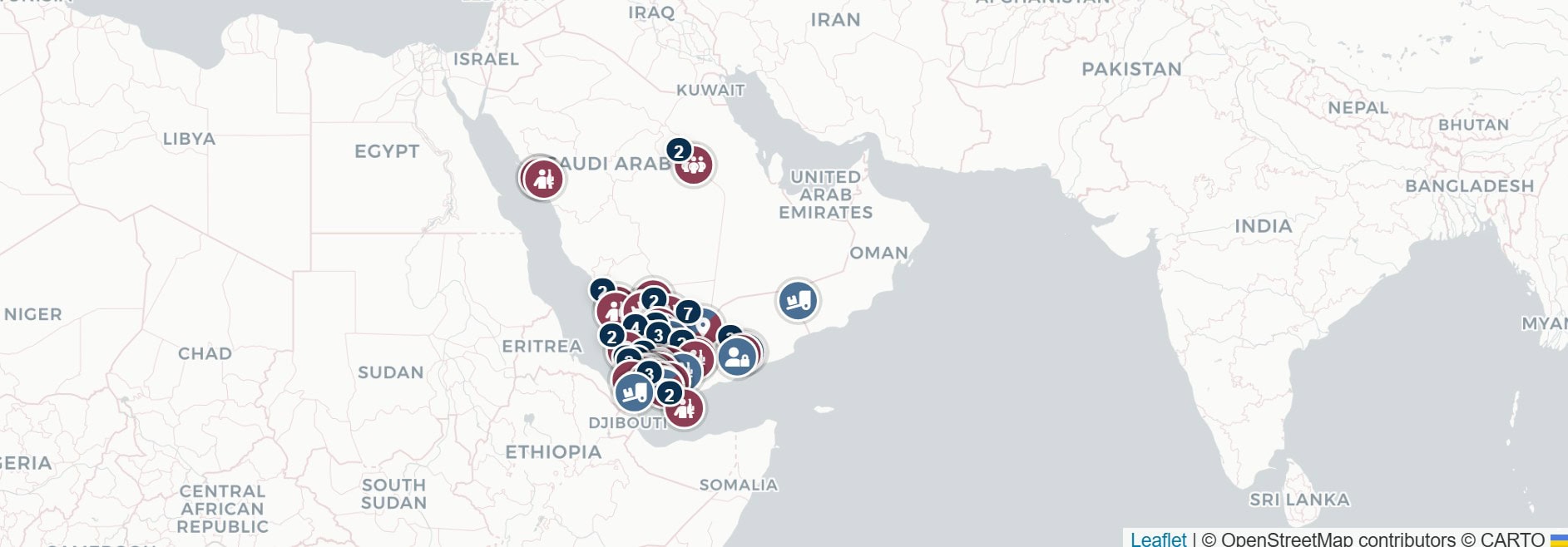
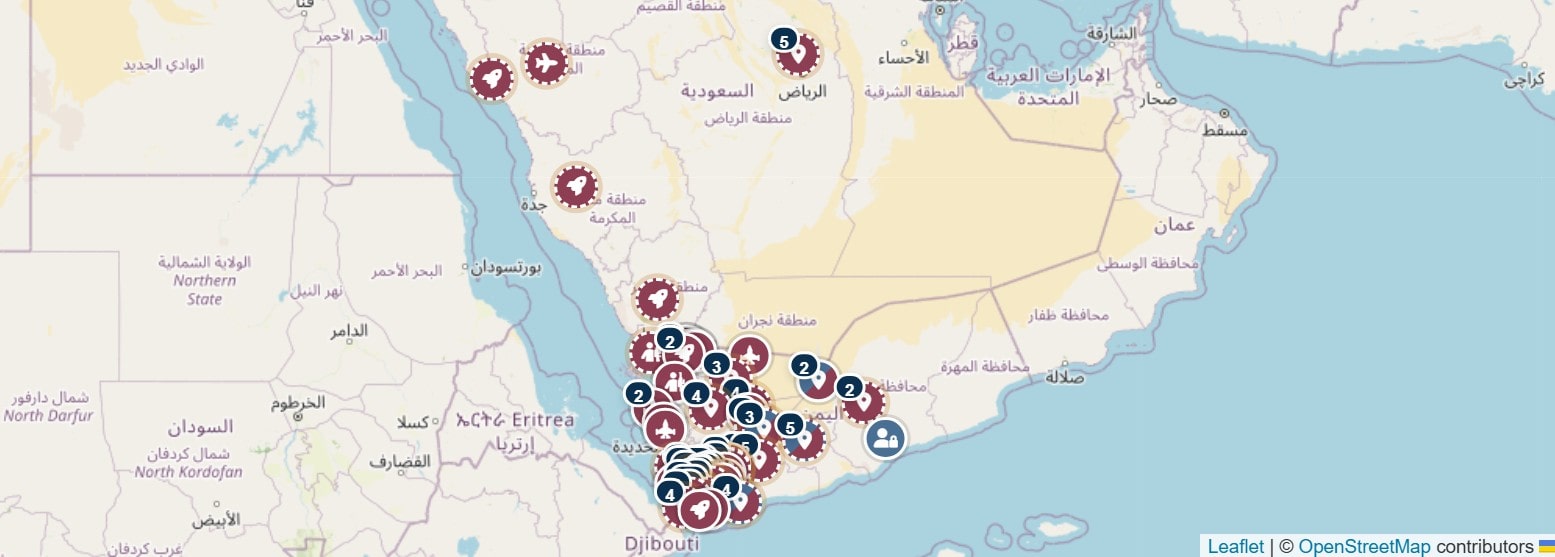
Interactive Map – By South24 Center © OpenStreetMap
09-08-2026 at 1 PM Aden Time

South24 Center (Aden)
Security and military monitoring by South24 Center covering the period from July 24 to August 7, 2026, showed a significant escalation in military operations involving the Houthi militia, with much of the confrontation shifting from Yemen’s internal frontlines toward attacks targeting Saudi Arabia, its oil interests, and related shipping routes. The escalation culminated in deadly attacks targeting Yemeni and Saudi forces in Hadramout and Marib.
During the reporting period, South24 recorded 84 security and military incidents and developments, including 70 military and 14 security-related incidents. These ranged from ground clashes, drone and ballistic missile attacks, airstrikes and maritime operations to security incidents, assassinations, tribal clashes, and anti-smuggling and counter-narcotics operations.
Signs of a direct escalation with Saudi Arabia emerged early in the period. On July 24, the Royal Saudi Air Force carried out a military operation against Houthi positions in Hodeidah, which Saudi military spokesman Turki Al-Maliki said came in response to threats to navigation in the Red Sea.
The following day, Reuters reported that an air-defense system operated by Greek military personnel in Saudi Arabia intercepted two ballistic missiles launched by the Houthis toward refineries in Yanbu. The Houthis, meanwhile, said they had launched attacks involving dozens of missiles and drones against Saudi Aramco targets in Jizan and Yanbu. Reuters later cited two sources as saying damage had been reported at a site following an attack targeting Aramco’s Jizan refinery.
The attacks expanded over the following days. The Houthis said they targeted facilities linked to the supply and transport of oil from eastern Saudi Arabia to Yanbu using drones. They also claimed attacks on oil tankers and vessels linked to Saudi Arabia, including the NCC GHAZAL, followed later by a tanker off the port of Yanbu and the oil tanker Daisy in the Gulf of Aden.
On August 4, the Houthis said they had targeted what they described as a “sensitive target” at Najran Airport with a drone. The maritime escalation coincided with an incident reported by the United Kingdom Maritime Trade Operations, or UKMTO, about 95 nautical miles southeast of Aden, hours after a military source reported that a Houthi missile had been launched from the Mukeiras area toward the Gulf of Aden.
The escalation was also reflected in political and military rhetoric. Houthi leader Abdul-Malik Al-Houthi said indications pointed to Saudi Arabia moving toward a “comprehensive escalation,” warning that his group would respond with a similar escalation. The Houthis also repeatedly said they were continuing what they describe as a “naval blockade” on Saudi vessels.
In response, Saudi Arabia hosted a military meeting on July 30 that, according to the monitoring, resulted in the establishment of a Saudi-led defensive maritime coalition to discuss protecting freedom of navigation in the Bab Al-Mandab Strait, as military operations against Houthi positions inside Yemen continued.
Amid domestic developments, Southern Transitional Council President Aidarous Al-Zubaidi, in his first publicly announced meeting, said defending the South represented the highest national priority for the STC and the Southern Armed Forces. He warned hostile northern forces against any attack on the South, its territory or resources, and called on the Southern Armed Forces to preserve and protect the gains already achieved.
The deadliest turn came on August 6, when air and missile attacks struck Al-Ruwaik, Al-Abr and positions in Marib. According to the casualty toll documented by the monitoring and reported by Agence France-Presse, around 58 members of Yemen’s Emergency Forces and Nation Shield Forces were killed in the attacks.
The monitoring also recorded the death of a Saudi officer and the injury of four other Saudis in the attack targeting camps in the Al-Abr and Al-Wadiah areas, according to health sources.
The Houthis claimed responsibility for the attacks, saying they had used a large number of ballistic missiles and drones to target what they described as “Saudi military buildups” and camps belonging to Emergency Forces in Hadramout and Marib. The group also claimed that hundreds had been killed or wounded, a figure not included in South24’s monitoring due to the absence of independent confirmation.
The escalation continued the following day, when the Houthis said they had targeted the Sahn Al-Jin military camp in Marib. Yemen’s Health Ministry reported that two civilians were killed and 14 others wounded in shelling that struck residential areas and camps for displaced people.
In Harib, southern Marib, three members of the Shabwa Defense Forces were killed and four others wounded in a Houthi drone attack on August 7, according to a South24 Center correspondent. Shabwa Defense Forces later responded by launching an operation dubbed “Rapid Response,” which they said targeted Houthi positions and command-and-control centers using Katyusha rockets and drones.
The fighting was not limited to Marib and Hadramout. The Al-Dhalea frontlines witnessed repeated military activity, including Houthi artillery and mortar shelling and drone attacks targeting Al-Fakher, Murais, Hajar and Battar. Southern forces responded with artillery and rocket strikes against Houthi positions and reinforcements.
In one of those attacks, one southern soldier was killed and two others wounded on the Al-Fakher front. Two additional soldiers were wounded in a drone attack on Murais and Hajar, while three soldiers were later wounded in Houthi shelling on the Murais front.
In Lahj, two Nation Shield soldiers were wounded in a drone attack on Al-Zaytouna military camp near Al-Anad Air Base, while southern forces shot down Houthi drones on the Al-Had front in Yafa and in Al-Qubaita.
Taiz also witnessed sporadic clashes. In one incident, five Houthi fighters were killed while attempting to infiltrate Jabal Han. Elsewhere, a government soldier was killed in Maqbanah, while a civilian was killed by a Houthi sniper in the same district.
At least 78 killed and 37 wounded
After excluding incidents in which the numbers of those killed or wounded were not specified, South24’s monitoring recorded at least 78 people killed and 37 others wounded during the reporting period.
Among cases in which the victims’ status could be clearly established, 69 military and security personnel were killed and 15 others wounded. This figure includes members of government and southern forces, as well as Houthi fighters whose deaths were confirmed in the recorded incidents.
Among civilians, the monitoring documented three deaths and 14 injuries, including a civilian killed by Houthi sniper fire in Maqbanah, Taiz, as well as two civilians killed and 14 others wounded in shelling that struck residential areas and displacement camps in Marib.
The recorded incidents also included six other deaths and eight injuries in tribal clashes, assassinations and other incidents.
South Yemen’s governorates accounted for 42 of the 84 security and military incidents recorded during the period, or roughly half of the total. These included 29 military and 13 security-related incidents.
Al-Dhalea recorded the highest number among the southern governorates, with 16 incidents, followed by Hadramout with 11, Aden with five, and Abyan, Lahj and Shabwa with three each. Al-Mahra recorded one incident, while no incidents were documented in Socotra during the period.
Overall, the monitoring shows that the second half of the reporting period was the deadliest and most escalatory, as Houthi pressure increasingly shifted toward forces linked to Saudi Arabia and the Kingdom’s oil and maritime interests, while fighting continued along the traditional frontlines in Al-Dhalea, Taiz and Marib. The developments pushed military confrontation to levels not seen on these fronts during the preceding period, amid international warnings over the risk of a wider war.
You can download or browse the interactive map below: