SOUTH24 CENTER FOR NEWS & STUDIES
SOUTH24 CENTER FOR NEWS & STUDIES


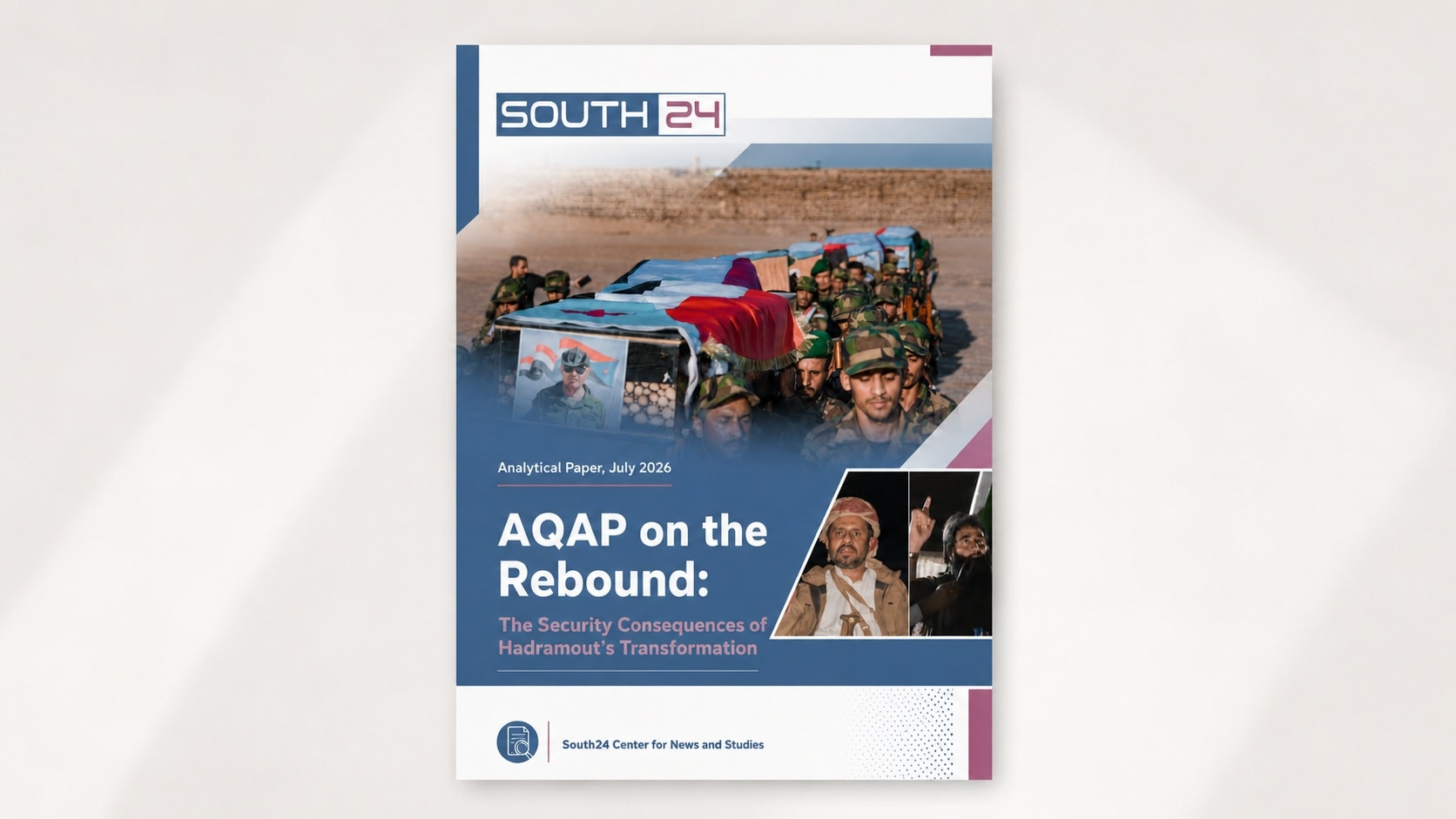
Cover image designed with the assistance of AI.
Last updated on: 27-07-2026 at 2 PM Aden Time

Analytical Paper | South24 Center
Introduction
The military developments that unfolded in Hadramout Governorate in early 2026 marked a turning point in the security landscape of South Yemen. The developments coincided with Saudi military intervention, including a series of airstrikes targeting the positions of southern forces responsible for securing the governorate. In the aftermath, clear signs emerged of a resurgence in extremist activity, initially in Hadramout before spreading to several other southern governorates.
This came after years in which southern forces had successfully constrained the movements of extremist groups and reduced their operational activity, contributing to a relative degree of security and stability. The timing of the recent developments raises questions about the relationship between the latest military and security shifts and the re-emergence of an environment that has enabled extremist groups, including Al-Qaeda in the Arabian Peninsula (AQAP), to regain their freedom of movement and once again expand the scope of their activities. The resulting security vacuum has also provided the Houthi group with operational incentives to step up its activities and increase pressure on several fronts.
Against this backdrop, this paper seeks to trace the trajectory of the growing activity of extremist groups in southern Yemen following the events in Hadramout; analyze the relationship between recent military and security shifts and the re-emergence of the terrorist threat; and assess the potential direction of this activity and its implications for local and regional stability in the coming phase.
The Consequences of Declining Attention to Counterterrorism in Yemen
Counterterrorism has long been one of the key determinants of U.S. policy in Yemen. However, recent years have witnessed a notable shift in the nature of this engagement. Direct U.S. activity has declined since 2019, both in terms of airstrikes and field operations, while the role of regional partners has grown. Foremost among them is the United Arab Emirates (UAE), which has played a prominent role in intelligence gathering, surveillance and reconnaissance activities, and ground operations alongside its local southern partners. The UAE has also participated in targeting AQAP operatives in Hadramout, Marib, Shabwa, and Abyan.
Over the years since the outbreak of Yemen’s conflict in 2015, AQAP has come under intense security and military pressure, resulting in the killing or targeting of a significant number of its first- and second-tier leaders. This weakened the group’s leadership structure and limited its ability to plan and manage its domestic and external operations. The group’s decline also affected its ability to manage its rivalry with ISIS, which escalated into armed clashes between the two sides in some areas. Nevertheless, these pressures did not lead to the complete dismantling of AQAP. The group maintained local networks and dormant cells that allowed it to retain a degree of organizational flexibility and revive some of its activities whenever security and political shifts created an environment conducive to repositioning and reactivating its operations. At the same time, ISIS elements have continued to emerge in some of the areas where the group maintains a presence, particularly in the Qayfa area of Rada’a District in Al-Bayda Governorate. Reports and field observations have documented their public appearances at social gatherings, weddings, and religious events, as well as movements in areas close to front lines with the Houthis. However, it remains unclear how effective the measures taken to curb the group’s activities in these areas have been.
These troubling developments on the ground have coincided with a notable shift in international strategy. Despite previous U.S. praise for the counterterrorism capabilities of southern forces affiliated with the Southern Transitional Council (STC), Washington’s media and political engagement with the issue has declined in recent years compared with the attention it received during the wars in Afghanistan and Iraq. The pace of U.S. strikes in Yemen may also have slowed or entered a prolonged period of suspension, potentially giving these groups greater room to exploit their organizational flexibility and regroup. Nevertheless, the United States has not, to date, officially declared that it has achieved its objectives or ended its war on terrorism, nor has it publicly abandoned those objectives.
Furthermore, counterterrorism efforts are facing a notable decline amid the absence of effective coordination within the Presidential Leadership Council (PLC), particularly following the disappearance from the scene of Major General Aidarous Al-Zubaidi, chairman of the STC, who had been leading these efforts in direct coordination with Emirati allies. This vacuum provides extremist groups with a genuine opportunity to reorganize, while continued divisions within the camp of the internationally recognized government also serve the interests of terrorist organizations and groups designated as terrorist entities, including the Houthi group. The Houthis are seeking opportunities to expand into other areas, particularly after recently announcing a general mobilization and declaring full and immediate readiness to reinforce the fighting fronts and bolster their forces with additional fighters. Therefore, the continuation of the current situation threatens not only Yemen’s security and stability but also poses a significant risk to regional security, the safety of energy supply routes, and the flow of global trade. This is particularly concerning as the Red Sea and Bab Al-Mandab Strait have become a genuine testing ground for the spillover effects of the internal crisis in South Yemen.
The Redeployment of Terrorist Groups
Since early 2026, the activity of “terrorist” groups has witnessed a significant escalation and become more organized, as these groups have sought to reposition themselves and exploit the state of distraction created by the military and political developments that followed the events in Hadramout. This has allowed them to expand their freedom of movement and reactivate their operations in several areas. The groups’ renewed activity has also been driven by several developments, most notably the military preoccupation among forces opposed to the Houthis, the redeployment of forces across several governorates, and the resulting security gaps that have weakened security and military coordination. This, in turn, has provided the groups with greater room to maneuver, whether by reactivating dormant cells or carrying out operations aimed at demonstrating their presence and regaining momentum.
This shift can be observed through several key trends, most notably:
1. Geographic Expansion and Weapons Looting
The military developments in Hadramout marked a critical turning point in the security landscape, quickly giving rise to field-level chaos that was exploited by local actors. The events of January 4, 2026, in Mukalla and the vicinity of Al-Rayyan International Airport exposed the depth of this security vacuum after military camps and weapons depots were subjected to widespread looting. Tribal groups, along with armed men arriving from Marib Governorate who are believed to have been affiliated with AQAP, reportedly took part in the looting, resulting in vast quantities of weapons and military equipment falling into the hands of non-state actors. The greatest danger may lie not merely in the proliferation of weapons, but also in the timing and opportunities this created for extremist groups to move. These groups demonstrated clear flexibility in attempting to exploit the new reality, particularly after the withdrawal of southern forces and the disruption of their balance of power following the Saudi air intervention.
Similarly, field sources with which South24 Center has established contact documented simultaneous and overt movements that were not confined to parts of Wadi Hadramout, but extended to strategic districts in Shabwa Governorate, including the Mazab Mountains in Al-Musainaa, Wadi Khawrah, Al-Rawdah, and Azzan, reaching as far as Hatib District, which borders Abyan Governorate. These groups appear to be betting on the military parties’ preoccupation with regrouping in order to establish a new foothold ahead of any potential return to stability. In doing so, they are seeking to break the period of decline that had been imposed on them over the past several years in areas of South Yemen. These concerns have not remained confined to the group’s traditional geographic area of activity. The developments have also revealed signs of a networked connection extending to the strategically important Al-Mahra Governorate. This was particularly evident in an incident in January in which a drone targeted a Somali national suspected of links to Somalia’s Al-Shabaab movement. This development revives an old scenario with more dangerous tools, particularly as it once again highlights the vulnerability of South Yemen’s open coastal and desert areas to becoming rear corridors for transnational networks.
2. The Escalation of Terrorist Operations in Scale and Sophistication
An early indication of the growing threat came with the first hostile operations against southern forces stationed in the Al-Abr area of Wadi Hadramout, following their establishment of control over the area in December 2025. The attacks included a terrorist drone strike that directly targeted their vital positions there. One of the most serious manifestations of terrorist-cell activity also emerged in Aden, where the convoy of Brig. Gen. Hamdi Shukri, commander of the Second Brigade of the Southern Giants Brigades, was targeted in an attack that left him wounded, killed four of his escorts, and wounded five others.
Terrorist groups have not limited their attacks to military and security forces. They have also targeted prominent civil society figures, including Wissam Qaed, acting executive director of the Social Fund for Development. Confessions by one of the suspects in the attack reportedly revealed the involvement of the Houthi group, as well as the participation of individuals who had previously been involved in assassination operations carried out by what was then known as the Amjad Khaled Cell, or the “Turba Cell.” The assassination of journalist Mohammed Al-Aydah on June 24, 2026, in a bombing in the city of Mukalla, Hadramout, was another manifestation of these security repercussions, despite six months having passed since Saudi-backed forces took control of the city. In addition, field movements observed in early June pointed to the possibility of AQAP resuming its operational activities in Hadramout Governorate after years of decline. This was highlighted by the emergence of a video showing masked and armed individuals believed to be affiliated with the group as they removed advertising billboards for the “Shelter for Abused Women” project in Mukalla.
Earlier, in May 2026, another indicator of growing military activity in areas where extremist groups operate emerged when a U.S. MQ-9 Reaper drone was shot down in a desert area of Wadi Ubaidah, east of Marib city. The Houthis claimed responsibility for downing the drone, saying it had been carrying out what they described as “hostile missions.” This, in turn, reflects a degree of convergence in the field interests of the Houthis and AQAP, as actions aimed at reducing military and intelligence pressure on extremist groups can create an environment conducive to their repositioning and the restoration of part of their operational activity.
As pressure on AQAP has declined, signs of its renewed activity have begun to emerge on the ground. In June 2026, the Loder District of Abyan Governorate witnessed a terrorist attack that killed a member of the National Security Forces, formerly known as the Security Belt forces. The escalation continued on July 14, when AQAP launched an attack on a security facility in the governorate using RPG rounds and hand grenades, killing two soldiers from the same force. This reflects the group’s continued targeting of security institutions in an effort to wear them down and destabilize Abyan.
What is particularly noteworthy is that the group’s activity has been concentrated primarily in governorates under the control of the internationally recognized government, while it has been almost entirely absent from areas under Houthi control. This geographic disparity reinforces theories of indirect “mutual accommodation” or overlapping interests between the two sides. At the very least, it reflects operational priorities that lead the group to avoid Houthi-controlled areas while concentrating its operations instead on the strategic depth of the forces opposed to the Houthis, particularly in South Yemen, exploiting the internal tensions within the government camp.
3. Reviving Propaganda and Recruitment Efforts
The recent field movements of extremist groups have been closely linked to their sustained efforts to rebuild their ideological base and mobilize their ranks. Following the takeover of Hadramout by southern forces and their subsequent withdrawal in the wake of Saudi airstrikes, AQAP’s media discourse displayed a new dynamic aimed at exploiting the prevailing security fluidity. An audio recording attributed to an AQAP figure known as “Abu Al-Baraa Al-Sanaani” emerged, containing explicit directives calling for intensified direct attacks against southern forces and framing such action as an “extension of an ongoing existential battle.” This rhetoric represents a clear tactical attempt to activate dormant cells and direct their movements on the ground in line with the new military developments.
The alignment of this propaganda campaign with the broader rhetoric adopted by the group’s leader, Saad Atef Al-Awlaqi, further demonstrates that these coordinated messages are intended not only to drive the group’s operational activities but also to rebuild its “propaganda structure,” which had deteriorated during years of decline. Al-Awlaqi was quick to capitalize on the developments in Hadramout, describing the withdrawal of southern and Emirati forces from parts of the governorate as “breaking the idols.” This suggests that the group is simultaneously seeking to reassert its ideological identity in its targeted areas of influence.
4. Coordination Among Maritime Smuggling Networks
Over the past two years, the relationship and cooperation between the Houthis and Somalia’s Al-Shabaab movement have undergone a qualitative shift. Their cooperation is no longer limited to traditional smuggling networks but has expanded to include the exchange of weapons, training, and military and logistical expertise. The United Nations documented an increase in the level of coordination between the two sides in 2025, with the Houthis providing weapons and advanced military capabilities in exchange for access to services linked to smuggling and piracy networks over which Al-Shabaab exercises significant influence in the Horn of Africa and the Gulf of Aden.
In the face of this transnational threat, the strategic importance of the Hadramout coast becomes particularly evident. Countering smuggling along the Arabian Sea coastline was a central justification for the southern forces led by the Southern Transitional Council (STC) in their efforts to consolidate control over the area, given that the Houthis and terrorist organizations, foremost among them Al-Shabaab, benefit from these maritime routes. This effort formed part of a broader strategy aimed at containing the spread of extremist cells and preventing their expansion into the governorate’s districts and desert areas, which provide fertile ground for such groups and enable them to secure their supply lines. However, achieving these objectives has become extremely difficult amid the exclusion of southern forces from the security and military landscape there.
5. The Inclusion of Terrorism Suspects in Prisoner-Exchange Deals
The agreement reached between the internationally recognized government and the Houthi group, under United Nations auspices, to release more than 1,600 prisoners and detainees from both sides sparked widespread controversy, objections, and protests in several areas of South Yemen, particularly Shabwa and Radfan. The backlash was driven by allegations that individuals accused or convicted of terrorism and assassination-related crimes had been included on the exchange lists. Among them are suspects accused of killing Major General Thabet Jawas, others accused of bombing the convoy of former Aden Governor Ahmed Hamid Lamlas, as well as individuals allegedly involved in a series of assassinations targeting a number of Salafist and prominent social figures. These objections have once again highlighted the security and legal risks of conflating conflict-related detainees with terrorism cases, and the potential consequences for security and stability in South Yemen. This is particularly significant given that most of the names circulating have either been convicted by courts or charged in terrorism-related cases, which places them outside the scope of conflict prisoners and raises legal and security concerns over their inclusion in the exchange. Reclassifying such individuals as “prisoners” through a political decision, in order to meet the demands of one of the negotiating parties, could undermine the principle of the rule of law and weaken the course of justice.
It is important to note that including such cases in agreements concluded under UN auspices could raise questions about the extent to which these arrangements are consistent with the principles of transitional justice and international law. Distinguishing between conflict prisoners and individuals accused or convicted of terrorism-related crimes is essential to preserving the humanitarian character of prisoner exchanges and preventing them from becoming a mechanism that allows perpetrators of serious crimes to evade accountability. Many victims’ families have expressed their opposition to the inclusion of terrorism suspects in prisoner-exchange deals by organizing protests calling for judicial rulings to be enforced and for terrorism cases to be kept outside the scope of political settlements. Meanwhile, implementation of the exchange, which had been scheduled for July 11, 2026, was postponed amid mutual accusations between the Yemeni government and the Houthis over responsibility for the delay. Objections to the exchange lists emerged as one of the key factors fueling widespread controversy over the agreement.
Taking Stock: The Road Ahead
There is a clear and close link between the escalation of extremist activity and virtually every political shift or major political development in Yemen. This systematic correlation, supported by field evidence, particularly in the aftermath of the events in Hadramout, strengthens the hypothesis that these groups are being systematically exploited for political and security purposes by local and regional actors who have succeeded in establishing deep channels of influence within their leadership and operational structures. The implications of this penetration go beyond traditional financial or logistical support to include the ability to steer the operational direction of these groups and determine the timing and geography of their attacks. This suggests that these groups are not acting solely on the basis of their own ideological doctrines, but also function as tools that can be activated to disrupt the situation whenever there is a shift in the balance of power on the ground or to reshape the security landscape in targeted governorates in ways that serve the interests of those who have penetrated their structures.
Accordingly, the current turning point in Yemen’s counterterrorism landscape requires urgent strategic measures to protect the gains achieved by southern forces during the previous phase. The threats are no longer limited to targeting military and security leaders. Critical and sovereign infrastructure, particularly the oil and gas sectors, has also come under direct threat. The risk is further heightened by the technological and operational advances made by these groups, including the use of drones and thermal night-vision surveillance systems in their operations. This shift also places vital maritime corridors at risk, as these groups exploit modern tools and their long-term presence along the coastline stretching between the Gulf of Aden and the Arabian Sea.
The absence of the UAE-backed operational model calls for consideration of an approach that combines intelligence capabilities, military support, and local security, drawing on the previous experience of southern forces. Given the current circumstances, in which Saudi Arabia has taken the lead in shaping security strategy since early 2026, it is essential to reassess field options and rely on experienced local forces as a central pillar of the counterterrorism framework. Involving Salafist formations that lack adequate operational capabilities in confronting organizations with decades of experience in guerrilla warfare, recruitment, and concealment could produce counterproductive results. Investing in qualified southern forces therefore represents the most realistic option for safeguarding stability.
Findings and Recommendations
Overall, the current evidence indicates that the escalation of extremist activity in South Yemen during 2026 has been linked to the military and security transformations that followed the events in Hadramout, and the security vacuums and decline in coordination among anti-Houthi forces that resulted from them, particularly following the exclusion of the Southern Transitional Council from the political and security landscape. This environment has enabled extremist groups to reposition themselves, expand their operational and propaganda activities, and strengthen their links with transnational smuggling networks, thereby raising the level of threat to local and regional security. At the same time, recent developments have shown that the risks are no longer confined to the reactivation of extremist groups on the ground. They have also extended into political negotiations, particularly amid controversy over the inclusion of individuals accused of terrorism-related offenses in prisoner-exchange deals. If implemented, such arrangements could provide an opportunity for individuals involved in terrorist activities to be recycled into the wider political and security landscape, further exacerbating the threats facing South Yemen.
Accordingly, the continuation of internal divisions, the absence of a coherent counterterrorism strategy, and the weakening of local forces that have accumulated extensive field experience in confronting extremist organizations, alongside the politicization of certain sensitive security issues, will provide these groups with additional opportunities to regain influence. Restoring security coordination, strengthening the capabilities of local southern forces, and maintaining a clear separation between terrorism cases and conflict-related detainees in any political arrangements are therefore essential requirements for preserving stability and preventing South Yemen from once again becoming an attractive environment for extremist organizations.