SOUTH24 CENTER FOR NEWS & STUDIES
SOUTH24 CENTER FOR NEWS & STUDIES


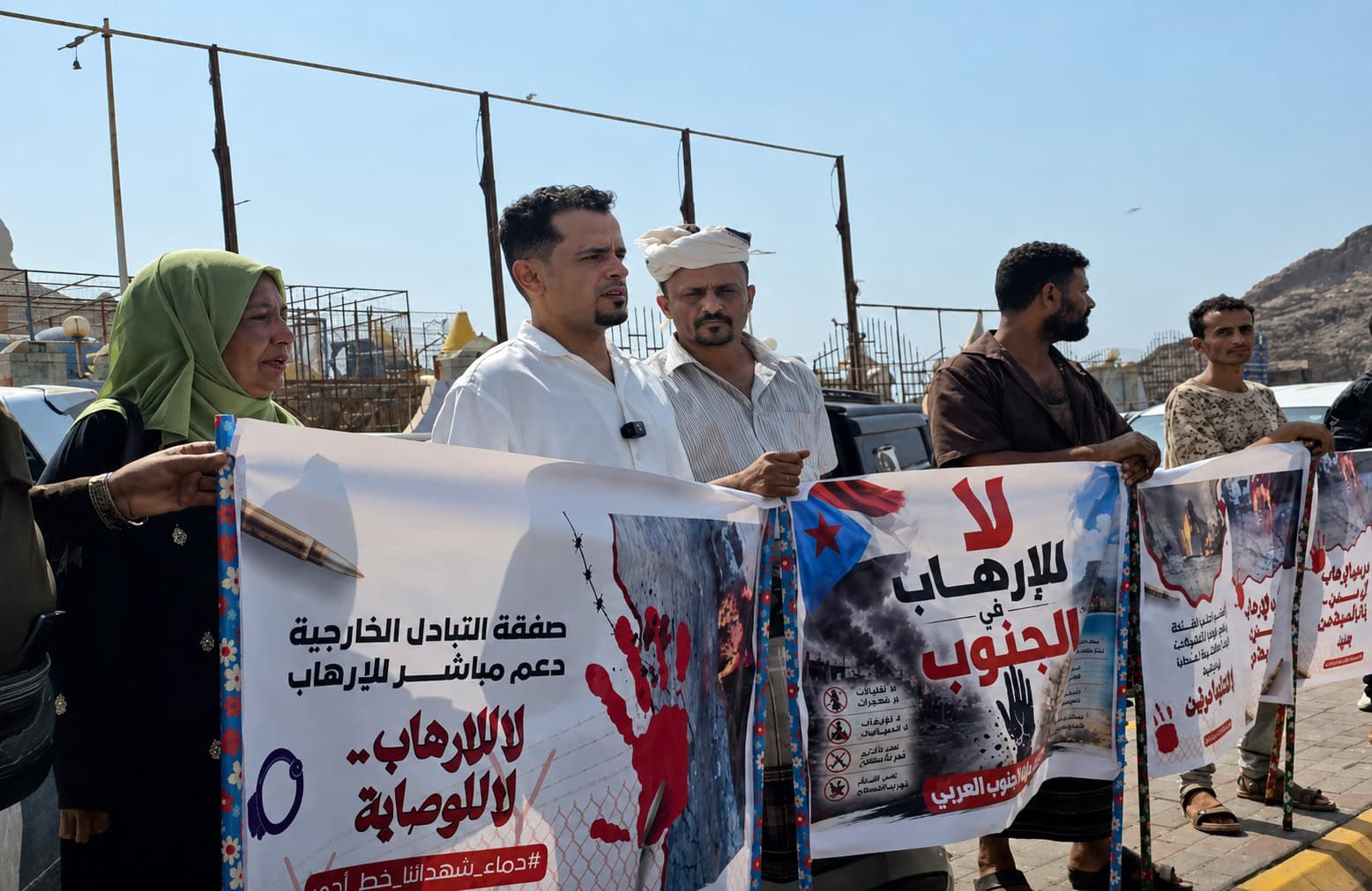
Protesters hold banners outside Al-Maashiq Presidential Palace in Aden, rejecting the possible release of individuals convicted or accused in terrorism cases under a prisoner swap deal. July 7, 2026 (Local activists)
07-07-2026 at 5 PM Aden Time
Aden (South24 Center)
Families of victims of terrorist attacks staged a protest on Tuesday, July 7, outside the gates of Al-Maashiq Presidential Palace in the capital, Aden, rejecting what they described as attempts to include individuals convicted in terrorism cases in a prisoner and detainee exchange deal between the Yemeni government and the Iran-aligned Houthi group.
The protesters raised banners and chanted slogans demanding the enforcement of court rulings issued against those convicted in assassination and bombing cases. They said any move to release such individuals under a political or humanitarian arrangement would undermine the rights of victims and their families, and could pose a direct security threat in government-controlled governorates.
Participants called on the Yemeni government, judicial authorities, the United Nations, and the International Committee of the Red Cross to ensure that individuals convicted of or charged with terrorism-related crimes are excluded from any prisoner exchange arrangements. They stressed that cases involving assassinations, bombings, and attacks on civilians and military commanders should remain under judicial authority and should not be treated as ordinary conflict-related detention files.
The protest comes amid growing controversy over the prisoner and detainee exchange agreement reached in the Jordanian capital, Amman, on May 14, 2026. The deal, negotiated under UN auspices and with the participation of the ICRC, covers more than 1,600 conflict-related detainees, making it the largest arrangement of its kind since the outbreak of Yemen’s current war.
Figures announced by the parties have varied. A government negotiator said the agreement involves around 1,728 detainees from both sides, while Houthi official Abdulqader al-Mortada said the deal includes the release of about 1,100 Houthi-affiliated detainees in exchange for 580 detainees held by the Houthis, including seven Saudis and 20 Sudanese.
The agreement followed 14 weeks of negotiations in Amman and built on earlier discussions held in Muscat, Oman, in December 2025. The detainee file has been one of the most sensitive humanitarian tracks in Yemen’s war since the 2018 Stockholm Agreement, under which the ICRC previously facilitated major release operations in 2020 and 2023.
While the UN and the ICRC have framed the agreement as a humanitarian step aimed at reuniting families and building confidence between the parties, the latest protest in Aden highlights a parallel concern among victims’ families: that the humanitarian track could be used to release individuals implicated in terrorism cases before judicial processes are completed.
The ICRC has repeatedly stressed that its role in the release operation is strictly humanitarian and neutral. It says it does not take part in political negotiations, does not determine who is released, and does not confirm or publish lists of detainees. According to the organization, the parties to the conflict are responsible for determining the names and timing of releases, while the ICRC’s role is limited to verifying identities, confirming detainees’ willingness to be released, conducting medical checks, and facilitating safe and dignified transfers.
On Wednesday, July 1, the Legal and Human Rights Affairs Authority of the Southern Transitional Council warned against including individuals accused of terrorism or links to internationally designated organizations in the exchange deal. The authority said that prisoner exchange agreements are, in principle, legitimate humanitarian measures under international humanitarian law, but warned that such legitimacy would be undermined if the mechanism were used as a cover to release individuals involved in terrorist activities or suspected of links to terrorist organizations.
In its statement, the authority said that including members or affiliates of terrorist organizations in exchange lists would constitute a grave violation of national and international legal obligations. It warned that such a step could facilitate the re-empowerment of these elements and their return to the theater of operations.
The authority also argued that individuals accused of terrorism-related crimes do not enjoy the same legal status as conflict-related detainees covered by humanitarian release arrangements. It said terrorist crimes remain subject to the principle of individual criminal responsibility and must be addressed through judicial procedures.
Citing Yemeni law and international counterterrorism obligations, the authority said political or negotiated arrangements cannot cancel criminal responsibility or suspend the enforcement of penalties except through judicial rulings. It called on the UN and the international community to open an independent and transparent investigation into the criteria used to select names included in the exchange lists, and to ensure that humanitarian tracks are not used as a tool for impunity.
The controversy has been fueled by leaks and reports circulated by media outlets and journalistic sources claiming that individuals convicted of or accused in terrorism cases may be included in the latest exchange lists. No official list of names has been published so far, and South24 Center has not been able to independently verify the leaked names.
The leaks have been linked in particular to the case of those convicted in the assassination of Major General Thabit Muthanna Jawas, former commander of the Al-Anad Military Axis and one of the most prominent anti-Houthi military commanders in South Yemen.
Jawas was killed on March 23, 2022, when a car bomb targeted his convoy in the Al-Madina Al-Khadra area, north of Aden. The attack also killed his son and several of his escorts. Yemeni authorities at the time described the assassination as a terrorist attack, though no group immediately claimed responsibility.
In November 2024, the Specialized Criminal Court in Aden sentenced four people to death after convicting them of involvement in Jawas’ assassination. A fifth defendant was sentenced to ten years in prison. Among those convicted in absentia was former military commander Amjad Khalid, who remains wanted by authorities in Aden.
Authorities and security agencies in Aden accuse Khalid of leading a cell involved in bombings and assassinations, and of receiving financial and logistical support from the Houthis. Khalid has also been linked by Aden authorities to other deadly attacks, including bombings that targeted Aden airport’s gate and the convoy of the Aden governor.