SOUTH24 CENTER FOR NEWS & STUDIES
SOUTH24 CENTER FOR NEWS & STUDIES


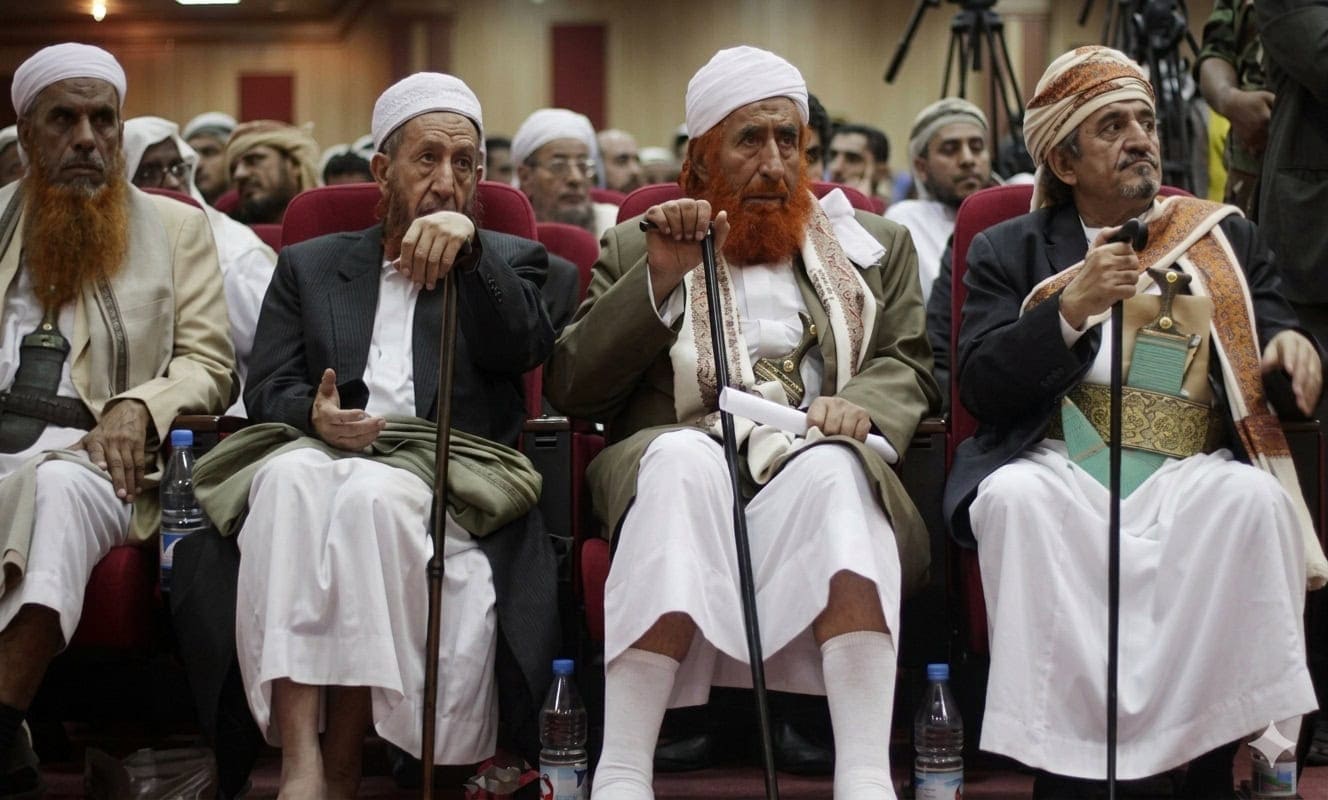
Leaders of the Islah Party in Yemen (the Yemeni branch of the Muslim Brotherhood) (image sourced from the internet)
Last updated on: 05-05-2026 at 8 PM Aden Time

Mohammad Fawzi (South24 Center)
In the current regional context, where Yemen’s conflict increasingly intersects with shifting U.S. priorities in the Middle East, there are growing signals suggesting a possible move by Washington toward designating Yemen’s Islah Party, the local branch of the Muslim Brotherhood, as a terrorist organization. This raises key questions over whether the U.S. administration is moving toward such a designation, or whether these signals are part of broader political pressure aimed at reshaping Yemen’s political landscape. It also raises questions about the potential implications of such a step and its impact on the country’s balance of power.
First: Key Indicators of a Possible U.S. Shift
Recent developments point to several indicators suggesting internal discussions within U.S. policy circles regarding a reassessment of the Islah Party’s status and possibly moving closer to a terrorist designation. These indicators include official actions, regional dynamics, and shifting policy priorities.
1. Review of Islah’s Status
Reports indicate that the United States is conducting a broad review of whether to place the Islah Party and its associated economic and social networks on terrorism designation lists. According to these reports, the party has attempted to leverage its influence within the Yemeni government to frame any potential designation as an obstacle to peace and a complication for humanitarian efforts.
These developments suggest a potential shift in U.S. engagement, from pragmatic cooperation with local actors toward a broader reassessment that extends beyond political considerations to include economic and social structures linked to the party.
2. Designation of Brotherhood Branches
At the beginning of 2026, the U.S. administration designated Brotherhood branches in Egypt, Lebanon, and Jordan as terrorist organizations and imposed sanctions, citing threats to U.S. interests. The Sudanese branch was also designated more recently.
While this approach has been interpreted as selective and case-based, assessing each branch according to its local behavior, it also creates a precedent that could extend to other branches, including Yemen’s Islah Party, if security concerns are deemed sufficient. This reflects a gradual shift in perception from viewing the Brotherhood as a political actor that can be managed to a potential security risk in fragile environments.
3. Domestic U.S. Political Context
In addition to Executive Order 13224 issued under President Donald Trump, which targeted several Brotherhood branches, the states of Texas and Florida have designated the Muslim Brotherhood and the Council of American-Islamic Relations (CAIR) as terrorist entities at the state level.
These developments reflect both longstanding political commitments to limit the influence of Islamist movements and a broader shift in segments of the U.S. political landscape, where concerns about political Islam are increasingly linked to national security. Conservative political currents, advocacy groups, and policy think tanks have further reinforced this direction.
4. Regional Positions
Arab states, including the United Arab Emirates, Saudi Arabia, and Egypt, have long classified the Muslim Brotherhood as a terrorist organization, based primarily on security assessments that view its transnational networks as a source of instability.
This relative regional consensus has contributed to sustained pressure on international actors to reframe the group from a political movement to a security threat. Given Washington’s strategic partnerships with these countries in security, energy, and counterterrorism, this alignment carries increasing weight in U.S. policy considerations.
5. The Yemeni Context
In Yemen, the Islah Party is not only viewed as a branch of the Muslim Brotherhood but also as a domestic political actor accused of tolerating or engaging in patterns of violence and violations on the ground.
The party has struggled to clearly separate its political role from armed dynamics and has at times operated within militia-driven and tribal alliance structures outside formal state institutions, contributing to continued instability.
It has also been accused of leveraging state institutions to expand affiliated networks, raising concerns over governance distortion and weakening institutional state-building.
Second: Possible Scenarios
1. Full Terrorist Designation
This scenario assumes the United States moves to designate the Islah Party in its entirety, based on accumulated security assessments and regional pressure, along with evolving domestic attitudes toward the Muslim Brotherhood.
Such a decision would mark a major strategic shift, redefining Islah from a pragmatic political partner to a security threat requiring containment. It would likely trigger a major restructuring of Yemen’s pro-government bloc and reshape internal alliances and institutional arrangements.
2. Partial or Targeted Designation
This scenario involves a more selective approach, targeting specific individuals, factions, or affiliated entities linked to violence or illicit financing rather than the party as a whole.
This approach aligns with a broader U.S. tendency to use sanctions as a calibrated pressure tool while maintaining political channels. It could push the party toward internal restructuring and clearer separation from ideological affiliations, though it may also deepen internal fragmentation.
3. Maintaining the Status Quo with Designation Threats
Under this scenario, Washington avoids formal designation but continues to use the possibility as leverage to influence behavior and encourage political concessions.
This approach preserves flexibility and reduces strategic risks, but prolonged ambiguity could weaken the credibility of the threat over time if no formal steps follow.
In conclusion, the current trajectory suggests a growing trust deficit and a shift away from purely pragmatic engagement with Yemen’s Islah Party. Any potential designation would represent more than a legal step; it would signal a structural change in Washington’s approach to Yemen.
Such a shift would redefine Islah from a political actor into a security liability, potentially reshaping Yemen’s broader political and military landscape.
For the party itself, the implications would be significant, including increased isolation, financial restrictions, and internal pressure between pragmatic and hardline factions, potentially affecting its cohesion over time.