SOUTH24 CENTER FOR NEWS & STUDIES
SOUTH24 CENTER FOR NEWS & STUDIES


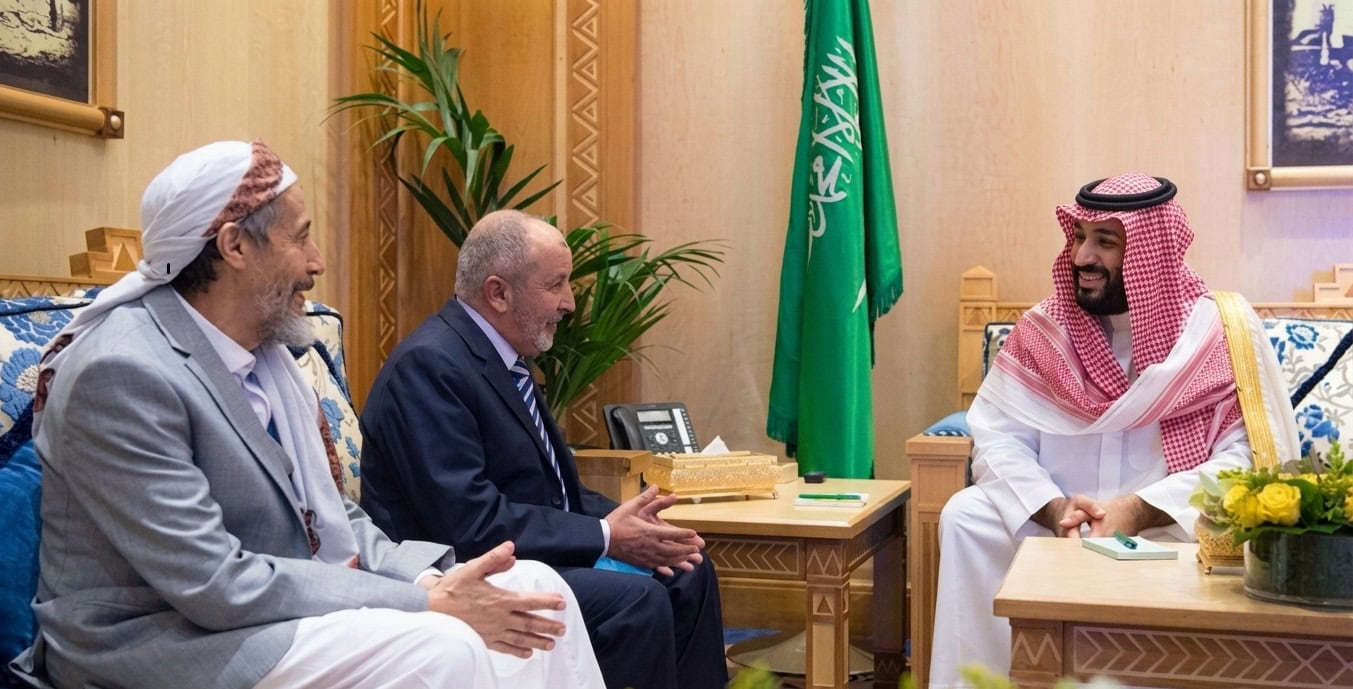
Saudi Crown Prince Mohammed bin Salman meets with the head of the High Authority of the Islah Party in Riyadh, Saudi Arabia, on November 9, 2017. (Photo: Al-Islah – Handout)
Last updated on: 30-04-2026 at 9 AM Aden Time

“A more coherent strategy for Riyadh would be to recognize the STC as an indispensable—if imperfect—actor. It should simultaneously reduce reliance on ideologically ambiguous partners, and most importantly, align the Yemen policy with Saudi Arabia’s broader regional stance.”
Dr. Abdul Galil Shaif
Saudi Arabia may be making a strategic mistake in Yemen, one that risks empowering the very forces it has long opposed. In the south of the country, efforts to sideline the Southern Transitional Council (STC) are currently reshaping the political landscape. The likely beneficiary is not a neutral or technocratic authority, but the Al-Islah Party, a movement widely associated with the Muslim Brotherhood and long embedded within Yemen’s internationally recognized government. That should raise alarms in Riyadh.
The STC has had its own flaws. It is in the meantime internally divided and possibly disorganized as a consequence of Saudi intervention, its governance record is questionable, and its push for southern independence complicates Saudi Arabia’s stated objective of preserving Yemeni unity. But it is also one of the few organized forces in southern Yemen with meaningful local support, functioning security structures, and a consistent stance against Islamist political expansion. Undermining it without a credible alternative is not strategy, it is a huge gamble.
Since the 2019 Riyadh Agreement, Saudi policy has focused on holding the anti-Houthi coalition together, often at the expense of coherence. This has required accommodating factions linked to Islah, despite the Kingdom’s broader regional opposition to Muslim Brotherhood–aligned movements. As the International Crisis Group has repeatedly noted, the agreement has failed to produce unified command structures or durable governance arrangements. The result is a contradiction at the heart of Saudi policy: countering Islamist influence regionally while tolerating—and in some cases enabling—it within Yemen.
Recent developments in Hadramout illustrate how this contradiction is playing out. STC-aligned forces have expanded their presence in parts of the governorate, clashing with government-aligned units, some of which have ties to Islah. Saudi Arabia decided to oppose the expansion of the STC and used its air force to push them back and out of Hadramout. Yemen’s recent history offers a clear warning. Islamist networks expanded significantly following unification in 1990 and during the 1994 civil war, embedding themselves within state institutions. As analysis from the Carnegie Middle East Center shows, these networks have proven highly adaptive and capable of exploiting state weakness.
Al-Islah itself has long been intertwined with Saudi policy. It has been a major political actor since unification and has maintained close ties with Riyadh, particularly during the war against the Houthis. That pattern now risks repeating itself under far more dangerous international conditions. What makes this moment more consequential is the shifting international posture toward Muslim Brotherhood–linked movements—especially in the United States. Notably, Washington has not designated the Muslim Brotherhood as a whole as a Foreign Terrorist Organization. But policy is clearly moving in that direction. In 2025–2026, the U.S. began designating specific Brotherhood branches as terrorist organizations and initiated broader designation processes. Congress has repeatedly introduced legislation such as the Muslim Brotherhood Terrorist Designation Act. Most significantly, in April 2026, Washington began formally reviewing whether to designate Yemen’s Islah party and over 160 affiliated entities.
Even before formal designation, the U.S. is already entangled in a contradiction of its own: working with a Yemeni government that includes Islah figures while simultaneously increasing scrutiny of Brotherhood-linked networks. As one recent analysis notes, the United States has effectively found itself “on the same side” as Islah within Yemen’s anti-Houthi coalition. This ambiguity is unlikely to last. This is where the risks for Saudi Arabia begin to multiply—and extend far beyond Yemen.
Saudi Arabia’s Growing Strategic Exposure
1. Strains with the United States and Western Allies
Saudi Arabia officially designated the Muslim Brotherhood as a terrorist organization in 2014. Yet its Yemen policy increasingly depends on actors linked to that same network. This contradiction is no longer going unnoticed in Washington. Recent discussions between U.S. lawmakers and Saudi officials have already raised concerns about Riyadh’s cooperation with Islah-linked actors. If the U.S. moves toward formal designation or expanded sanctions, it could cause some headache for Riyadh. For one, Saudi-backed Yemeni institutions could come under scrutiny; secondly, intelligence and counterterrorism cooperation between the US and Riyadh could face new political conditions; and thirdly, financial networks linked to coalition actors could be restricted or investigated. In effect, Saudi Arabia risks being caught between its Yemen strategy and its most important security partner.
2. Friction with Regional Allies—Especially the UAE
The United Arab Emirates—Saudi Arabia’s closest regional partner—takes a far harder line on the Muslim Brotherhood and has already designated it a terrorist organization. This divergence is not theoretical. It has already produced tensions on the ground in Yemen, where UAE-backed STC forces have directly clashed with Islah-aligned units. Analysts note that Yemen has contributed to a widening strategic gap between Riyadh and Abu Dhabi. If Saudi policy continues to empower Islah, the Saudi–UAE coordination could weaken further, the proxy conflicts in southern Yemen could intensify, and worse, the Coalition coherence against the Houthis could erode
3. Openings for Regional Rivals
Saudi Arabia’s inconsistency also creates opportunities for its rivals. Iran stands to benefit from fragmentation within the anti-Houthi coalition, while Qatar and Turkey, both historically more sympathetic to Brotherhood-linked movements, may find greater room to expand influence. Importantly, Islamist networks themselves thrive in precisely these fragmented, ambiguous environments. In other words, what begins as a tactical compromise in Yemen risks becoming a broader strategic vulnerability.
The uncomfortable reality is this: the STC may not align with Saudi Arabia’s long-term vision for Yemen, but excluding it from the political equation does not produce a more stable or more moderate South. It risks producing the opposite. A vacuum in southern Yemen will not remain empty. It will be filled—most likely by actors with stronger ideological organization, deeper networks, and greater political discipline. That is precisely the environment in which Muslim Brotherhood–linked movements have historically thrived.
Saudi Arabia’s Yemen policy is no longer just a local or regional issue. It is increasingly tied to -- the U.S.’ counterterrorism policy, to Gulf rivalries, and to the broader future of political Islam in the region. Keeping this in mind, a more coherent strategy for Riyadh would be to recognize the STC as an indispensable—if imperfect—actor. It should simultaneously reduce reliance on ideologically ambiguous partners, and most importantly, align the Yemen policy with Saudi Arabia’s broader regional stance.
While there is still time to adjust course, doing so would require acknowledging a simple reality: that contradictions in foreign policy do not remain contained. They expand—reshaping alliances, empowering rivals, and creating risks that are far harder to control. And in Yemen’s South, that is a risk Saudi Arabia can ill afford.