SOUTH24 CENTER FOR NEWS & STUDIES
SOUTH24 CENTER FOR NEWS & STUDIES


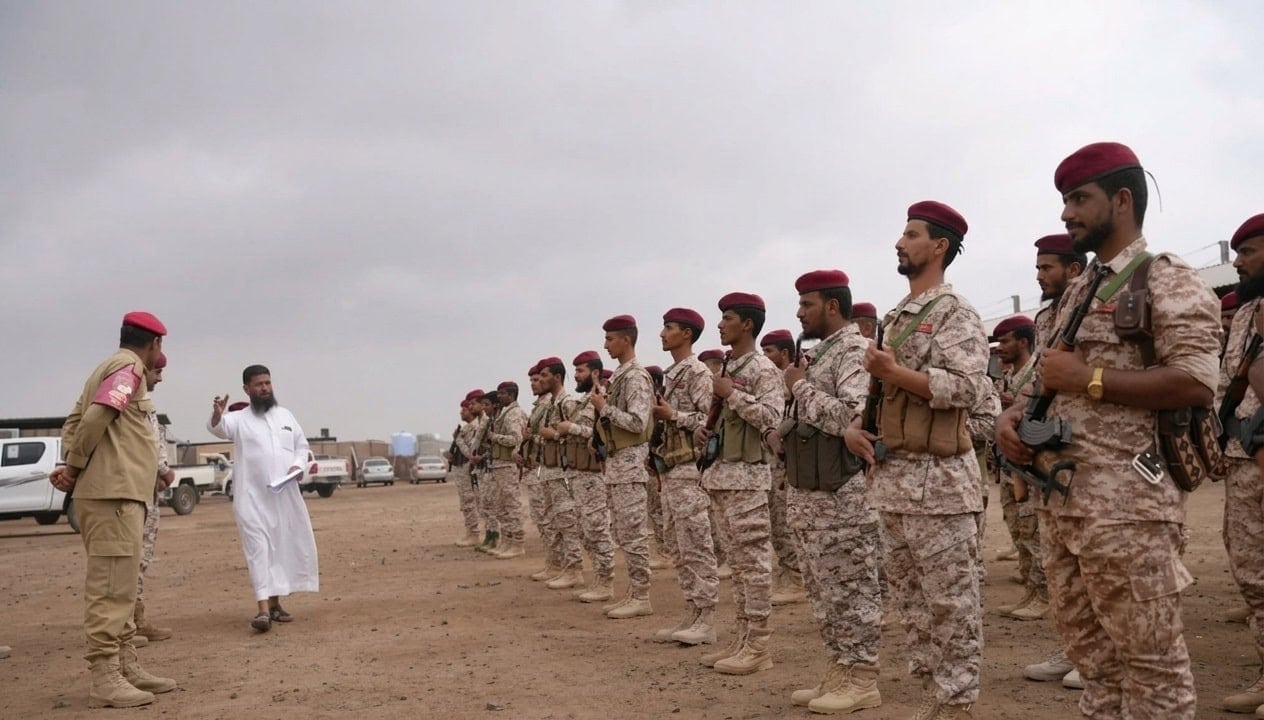
Military police forces affiliated with the Nation’s Shield review their readiness in the capital, Aden, April 9, 2026 (official Nation’s Shield Forces Facebook page).
Last updated on: 30-04-2026 at 11 AM Aden Time

Abdullah Al-Shadli (South24 Center)
Since December 2025, military and security dynamics in South Yemen have entered a new phase. With the launch of Operation “Promising Future” and the advance of Southern Forces into Wadi Hadramout and Al-Mahra, the balance of power appeared to be shifting toward consolidating the influence of Southern Forces. These forces have accumulated significant combat and security experience since 2015 and have been politically organized under the Southern Transitional Council (STC) since 2017.
However, this trajectory quickly took a sharp turn in early January 2026, as developments on the ground intersected with new variables that reshaped the balance of power. Most notably, Southern Forces withdrew from the two governorates under pressure from Saudi strikes.
These changes extended deep into the military and security structures across other governorates. In Shabwa, experienced Southern units were withdrawn from active frontlines and replaced with alternative formations, sparking debate over operational readiness versus redistribution priorities. In Hadramout, the measures affected security and military units involved in counterterrorism efforts since the liberation of Mukalla. Meanwhile, Aden entered an advanced phase of wide-ranging security restructuring, including the merger of several forces into a new body under Yemen’s Ministry of Interior.
Yet these transformations have not been one-directional. Alongside concerns about the redistribution of power at the expense of certain Southern formations, there are parallel indications of attempts to contain the impact of these changes and preserve the cohesion of southern military structures, albeit at a reduced but still tangible level. Committees have been formed to address the status of affected units, such as the Barasheed Brigade. At the same time, steps have begun to integrate local forces, including units from the Hadrami Elite Forces and Security Support Forces, into formal security frameworks in Hadramout, following months of marginalization and dismissal. Some observers interpret this as part of a broader institutional reorganization effort.
Amid these overlapping dynamics, a more complex picture is appearing. The ongoing changes reflect a mix of structural reorganization and efforts to reassert control on one hand, and a redistribution of influence on the other. This places South Yemen at a sensitive juncture, where the trajectory remains uncertain, between the possibility of building a more cohesive military and security system and the risk of an imbalanced restructuring that could reproduce tensions in new forms.
How has the balance of power changed since early 2026?
The transformations in South Yemen since January 2026 go beyond the mere redeployment of forces; they represent a broader shift in how the military and security landscape is being managed.
Following the withdrawal of Southern Forces from Hadramout and Al-Mahra, restructuring efforts expanded into Aden, Shabwa, Lahj, and Abyan through a gradual process. This included the reclassification of local formations, renumbering, biometric registration, and personnel audits conducted by Saudi-supervised committees responsible for salary disbursement. This process was accompanied by an expanded deployment of “Nation’s Shield” forces across these governorates.
In Aden, changes began with a series of decisions and measures. Units of the Security Belt Forces, originally established with direct Emirati support, were reclassified under the designation “National Security Forces,” with plans to integrate them into the “Special Security Forces” under the Ministry of Interior as a unified umbrella. This framework also includes the Aden Security Emergency Forces and the Aden Perimeter Forces, responsible for securing entry and exit points. These steps were accompanied by the appointment of Major General Abdulsalam Al-Jamali as overall commander and Brigadier Jalal Al-Rubaie as commander in the capital, Aden.
Following these decisions, along with others appointing new leadership for National Security Forces in Abyan and Southern military brigades, a phase of operational adjustments began. Units were redeployed within Aden’s districts, several checkpoints were relocated, and authorities repeatedly announced plans to relocate military camps and heavy weaponry outside the city, leaving the new force focused solely on internal security tasks.
Despite these commitments, military units affiliated with Nation’s Shield continued to arrive at Saudi-supervised camps in Aden, such as Al-Shaab Camp and Salah Al-Din Base, through January and February.
Aden and its surroundings have since witnessed a gradual deployment of Nation’s Shield forces, particularly at the city’s northern entrances, including the Al-Rabat area, around Al-Anad Air Base in Lahj, and along key routes linking Aden to neighboring governorates.
During the same period, Nation’s Shield forces underwent leadership restructuring. Bassam Al-Mehdhar was appointed commander, and Abdulrahman Al-Lahji as chief of staff, replacing former commander Bashir Al-Subaihi, who, according to informed sources, had refused to engage Southern Forces in Hadramout during December and early January. These changes coincided with the graduation of new recruits from training sites, including Al-Abr, located between Hadramout and Saudi Arabia.
The reconfiguration of the balance of power also extended to some of the most sensitive units in Aden, particularly those linked to the STC’s military decision-making center. In January, a notable turning point occurred when the Storm Forces and Presidential Protection units affiliated with the STC withdrew from Aden’s districts, replaced by deployments of the Giants Brigades and Nation’s Shield forces.
This coincided with another track involving biometric registration, financial auditing, and personnel tracking of various Southern formations under Saudi supervision. Salary payments were tied to updated personnel records, effectively transforming payroll from an administrative function into a tool of influence over force structures.
In Shabwa, changes became visible along frontline areas. In March 2026, the Giants Brigades withdrew from the Harib front and were replaced by Shabwa Defense Forces under direct Saudi supervision. This included repositioning forces along the Harib–Bayhan axis and linking them to new field command structures.
Saudi forces also assumed control of the Murra military base in Shabwa from Emirati forces earlier in the year. From this base, Saudi military representative Musleh Al-Otaibi oversees arrangements in the governorate, while Falah Al-Shahrani supervises broader coordination across Aden and other areas.
In Hadramout, developments took on a gradual but clear operational pattern, reflecting a reshaping of the internal balance of power. Recent months have seen the return of northern troops from the First Military Region and their regrouping in Wadi Hadramout within brigades that had previously been expelled by Southern Forces in December.
Prior to this, several decisions were issued appointing new leadership for both the First and Second Military Regions, including figures close to Saudi Arabia. Among them was Fahd Bamoumen, commander of the second division of Nation’s Shield forces, who was also appointed commander of the First Military Region.
At the same time, northern emergency forces have remained present in Wadi Hadramout, despite earlier Saudi commitments to withdraw them and allow local forces from Hadramout and Al-Mahra to take over security responsibilities.
These developments were accompanied by measures targeting key security formations. Hundreds of officers and personnel from the Barasheed Brigade, one of the most prominent units involved in counterterrorism operations alongside the Hadrami Elite Forces since 2016, were dismissed. Similar measures affected members of the Security Support Forces through exclusion or reclassification, often on regional grounds, particularly targeting (Southern personnel from outside Hadramout).
In parallel, a process was announced to integrate remaining Hadrami personnel from the Hadrami Elite Forces and Security Support Forces into official security structures in Wadi and Desert Hadramout under the Ministry of Interior. However, this process has raised political concerns, notably from STC Vice President Faraj Al-Bahsani, who stressed the importance of maintaining the cohesion of the Hadrami Elite Forces and warned that weakening them could negatively affect security stability in the governorate. Al-Bahsani, a former governor of Hadramout and commander of the Second Military Region, played a key role in leading operations against Al-Qaeda in 2016.
A Single Dominant Actor
Southern journalist Abdulqader Al-Anqari argues that Saudi Arabia has become the “sole primary actor” in the military and security landscape of South Yemen, overseeing its restructuring in line with its strategic calculations, whether to curb the influence of the STC or prepare for a potential confrontation with the Houthis should the political process fail.
He told South24: “What is happening may partly be understood as force redistribution in preparation for a possible confrontation with the Houthis, but the indicators go beyond that, reflecting a parallel process of reshaping the Southern landscape.”
From another perspective, political activist Mahdi Al-Khalifi argues that what is described as repositioning “cannot be viewed as a routine military measure,” but rather as part of a broader political decision. He adds that these movements may represent “a redistribution of power at the expense of certain Southern formations,” placing them within a broader context of reengineering influence rather than simply improving field performance.
Officially, these steps are presented as part of a reform process aimed at restructuring military and security forces in South Yemen under Saudi sponsorship and integrating them into the Ministries of Defense and Interior. In principle, this direction appears logical and necessary for enabling the Yemeni government and the Presidential Leadership Council to operate within a more coherent institutional framework. However, field-level analysis reveals a more complex reality.
This process includes attempts at institutional recalibration, carrying potential political implications for the Southern cause, which has long rested on three pillars: the political entity (the STC), military power (Southern Forces), and a strong social base (the Southern population). As efforts to weaken the STC continue and the distinct identity of Southern Forces erodes, the risks facing the South appear greater than ever.
Next article