SOUTH24 CENTER FOR NEWS & STUDIES
SOUTH24 CENTER FOR NEWS & STUDIES


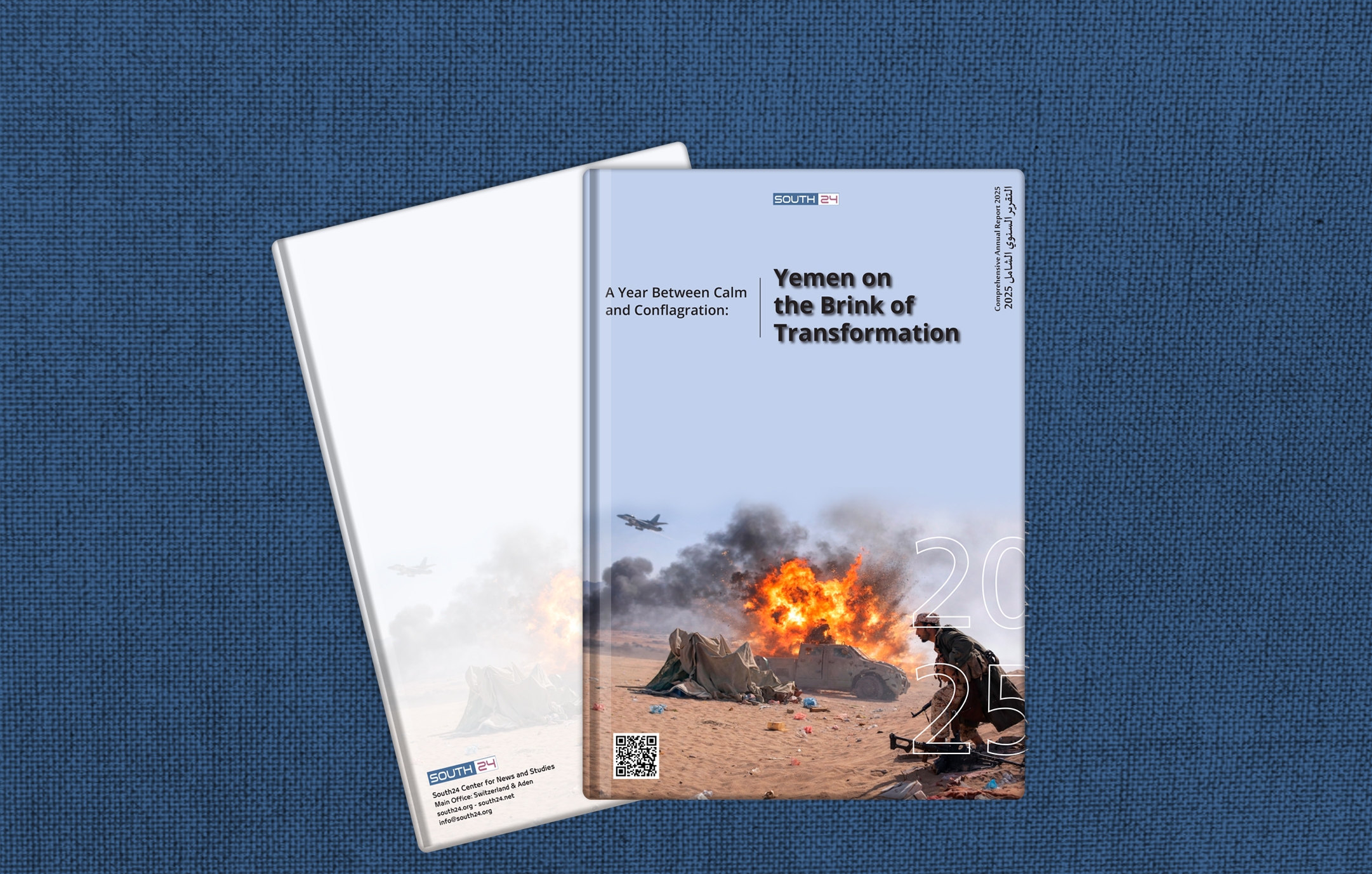
Cover of the Comprehensive Annual Report, Ahmed Al-Banna, South24 Center
Last updated on: 10-02-2026 at 1 PM Aden Time

South24 Center | Aden
The comprehensive 2025 Annual Report issued by the South24 Center for News and Studies, titled “A Year Between Calm and Conflagration: Yemen on the Brink of Transformation,” presents a portrait of a country advancing precariously toward change under the weight of overlapping crises. Political, security, economic, and humanitarian dynamics became increasingly intertwined, while the conflict continued to be managed through a logic of “containment” rather than moving toward a comprehensive settlement.
Although most months of the year were marked by a fragile de-escalation, 2025 concluded with what the report describes as a “relatively explosive ending,” following Saudi intervention in South Yemen, particularly in Hadramout and Al-Mahra. This intervention evolved into a direct test of the limits of influence both within and beyond the internationally recognized government’s camp, opening the door to new political and security arrangements at the beginning of 2026.
Prepared by a select group of South24 researchers, the annual report is structured around four main pillars, political, security and military, economic, and humanitarian. It analytically examines hundreds of documented developments across Yemen throughout the year, offering an integrated and authoritative reference for understanding the country’s evolving landscape. The report also includes an overview and statistical data on South24 Center’s activities in 2025, highlighting the strategic, journalistic, and training efforts undertaken by its team during the year.
First: The Political Track
According to the report, the political structure of the internationally recognized government remained “fragile” throughout 2025, as dysfunction within the Presidential Leadership Council deepened and the government’s capacity to manage public services and economic files declined. This further eroded public trust and left the political landscape exposed to successive crises rather than a stable reform-oriented trajectory.
Conversely, the Southern Transitional Council (STC), the report concludes, gradually shifted from a strategy of political pressure to one of “imposing facts on the ground,” with particular focus on Hadramout and Al-Mahra, driven by a growing conviction that prospects for a post-2019 political settlement had significantly diminished.
At the UN and international level, the report notes that the UN Special Envoy to Yemen delivered a total of 12 briefings to the Security Council during 2025, including four closed sessions, an indication of increasing complexity and the extent to which the conflict has become entangled with regional and international dynamics beyond Yemen’s internal arena.
The report also documents heightened international diplomatic activity, including a ministerial meeting held in New York on January 21, 2025, attended by the United Kingdom and more than 35 countries, which concluded with a joint statement reaffirming support for the Presidential Leadership Council (PLC).
On the detainees file, the report states that negotiations hosted in Muscat, on December 23, 2025, led to a prisoner exchange agreement providing for the release of 1,700 Houthi detainees in exchange for 1,200 government-affiliated personnel, including seven Saudis and 23 Sudanese nationals.
The peak of political transformation, as reflected in the report, came in December, when “political tensions reached their apex” amid escalating rifts within the pro-government camp. Hadramout and Al-Mahra became testing grounds for competing spheres of influence, narrowing the STC’s political maneuvering space and paving the way for a new Saudi-led approach.
The report concludes that the gap between the STC’s calculations and Riyadh’s approach to managing the South file widened toward the end of the year, culminating in direct Saudi intervention that reshaped the political and security landscape in South Yemen, particularly following the United Arab Emirates’ withdrawal from the area.
Second: The Security and Military Track
According to the report, 2025 unfolded under what it describes as an “unstable military de-escalation”, neither full-scale war nor sustainable peace. Attritional fighting persisted along internal frontlines, while the Houthis’ expanding regional role in maritime and aerial operations against Israel and the United States intensified. This escalation led to the group’s designation as an international terrorist organization and triggered an unprecedented aerial military campaign accompanied by waves of intense airstrikes, carrying far-reaching economic, humanitarian, and security repercussions.
In connection with airstrikes linked to the regional escalation, the report provides detailed casualty figures. It states that U.S. airstrikes against Houthi targets during the year resulted in 212 fatalities and 294 injuries, while Israeli strikes caused 21 deaths and 226 injuries. Citing UN sources, the report highlights two prominent incidents: an airstrike on Hodeida on April 17 that killed 84 people and wounded 150 others, and another strike on Saada on April 28 that resulted in 68 fatalities and 47 injuries.
By contrast, the military landscape inside Yemen throughout 2025 was characterized by limited engagements across various frontlines, both between Southern Armed Forces and Houthi militias, and on northern fronts between the Houthis and forces aligned with the internationally recognized government.
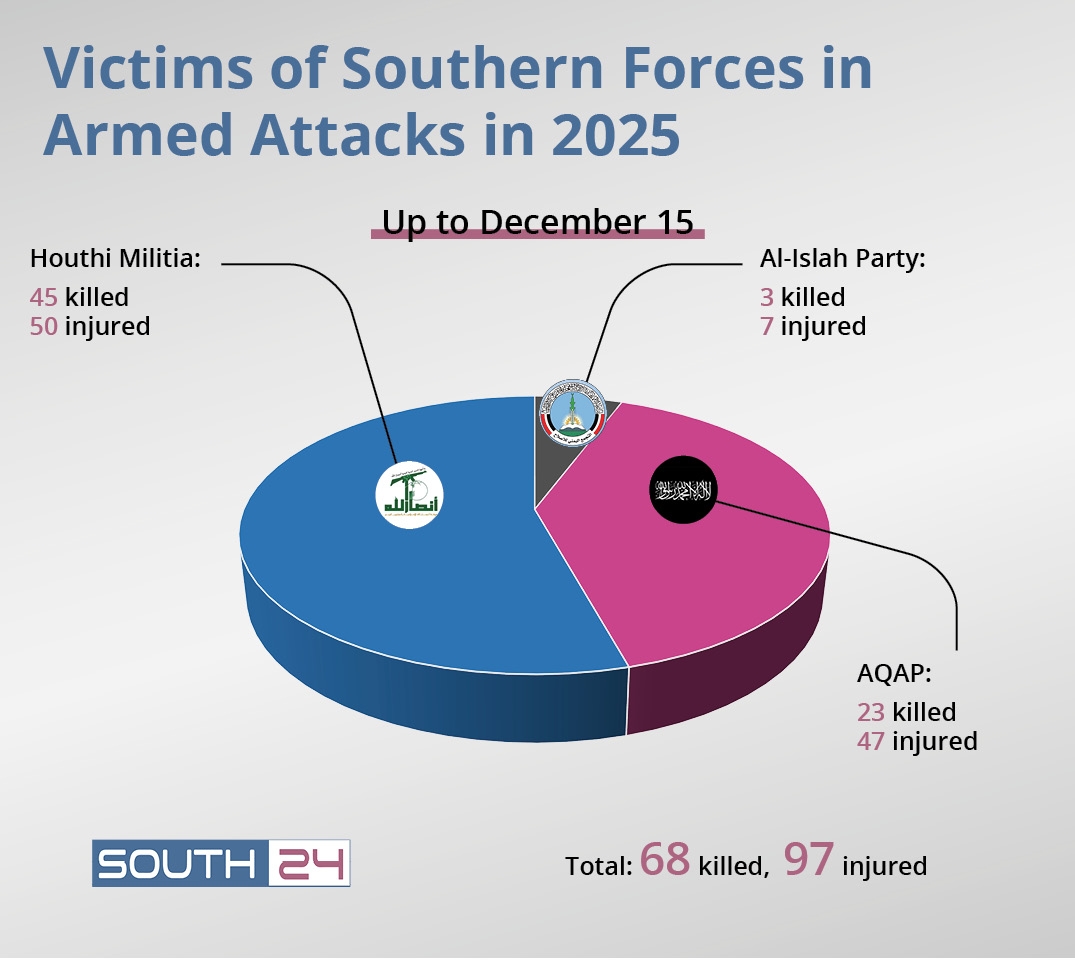
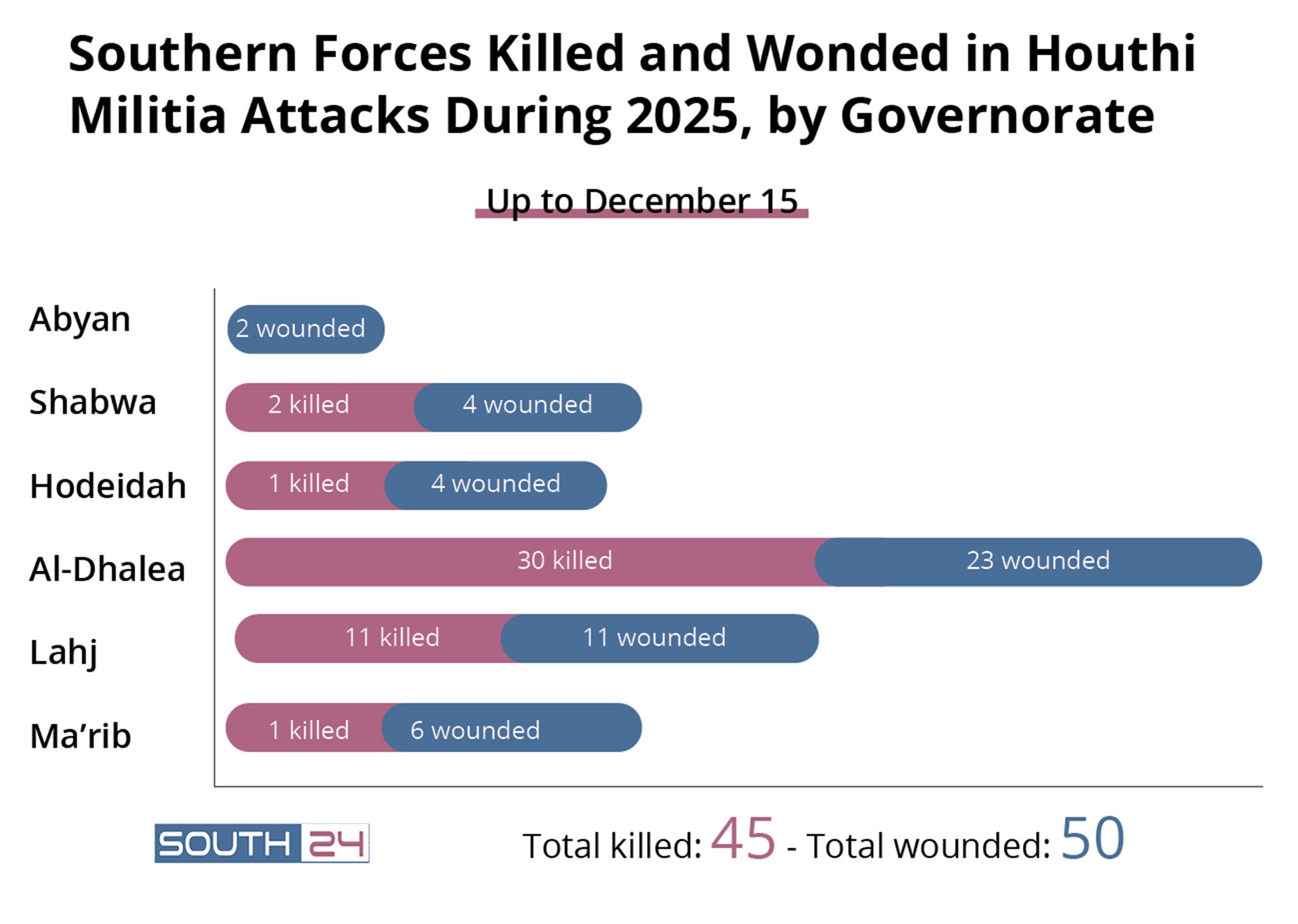
The report documents that, from the beginning of 2025 until December 15, Houthi militia carried out 58 attacks against the Southern Armed Forces across several governorates. Al-Dhalea was the most heavily affected, accounting for 33 attacks, followed by Lahj with 15 attacks, Shabwa with four, Abyan with two, as well as Hodeida and Ma’rib with two attacks each against southern forces deployed there.
These attacks resulted in the deaths of 45 soldiers and injuries to 50 others. Al-Dhalea recorded the highest casualty toll, with 30 killed and 23 wounded.
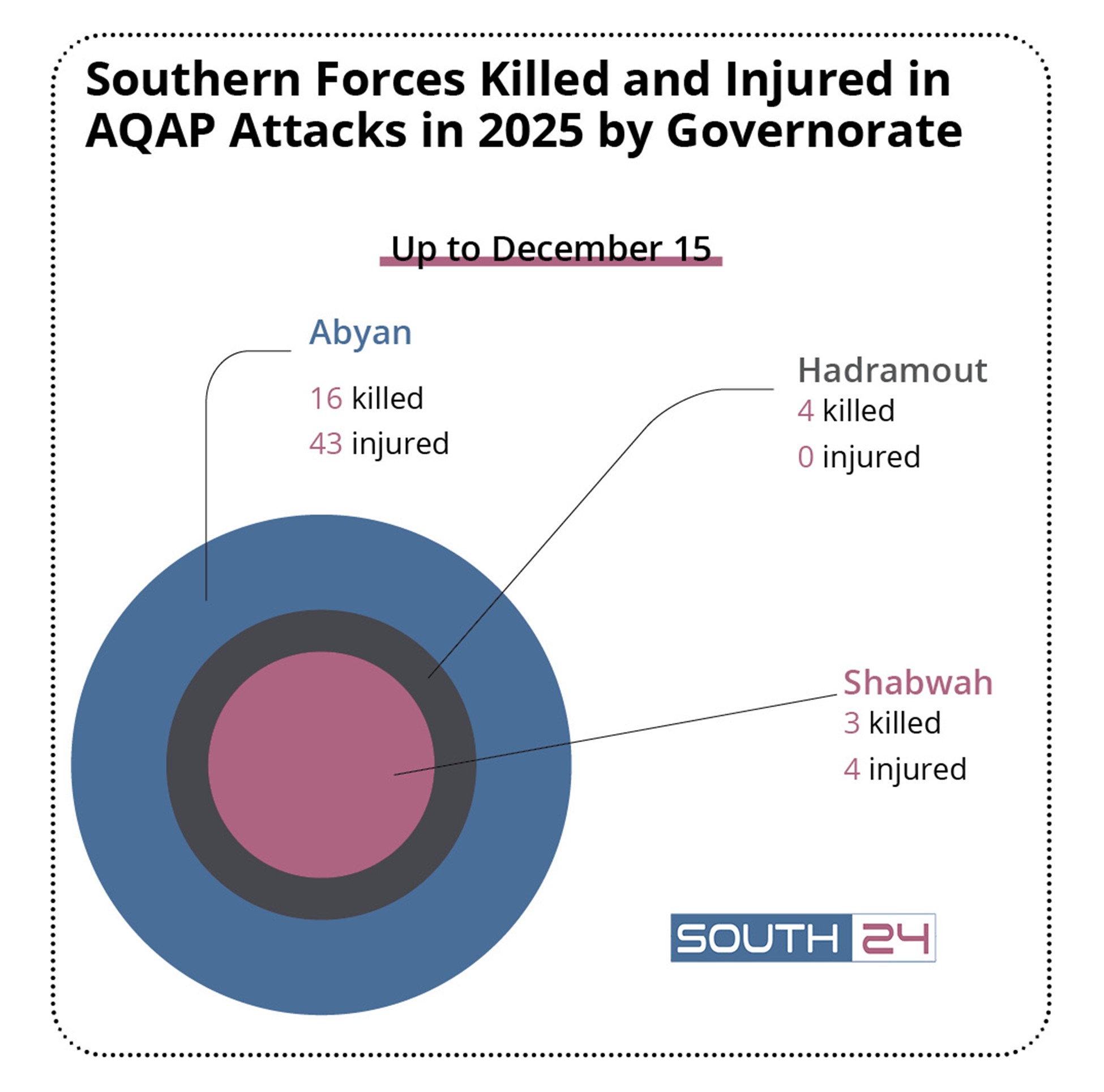
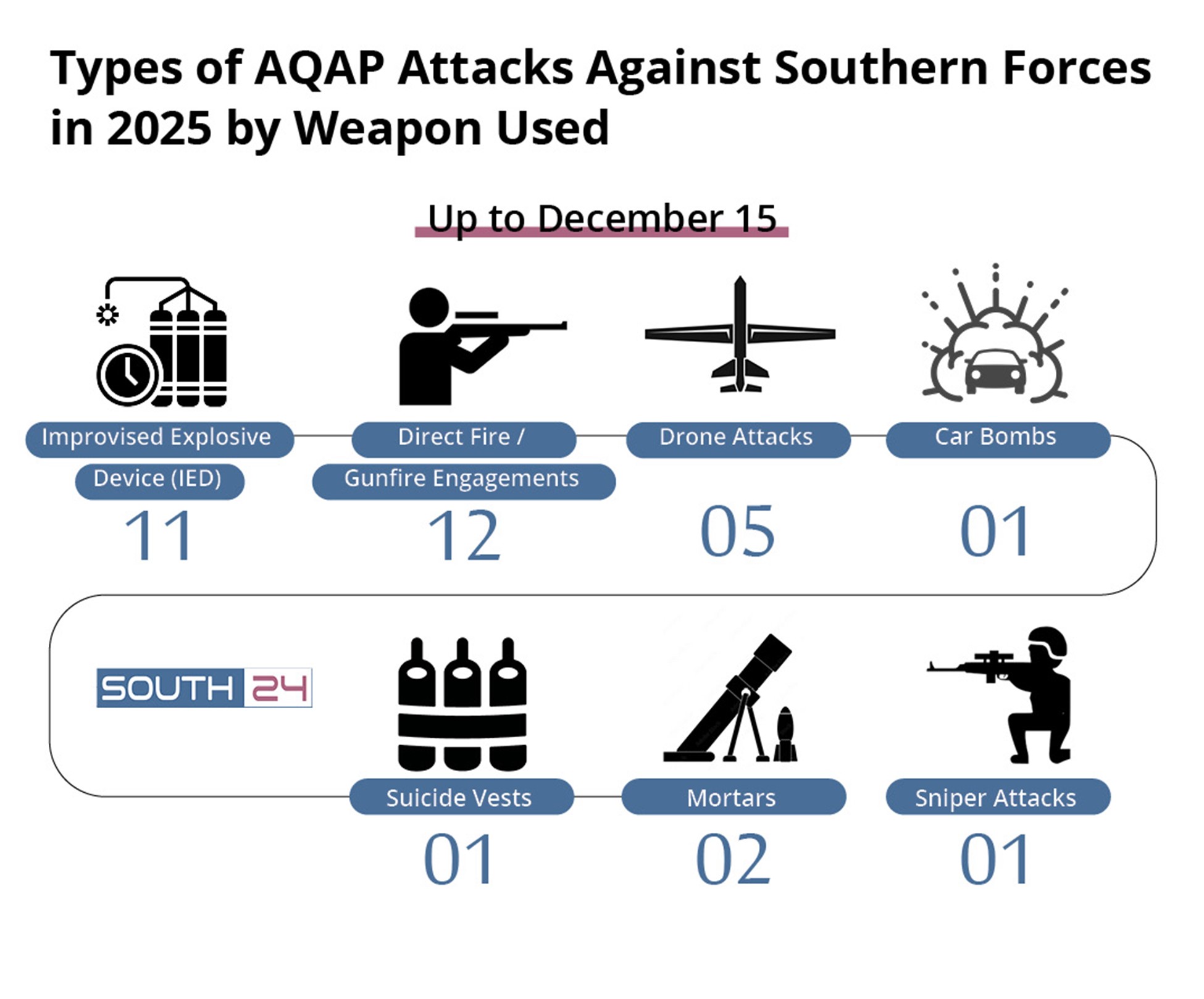
On terrorism-related developments, the report states that Al-Qaeda in the Arabian Peninsula (AQAP) carried out 31 attacks during 2025, resulting in 70 casualties killed or wounded, with a clear concentration in the governorates of Abyan, Shabwa, and Hadramout. According to the report, the group relied primarily on direct armed clashes in 12 attacks, followed by the use of improvised explosive devices in 11 attacks. Drones were used in five operations, in addition to limited use of car bombs, suicide belts, mortars, and sniper attacks.
With the United Arab Emirates’ withdrawal from Yemen’s counterterrorism file on January 2, 2026, amid tensions with Saudi Arabia and recent developments in Hadramout and Al-Mahra, the report warns that the counterterrorism effort, previously led by Abu Dhabi in partnership with southern forces, is entering a particularly dangerous phase. The report cautions of a potential resurgence of AQAP influence in South Yemen.
The defining southern turning point that closed the year, according to the report, was the late-2025 operation to assert control over Hadramout’s Wadi and Desert areas, and Al-Mahra.
This move encountered what the report describes as a “decisive Saudi stance,” manifested into airstrikes and direct intervention.
The developments ended with the redeployment and subsequent withdrawal of southern forces in early January 2026, alongside the initiation of new security arrangements in and around Aden.
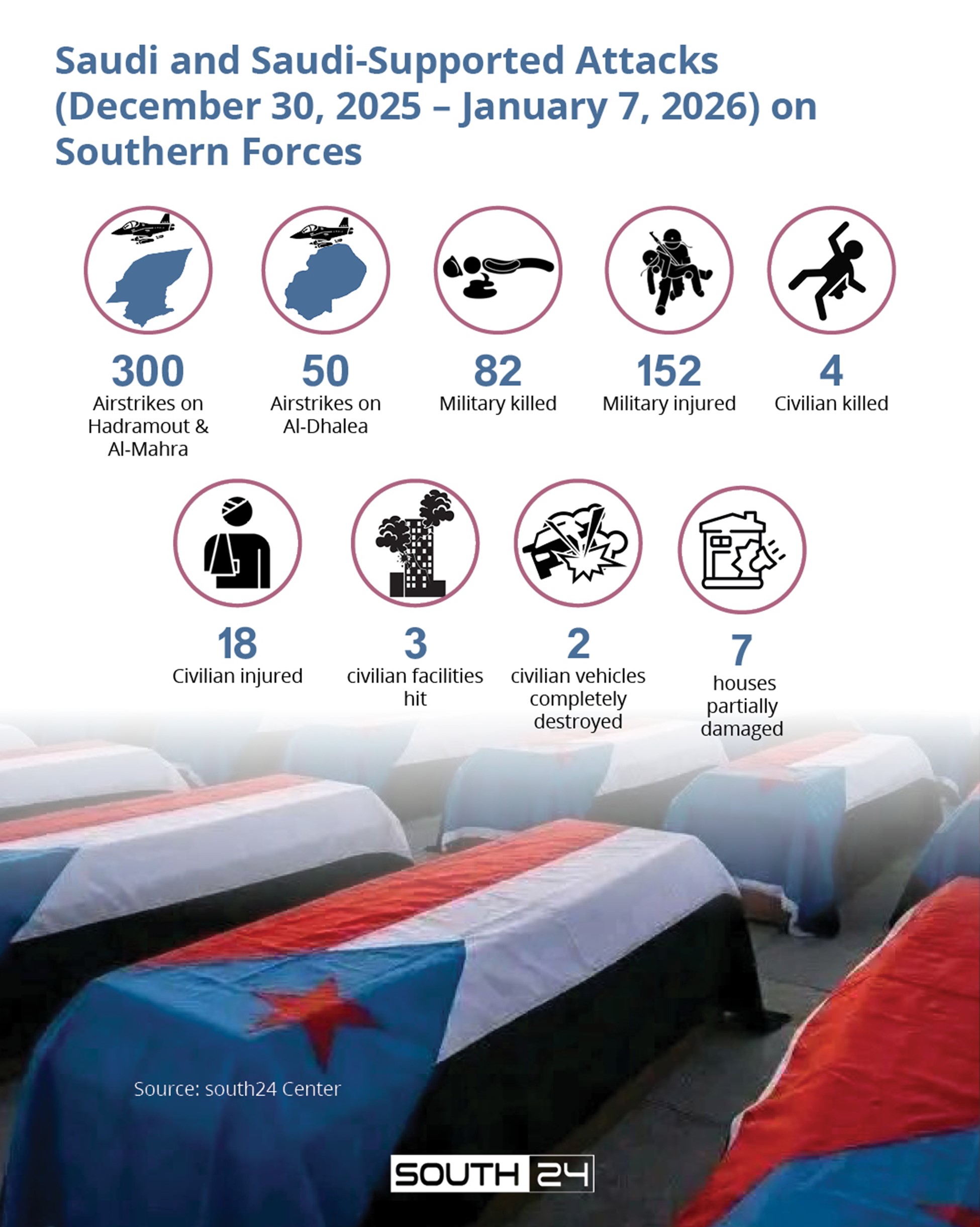
In this context, the report cites the Southern Armed Forces as stating that the Saudi Air Force carried out more than 350 airstrikes between December 27, 2025, and January 7, 2026, resulting in 80 military fatalities and 152 wounded, in addition to four civilian deaths and 18 civilian injuries.
Third: The Economic Track
The report assesses 2025 as a year marked by “unprecedented” economic turbulence, in which currency collapse coincided with inflows of external support and development projects of “limited structural impact.” Meanwhile, the economy continued to suffer from severe revenue constraints, the suspension of oil exports, and an expanding fiscal deficit.
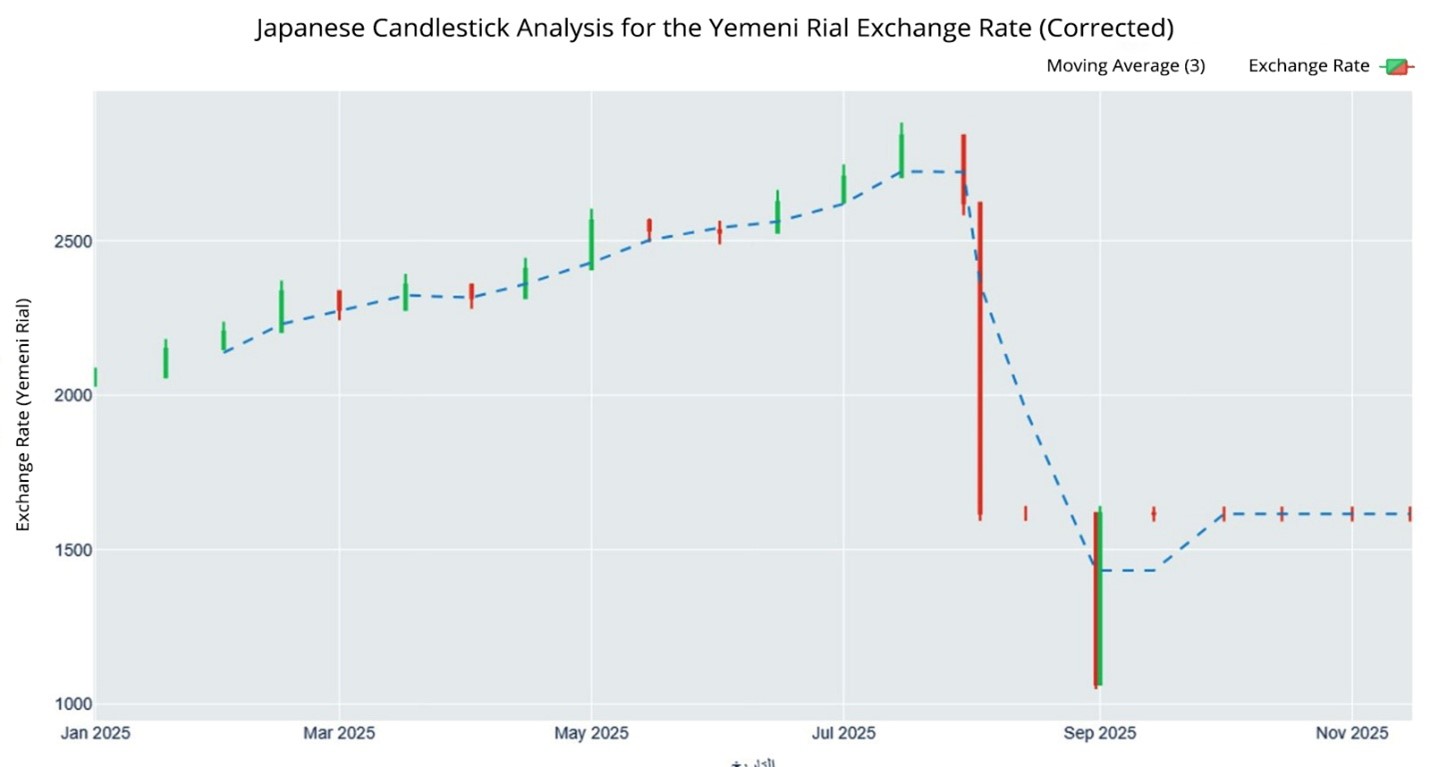
The report provides figures illustrating the trajectory of the currency in government-controlled areas. The exchange rate stood at 2,058 Yemeni rials per U.S. dollar at the start of the year, rising to 2,336 in March, 2,840 in July, before reversing course and entering a phase of “relative stability” in August at 1,617, conditional on external support and monetary policy measures.
Regarding monetary policy tools, the report notes that the Central Bank of Yemen in Aden conducted a total of 18 foreign currency auctions during 2025, with an aggregate value of approximately USD 2 billion to finance the import of essential commodities. It also points to regulatory actions targeting exchange companies, including the suspension of licenses for 83 firms in Aden over the course of the year.
On external support, the report cites several funding and aid commitments, including the United Arab Emirates’ announcement of 1 billion USD in support for renewable energy projects, as well as Saudi funding amounting to 1.38 billion SAR to finance service and development projects in Yemen. This was complemented by approximately 79 million USD in British assistance to counter food insecurity, in addition to more limited contributions from the European Union, the United States, Japan, and South Korea.
By contrast, the report highlights additional burdens on Yemen’s economy linked to maritime escalation, noting that the Houthis imposed fees on shipping companies amounting to as much as 180 million USD, an indicator of the rising cost of the war economy on trade and transportation.
Fourth: The Humanitarian Track
The report concludes that 2025 did not witness any tangible humanitarian improvement. Instead, needs expanded to encompass approximately 19.5 million people, with weak international funding identified as the single most influential factor behind the deterioration in the quality of basic services.
The report substantiates this assessment with sector-specific data: 17.8 million people lack access to healthcare; 17.4 million are at risk of disease; 4.5 million children are out of school; and 7.4 million people are in need of protection services. In the context of violations, the report documents 21 violations against journalists during 2025.
The report also notes the persistence of the landmine threat, despite a decline in casualties compared to previous years, recording 31 victims during the year (22 killed and nine injured). This, the report argues, demonstrates that “the threat has not ended,” even if overall figures have decreased.
Regarding natural disasters, the report states that floods and flash floods that struck several governorates between August and September 2025 resulted, according to preliminary figures, in 82 deaths and affected 46,500 people. On displacement and African migration, the report indicates that 151,500 African migrants arrived in Yemen during 2025, with 100 deaths or missing persons recorded at sea or along land routes, according to UN data.
Outlook for 2026
The report assesses 2026 as shaping up to be a “year of dual testing”: either political and security containment that reorders balances of power, or a return to tensions in new forms, while the economy and humanitarian situation remain the most fragile and vulnerable under any scenario.
Politically
• The report anticipates momentum toward a Saudi-sponsored “Southern–Southern” dialogue or conference to reorganize representational arrangements, though this may face resistance from an “angry street” if long-standing demands are not addressed.
• Continued fragility of the internationally recognized government’s institutions unless mechanisms of partnership, decision-making, and the future of the South are decisively resolved.
• Any settlement is likely to remain contingent on regional and international understandings rather than genuine internal consensus.
Security and Military
• The report expects the continuation of security sector restructuring in South Yemen under direct Saudi oversight.
• Hadramout and Al-Mahra remain susceptible to re-emerging as focal points of conflict due to unresolved root causes, including influence struggles, fragmented loyalties, and smuggling networks.
• The Houthis are expected to remain a significant regional pressure actor, with the possibility of renewed maritime or aerial escalation depending on regional developments, particularly shifts in U.S. policy toward Iran.
• Counterterrorism efforts are likely to weaken further amid growing risks of renewed AQAP activity.
Economically
• Continued reliance on external support to mitigate service and energy crises.
• Persistent vulnerability of the currency to relapse following any political or security shock.
• Escalating competition over resources, particularly in oil-producing governorates, further linking the economic file directly to political and security arrangements.
Humanitarian
• Continued gradual deterioration unless international funding improves.
• Intensified humanitarian pressures in the event of any new wave of security tensions, particularly in South Yemen.
• The humanitarian file is expected to remain more dependent on political and security stability than on response capacity alone.
The report ultimately concludes that, regardless of the trajectory Yemen’s crisis takes, Saudi Arabia will bear a major responsibility for shaping outcomes, particularly after becoming the sole external manager of the Yemen file following the United Arab Emirates’ full withdrawal from the country at the beginning of 2026, including from South Yemen.