SOUTH24 CENTER FOR NEWS & STUDIES
SOUTH24 CENTER FOR NEWS & STUDIES


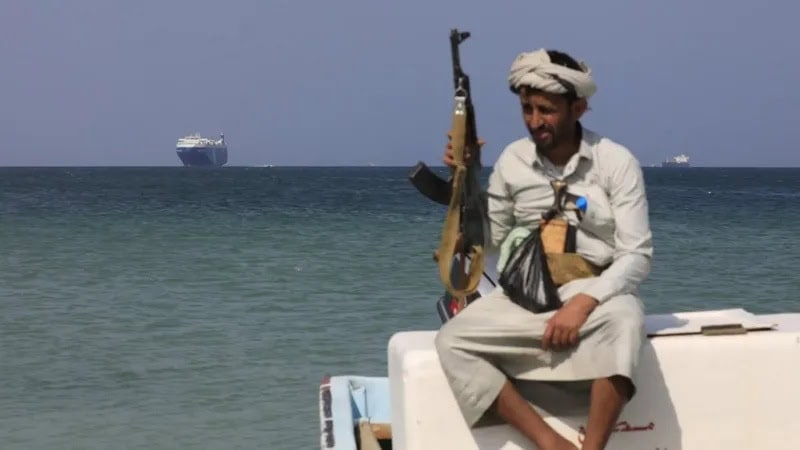
An armed Houthi fighter sits aboard a small boat in front of the Galaxy Leader cargo vessel, which the group hijacked in the Red Sea on November 19, 2023. The photo was taken off the Port of Al-Salif in Hodeidah Governorate on December 5, 2023 (EPA/Y
Last updated on: 10-08-2026 at 1 AM Aden Time

Mohammad Fawzi (South24 Center)
Over the past several days, Yemen's Houthi militia has shifted from military escalation in the Red Sea, driven by its external agenda and closely aligned with Iran's strategic calculations, which primarily sought to establish military deterrence, toward an attempt to exercise informal control over the maritime domain and regulate shipping traffic.
This shift raises the risk of the Red Sea evolving from an open international waterway into a sphere of influence where irregular military authority overlaps with maritime commerce. The implications extend well beyond Yemen, posing a growing threat to global economic security and creating a range of complex strategic challenges.
First: Dimensions of the Houthis' New Escalation in the Red Sea
The Houthi militia has embarked on a series of dangerous escalatory moves in the Red Sea aimed at imposing a new set of rules that would give the group greater leverage over international trade, global energy markets, and regional power dynamics. The most significant indicators of this strategy include the following:
1. Declaring a Maritime Blockade Against Saudi Arabia
On July 20, 2026, the Houthi militia announced the imposition of a maritime blockade on Saudi Arabia. Just days later, it claimed responsibility for missile and drone attacks targeting the oil tankers Ensilia and Leila. Saudi authorities subsequently confirmed that one of the vessels caught fire.
The significance of this move lies in several key considerations. First, it represents an attempt to establish new maritime deterrence equations targeting one of the world's largest oil exporters. The announcement appears to have been a Houthi response to the Yemeni government's recent escalation, amid accusations that Saudi Arabia was behind the military campaign following the Iranian aircraft crisis.
Second, the attacks' apparent success in causing a fire aboard one of the tankers, according to Saudi authorities, provides the Houthis with a propaganda victory intended to demonstrate their ability to penetrate maritime defense systems and threaten critical energy infrastructure and global supply chains.
Third, the escalation reflects an effort to redefine the concept of a maritime blockade. Rather than relying on physical control of territorial waters, the Houthis seek to create a high-risk operating environment that compels shipping companies and insurers to treat the Red Sea and Saudi Arabia's western coastline as an active conflict zone.
2. Iranian Directives to Close the Bab al Mandab Strait
Reports indicate that Iran instructed the Houthis to close the Bab al Mandab Strait and deploy missiles and drones on the highlands overlooking Hodeidah and the Gulf of Aden. These reports underscore Tehran's continued strategy of incorporating the Red Sea into its broader regional deterrence architecture.
Closing the Bab al Mandab would not merely disrupt maritime traffic. It would provide Iran with a strategic pressure point comparable to the Strait of Hormuz, enabling Tehran to influence two of the world's most critical maritime chokepoints through which a substantial share of global energy exports and international trade passes.
The reported deployment of missile and drone systems along Yemen's western coastline also suggests an effort to establish an Anti Access/Area Denial (A2/AD) umbrella, expanding the Houthis' ability to detect and engage both military and commercial vessels at greater distances while forcing international naval forces to operate in a far more complex security environment.
These developments do not necessarily indicate that the Houthis are capable of completely closing the strait, an objective that would be difficult to achieve or sustain in practice. Rather, they appear designed to raise the level of risk to the point where shipping companies and insurers reconsider transit through the Bab al Mandab, thereby generating an economic impact far greater than the military resources employed.
Should this equation become entrenched, the Red Sea could evolve into a theater of mutual deterrence between Iran and the United States and its allies, making maritime security increasingly dependent on broader regional dynamics rather than developments in Yemen alone.
3. Reports of Plans to Impose Transit Fees on Commercial Shipping
During the past several days, Reuters reported that Yemen's Houthi militia was considering imposing fees on commercial vessels transiting the southern Red Sea, one week after announcing its maritime blockade against Saudi Arabia. Although the Houthis later denied the reports, the mere discussion of such a proposal carries significant implications.
If implemented, the move would mark a fundamental shift from disrupting maritime traffic to attempting to administer it, allowing the Houthis to present themselves as a de facto authority with the power to regulate international shipping.
The proposal also appears to mirror Iran's recent calls for collecting transit fees or imposing special arrangements on shipping through the Strait of Hormuz. More importantly, such a step would establish a dangerous precedent under international maritime law by allowing an internationally unrecognized armed group to levy charges on vessels passing through an international strait governed by the United Nations Convention on the Law of the Sea and the principle of freedom of navigation.
Such a development would undermine one of the foundational principles governing global commerce.
4. Houthi Attacks on Saudi Oil Infrastructure
The Houthi militia announced that it had targeted Saudi oil facilities and sites belonging to Saudi Aramco in Jazan and Yanbu along the Red Sea coast. Meanwhile, Yemeni officials told Reuters that government air forces had carried out strikes against Houthi missile and drone launch sites, as well as weapons depots, in the governorates of Marib and Al Jawf.
These developments reveal an additional dimension of the Houthis' strategy. The shift from targeting maritime shipping to striking energy infrastructure along the Red Sea coast expands the scope of the threat to include one of the pillars of global energy security.
The objective extends beyond inflicting physical damage. It is intended to send a strategic message that any escalation against the Houthis will carry economic costs reaching far beyond Yemen and affecting international markets.
The selection of Jazan and Yanbu is particularly significant because both are integral to Saudi Arabia's Red Sea oil export network. Their targeting suggests an effort to threaten the Kingdom's strategic alternatives for reducing dependence on export routes through the Arabian Gulf and the Strait of Hormuz.
Second: Regional Implications of the Houthis' Escalation
The Houthis' activities in the Red Sea are no longer confined to posing a security threat to Yemen or international freedom of navigation. They have become a major driver of regional escalation across the Middle East. By expanding from attacks on commercial shipping to targeting energy infrastructure, declaring a maritime blockade, and signaling the possibility of imposing transit fees, the group has transformed a localized conflict into a broader regional crisis with far-reaching strategic implications. This can be understood through the following developments:
1. The Possibility of Houthi Involvement in the Damietta Port Incident
In a surprising development, Egyptian authorities announced that preliminary investigations indicated that the incident at Damietta Port was caused by a drone. Officials stated that investigations remain ongoing to determine the full circumstances and establish responsibility.
Following the announcement, the Damietta Port Authority confirmed that port operations continue to function normally, with shipping traffic, cargo handling, and loading and unloading activities proceeding according to scheduled operational rates.
For their part, the Houthis denied any involvement in the incident. The militia-run SABA News Agency quoted a source dismissing reports that the group had targeted a vessel at Egypt's Damietta Port.
Despite the Houthis' denial, the incident represents a significant escalation. It raises serious questions about the credibility of the group's previous threats to extend its operations into the Mediterranean Sea. It also introduces several possible scenarios, including an expansion of the operational theater beyond the Red Sea, attempts by other actors to draw Egypt directly into the regional confrontation, or efforts to test the readiness of Egypt's port security and air defense systems.
2. Momentum Toward New Maritime Security Coalitions
The Houthis' recent actions have pushed Saudi Arabia toward adopting a more collective approach to securing the Red Sea. Riyadh has moved to establish a regional and international maritime coalition to safeguard navigation and protect strategic sea lanes, an initiative that 14 countries have reportedly agreed to join.
The move reflects growing recognition that current maritime threats have surpassed the capacity of individual states and now require coordinated mechanisms for intelligence sharing, joint naval patrols, enhanced early warning systems, and integrated defenses against missiles, drones, and uncrewed surface vessels.
It also signals a gradual transformation of the Red Sea from a commercial transit corridor into a zone of collective security where regional and international interests increasingly intersect.
From a strategic perspective, the initiative represents an effort to rebuild a collective deterrence framework against a Houthi strategy designed to exhaust individual states. At the same time, however, it may lead the Houthis and, by extension, Iran to view the coalition as part of the military confrontation itself. That perception could increase the likelihood of attacks against vessels or naval assets belonging to coalition members, further transforming the Red Sea into a theater of competing security alliances rather than a limited maritime conflict.
3. Mounting Risks for Red Sea Littoral States
The Houthi escalation has shifted the costs of the conflict from the military sphere to the economic domain. Red Sea littoral states are increasingly bearing the consequences of disruptions to international shipping, even when they are not direct parties to the conflict.
This trend threatens to generate a wide range of adverse consequences, including increased shipping costs, higher insurance premiums, reduced port competitiveness, and broader economic pressures on countries whose trade and energy sectors depend heavily on secure maritime routes.
4. Providing the United States with Further Justification for Escalation
The Houthis' latest escalation effectively provides Washington with additional justification for increasing pressure on Iran. The United States has long maintained that the Houthis' advanced military capabilities, including long range missiles, drones, and maritime strike systems, rely to varying degrees on Iranian support, training, and technology transfers.
From this perspective, Washington no longer views Houthi attacks as an isolated Yemeni issue but rather as part of a broader Iranian strategy aimed at threatening freedom of navigation and reshaping the regional balance of power across critical maritime corridors.
The growing number of attacks on commercial vessels, Saudi oil infrastructure, and the Houthis' threats to impose a maritime blockade and levy transit fees further reinforce the U.S. narrative linking the group's actions to Iran's regional strategy. This, in turn, provides the U.S. administration with greater diplomatic leverage to rally international support for tougher sanctions on Tehran, intensify diplomatic pressure, and strengthen the American military presence in the Red Sea and the Arabian Gulf.
These developments could also be used by Washington to justify expanding preemptive military operations against Houthi military infrastructure, framing such actions as part of a broader strategy to contain Iranian influence rather than merely a response to individual attacks.
Third: Potential Implications
Current indicators suggest that the Houthi escalation in the Red Sea is no longer a series of limited military operations. Rather, it reflects a broader shift in the nature of regional conflict, one in which strategic maritime corridors are increasingly used as instruments of political, economic, and military coercion. If the Houthis continue to expand their missile and maritime capabilities while broadening the scope of their targets, the consequences will extend well beyond maritime security and Yemen's stability. They are likely to reshape regional security dynamics, global energy markets, international supply chains, and patterns of international military deployment. Against this backdrop, several potential implications stand out:
- Greater pressure on U.S.-Iran ceasefire efforts. Continued Houthi escalation could directly and indirectly undermine efforts to sustain the ceasefire between the United States and Iran. As Houthi operations intensify, the likelihood increases that tensions between Washington and Tehran will enter a more confrontational phase, whether through expanded sanctions, strikes on logistics and weapons transfer networks, or military operations targeting Iranian-linked assets or proxy groups. Such developments would heighten the risk of simultaneous crises unfolding across multiple regional theaters.
- Expanded international military presence in the Red Sea. Continued Houthi escalation is likely to prompt a stronger international military footprint in the region through the deployment of additional naval assets, the formation of new security arrangements and maritime coalitions, and the expansion of military bases, surveillance systems, and early warning capabilities. As a result, the Red Sea could become one of the world's most heavily militarized maritime corridors.
- Further regionalization of the Yemen conflict. As the Houthis become more deeply embedded in broader regional security dynamics, it will become increasingly difficult to separate the Yemeni conflict from wider geopolitical rivalries. This would reduce the prospects for an independent domestic political settlement and make any future peace agreement increasingly contingent on understandings reached among regional and international powers.
- Rising economic costs across the Red Sea region. Sustained Houthi escalation would inevitably drive-up maritime insurance premiums, shipping costs, and logistics expenses. These increases would, in turn, raise the cost of imports and exports for Red Sea States and contribute to higher inflation through increased transportation costs. Regional ports would also face growing operational pressures as trade routes shift, vessel schedules become more unpredictable, and transshipment activity declines, affecting broader economic sectors dependent on maritime services.
- Declining competitiveness of Red Sea ports. Continued instability is likely to weaken the competitiveness of ports along the Red Sea while delaying logistics and infrastructure investment projects linked to ports and special economic zones. It would also compel coastal states to increase spending on port security, coastal protection, and maritime surveillance, placing additional pressure on public finances. In this sense, one of the most significant consequences of the Houthi escalation is the transformation of the Red Sea from a driver of economic growth and regional trade integration into a source of economic risk and strategic uncertainty.
In conclusion, the Houthis' latest escalation in the Red Sea points to a dangerous structural shift in the region's security landscape. The group's actions are no longer driven solely by its confrontation with Saudi Arabia or its stated position on the Gaza war. Instead, they represent a broader transformation in the nature of maritime threats across the Middle East.
The Houthis are no longer targeting commercial vessels and oil facilities solely as military objectives. Rather, they are increasingly using strategic maritime corridors themselves as instruments of coercion to reshape regional deterrence dynamics and expand their strategic influence.
Perhaps the greatest long-term danger is that this model could be replicated by other armed non-state actors operating along the Red Sea, including groups such as Al-Shabaab, while simultaneously drawing additional regional and international actors into the expanding cycle of escalation centered on this critical maritime corridor.