SOUTH24 CENTER FOR NEWS & STUDIES
SOUTH24 CENTER FOR NEWS & STUDIES


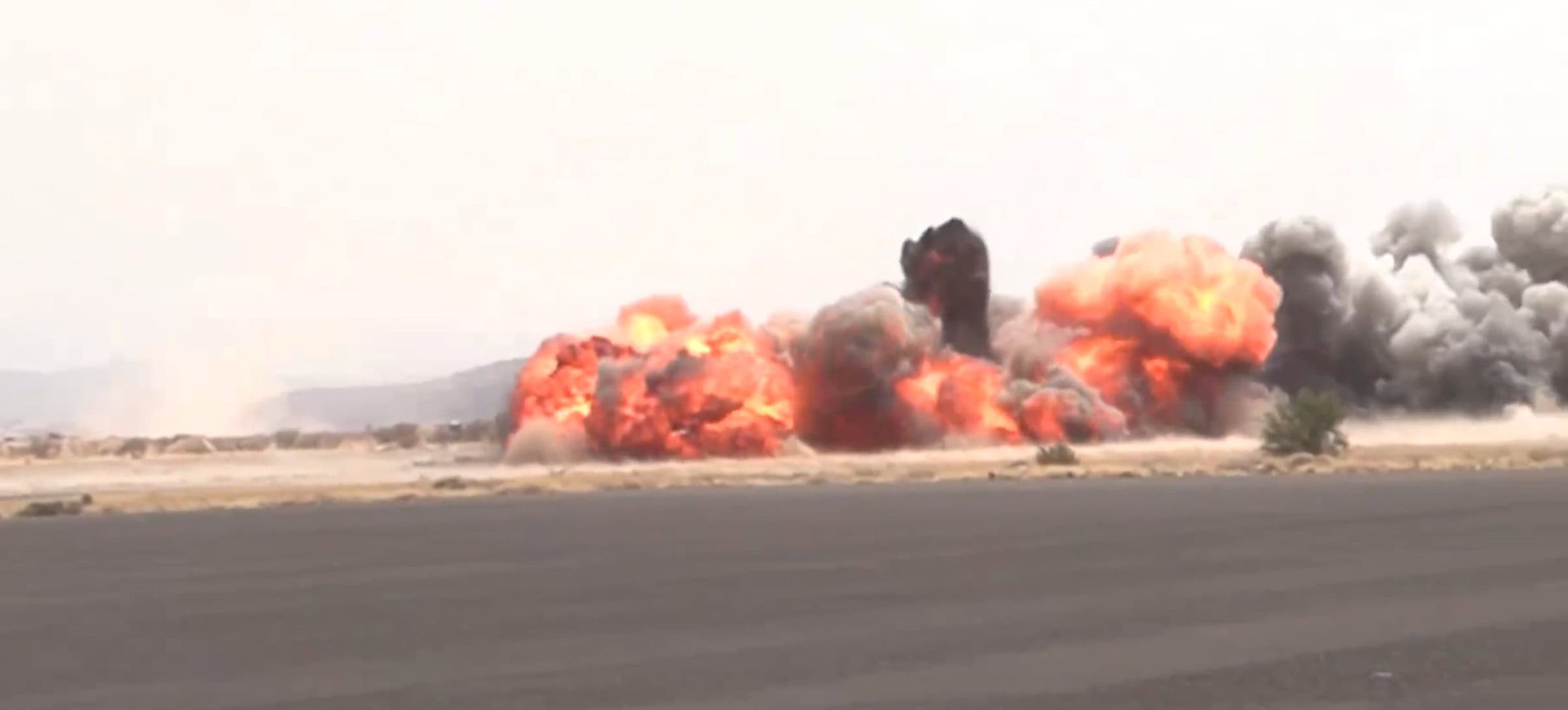
A still image taken from a video published by Houthi media shows the moment Sanaa International Airport was struck on July 13, 2026.
Last updated on: 13-07-2026 at 6 PM Aden Time
Aden (South24)
The runway at Sanaa International Airport was struck on Monday, July 13, shortly before an Iranian aircraft carrying a Houthi delegation was due to arrive. The Houthis blamed Saudi Arabia for the strikes, while Yemen’s Ministry of Defense said its forces had targeted the runway to prevent the aircraft from landing.
The incident has brought the dispute over unauthorized Iranian flights back to the forefront of tensions between the internationally recognized Yemeni government and the Houthis.
Houthi military spokesperson Yahya Saree accused Saudi Arabia of carrying out several strikes on the airport, saying the attack had brought the period of de-escalation to an end.
In a post on X, Saree said what he described as the “aggression” against Sanaa airport would not go unanswered, holding Saudi Arabia responsible for the escalation and its potential repercussions.
Yemen’s Ministry of Defense, however, claimed in a brief statement carried by the official Saba news agency that Yemeni forces had targeted the airport runway to prevent an Iranian aircraft from landing. It said the action followed the Houthis’ insistence on allowing Iranian aircraft to enter Yemeni airspace without authorization.
Government-aligned forces do not possess warplanes or long-range missiles capable of striking Sanaa airport. Their claim of responsibility, however, appears to reflect Saudi Arabia’s caution over being drawn into an open war with the Houthis or being seen as violating the terms of the agreement it signed with Tehran in Beijing in March 2023.
The ministry added that the Houthis had prevented Yemenia Airways, the national carrier, from landing at Sanaa airport while insisting on receiving Iranian flights. “For this reason, the airport runway was targeted,” the statement said.
The announcement came shortly after the Ministry of Defense called for the evacuation of Sanaa International Airport and warned civilians against approaching the area.
Separately, government-affiliated platforms had circulated a notice directing the cancellation of all flights to Yemeni airports. However, the Ministry of Transport in the capital, Aden, denied the authenticity of the circulating notice regarding the closure of all airports across the country and confirmed that flights were continuing.
It said action would be taken against any aircraft or party attempting to breach Yemeni airspace or violate instructions issued by the competent authorities.
The ministry said the measures were intended to protect civilians and prepare for possible security developments, stressing that the armed forces were ready to respond to any developments on the ground in defense of national sovereignty and security.
At the same time, the Presidential Leadership Council directed the government, armed forces, and security services to raise their readiness to the highest level and take what it described as legitimate measures to protect Yemen’s sovereignty.
The directives followed the Houthis’ insistence on receiving another Iranian flight at Sanaa airport.
Earlier on Monday, Yemeni Defense Minister Taher Al-Aqili warned that any unauthorized aircraft entering Yemeni airspace would be intercepted, holding Iran legally and morally responsible for the consequences of continuing to operate flights to Sanaa.
Al-Aqili said the Yemeni government, in coordination with regional and international partners, had sought to persuade Iran and the Houthis not to violate Yemeni airspace by operating Iranian flights.
He described the move as a challenge to international legitimacy.
“Patience has run out, and we will deliver the appropriate response to this flagrant violation,” he said, adding that Yemeni forces would confront aircraft violating the country’s airspace and sovereignty by all available means.
According to flight-tracking website Flightradar24, the Iranian aircraft disappeared from radar over Maabar in Dhamar Governorate, where it was last recorded at an altitude of 5.9 kilometers and a speed of 693 kilometers per hour.
Tracking data later showed that the aircraft had changed course toward Hodeidah Airport.
Local media reports said the plane, which was carrying the Houthi delegation, was diverted to Hodeidah after it was unable to land in Sanaa following the strike on the airport runway.
The transport minister in the Houthi-run government later confirmed that the aircraft had landed at Hodeidah Airport.
He said it was carrying members of the Houthi delegation, along with several patients and stranded Yemeni citizens.
The Houthis had earlier announced the aircraft’s arrival without identifying the airport, while local activists circulated footage they said showed the plane landing in Hodeidah.
Last week, the Presidential Leadership Council held an extraordinary meeting in Riyadh to discuss the repercussions of the July 3 Iranian flight to Sanaa airport.
The council described the flight as a “flagrant violation” of Yemen’s sovereignty and UN Security Council resolutions, holding Iran and the Houthis responsible for the escalation and the resulting threat to regional and international security.
During the meeting, the council discussed returning members of the Houthi delegation stranded in Tehran aboard a chartered Yemenia Airways aircraft, instead of using an Iranian carrier that it said served the interests of the Houthis and their backers.
The council also said Yemenia Airways was ready to resume commercial flights from Sanaa to Amman and other agreed destinations, provided that guarantees were in place to protect its aircraft and crews and that there was no interference in the company’s management or flight operations.
The current dispute began after an Iranian aircraft landed at Sanaa airport on July 3, marking the first publicly announced Iranian flight to the airport in nearly a decade.
The Houthis said the aircraft transported more than 200 stranded Yemenis, wounded people, and patients, as well as an official and civilian delegation that had attended memorial events for the late Iranian Supreme Leader, Ali Khamenei.
The group also claimed that it had confronted Saudi aircraft seeking to prevent the Iranian plane from landing in Sanaa.
It threatened to target Saudi airports and other vital interests on land and at sea if attempts to block flights to Sanaa airport were repeated.
Saudi Arabia later described the Houthi statements concerning the flight as an attempt to conceal the group’s escalation and accused the Houthis of rejecting the proposed peace roadmap.
The dispute over Iranian flights also became entangled with the prisoner exchange file.
Government sources said delays in implementing the latest prisoner swap agreement were linked to the Houthis’ demand that their delegation return from Tehran aboard an Iranian aircraft.
UN Special Envoy for Yemen Hans Grundberg said on July 11 that he had received assurances from both the government and the Houthis that they remained committed to implementing the May 2026 agreement, which the United Nations said covers more than 1,600 conflict-related detainees.
Following the strike, government-affiliated platforms circulated a notice directing the cancellation of all flights to Yemeni airports. However, the Ministry of Transport in the capital, Aden, denied the authenticity of the notice regarding the closure of all airports across the country and confirmed that flights were continuing.