SOUTH24 CENTER FOR NEWS & STUDIES
SOUTH24 CENTER FOR NEWS & STUDIES


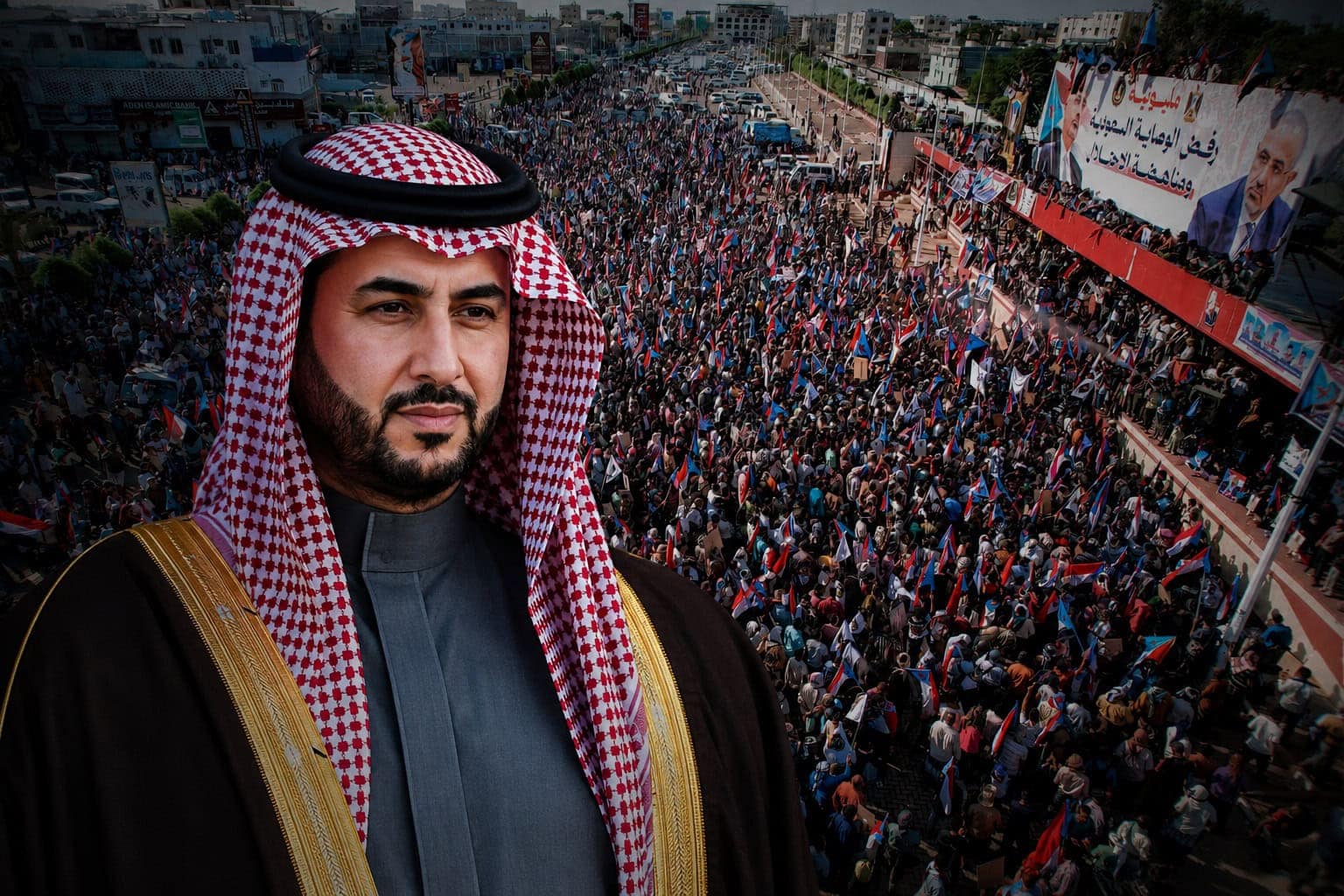
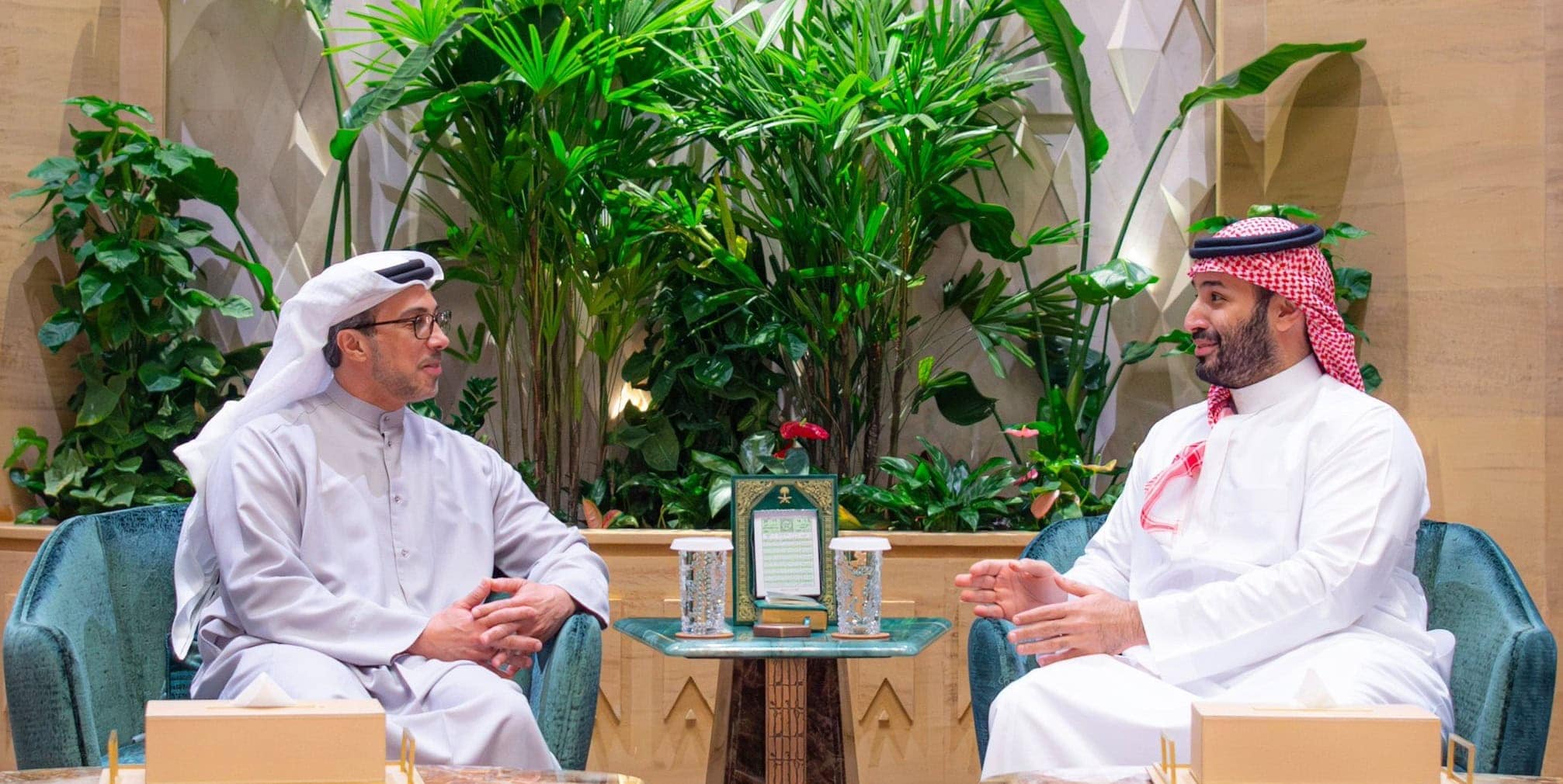
AI-generated composite image of Saudi Defense Minister Prince Khalid bin Salman, alongside the mass rally in Aden on June 20, 2026, rejecting Saudi tutelage (South24 Center)
Last updated on: 30-06-2026 at 8 AM Aden Time

South24 Center Editorial
Yemen’s Permanent Representative to the United Nations, Abdullah Al-Saadi’s remarks, during the latest UN Security Council session, were not merely another diplomatic briefing on developments in the Yemeni crisis. In essence they were an overt political declaration of coordinated pressure against the Southern Transitional Council (STC) and its leadership, and an explicit attempt to redefine the balance of political power in South Yemen through calculated accusations, and calls for sanctions, and political restriction.
The statement was characterized by an unprecedented level of severity, directly accusing President of the Southern Transitional Council, Major General Aidrous Al-Zubaidi, in acts of corruption, rebellion, and high treason. This was not a rhetorical excess or a diplomatic misstep, rather, it was part of a broader effort to engineer a new political narrative -- aimed at undermining Al-Zubaidi, marginalizing the STC, and paving the way for a new, manufactured southern representation that aligns with the agendas of dominant local and regional power centers. Political indicators suggest that certain actors within the Presidential Leadership Council, backed clearly by Saudi Arabia, are actively working to dismantle Al-Zubaidi’s political influence and popular support. This strategy reportedly aims to place him on the UN sanctions lists, impose legal impediments on his transnational movements, and sideline the STC in future peace negotiations on Yemen.
However, informed sources told South24 Center that this escalation has generated negligible international traction. Rather it is being viewed largely as a local and regional attempt to distract southern attention from systemic governance failures, that include, the collapse of public services and economic misery, and the complete lack of a vision to address the South Cause.
Today, Riyadh appears to be racing against time to reshape the South’s political representation in a bid to minimize the leverage of Al-Zubaidi and the STC. However, this strategy directly collides with ground realities that cannot be erased by official statements or UN briefings. The widespread visibility of Al-Zubaidi’s portraits at public rallies across Aden, Hadramout, and other southern governorates underscores that he retains significant political and symbolic capital among broad segments of southern society, making any attempt to bypass, or substitute him with proxy figures, highly unrealistic.
Concurrently, the promotion of parallel southern blocs and alliances appears to be a transparent attempt to avoid the test of popular legitimacy. Genuine political representation is not forged behind closed doors, nor manufactured by external decree, or legitimized by regional capitals. Rather it is built on a political leader’s ability to champion public aspirations, and withstand institutional pressure. Without widespread social and political acceptance within the South, any alternative entities will remain mere temporary functional tools, incapable of filling the political vacuum or even shifting the popular southern equation.
Contrary to the calculations of Riyadh and some of its partners, sustained pressure to diminish Al-Zubaidi’s role may ultimately bolster his symbolic and political standing rather than weaken it. Political experience in Yemen suggests that removing leaders from the formal political structure rarely ends their influence; rather it often transitions them into powerful symbolic figures. A clear historical precedent is former President Ali Salem Al-Beidh post-1994 who transitioned from a man of authority into an enduring symbol of the Southern Cause until his death. Today, the crowds filling public squares across the South show no willingness to substitute their recognized leadership for engineered political entities or alternatives that lack genuine popular legitimacy.
The deeper dilemma stems from the absolute deadlock of the South–South dialogue, a process long promoted by Riyadh and southern elites aligned with it, whether by choice or coercion. Compounding this deadlock is the lack of a clearly defined southern political project. This vacuum coincides with a succession of daily negative developments that threaten the gains of the South, reinforcing public consensus that Riyadh lacks a serious and equitable approach to resolving the South Issue, and is simply managing time and recycling familiar crises.
Crucially, this stagnation of the dialogue file does not stay confined to elite political salons; it has direct, volatile consequences on the ground. The slower the political process moves, and the wider the gap between promises and reality, the greater the momentum shifts to the southern streets, fueling an expanding protest movement. While public anger is undeniably fueled by the deteriorating living conditions and collapsing public services, reducing the current Southern mobilization to a mere crisis of electricity, salaries, or public services is a misleading oversimplification. The core driving force of this movement is political. This is unmistakably reflected in the nature of the slogans raised and the symbols displayed during rallies, where southern flags and images of southern leaders heavily overshadow banners focused on economic grievances.
The Risks of Sliding Toward a Security Crisis
Despite growing public anxiety regarding participation in protests, particularly following violent crackdowns on peaceful demonstrations in Aden, Hadramout, and elsewhere, the continued security repression is more likely to dismantle the barrier of fear than reinforce it. As the cost of silence rises, the likelihood of a widespread popular explosion becomes inevitable. At that stage, the challenge facing both the Presidential Leadership Council and Riyadh will shift from managing political representation to navigating a highly volatile security and military crisis.
Attempting to suppress political demands through purely security-driven measures is a guaranteed recipe for failure. Repression does not destroy a political cause; it gives it moral power and political momentum. Ultimately, the use of force against a mass movement amplifies the public anger, opening the door to a chaotic spiral that will be difficult to contain.
This escalation recalls the early stages of the Southern Peaceful Movement, when the Ali Abdullah Saleh regime, failing to defeat the movement politically or narratively, routinely resorted to security crackdowns. That strategy backfired entirely. Rather than crushing the Hirak movement, that repression fortified its legitimacy, expanded its social base, and transformed it into an unstoppable popular cause.
Historical precedent suggests that any Riyadh-backed local forces choosing the same path, whether acting under direct instructions or independently, are bound to replicate its failure, and will only serve in galvanizing and expanding the southern support base. Riyadh remains profoundly out of touch with the true pulse of the southern street. Reproducing failed exclusionary or coercive policies will only deepen popular resistance, mirroring earlier periods, when the Southern Movement expanded and developed its own momentum despite limited resources and little external backing.The critical difference this time is that the ‘northern authorities’, or what is formally referred to as the Yemeni government, are no longer the sole target of public anger. Saudi Arabia itself risks deeply alienating the southern collective consciousness, and widening the circle of public resentment toward its policies.
Consequently, Riyadh needs to tread carefully and reassess its approach. It must move away from narratives shaped by advisers who misread the South and simply reproduce the same exclusionary formulas that undermined Saleh’s grip after the 1994 war. There is still a profound gap when it comes to understanding the Southern Cause, and the sheer resilience of the southern public’s political aspirations. This movement is not a temporary crisis over infrastructure, electricity, water, and salaries. It is a deeply rooted political struggle, defined by its own history, collective memory, immense sacrifices, and accumulated grievances.
If Saudi Arabia fails to understand the historical depth and nuances of the Southern Cause, it risks replicating the errors of Yemen’s former regime -- embracing a flawed logic that assumes brute force can erase a people’s collective political consciousness. Such an approach, driven by misleading assessments from elites who remain stuck in a post-1994 mindset, actively harms the Kingdom’s interests. Instead of bringing stability, it will damage Saudi Arabia’s image and the future of its relationship with a neighboring people and territory bound to it by geography, borders, and shared interests.
The Real Test for Riyadh in the South
The Saudi policy in the South is facing a decisive test.
If Riyadh and its backed de facto authorities succeed in defusing southern public anger by adopting more flexible political, economic and security approaches, they might be able to mitigate public frustration and open a more realistic path toward resolving the Southern Issue. However, such an outcome is strictly conditional upon the dialogue process leading to a clear political framework that explicitly accommodates southern aspirations, most crucially, the right to self-determination. Reproducing ambiguous formulas that merely recycle the crisis under new labels will inevitably fail.
Conversely, if dialogue outcomes clash with public expectations, an unprecedented wave of public escalation will likely erupt, eclipsing current mechanisms of control and outstripping previous unrest. In that scenario, coercive pressure targeted at the STC or Al-Zubaidi will not weaken them; rather it will consolidate public alignment around them as central symbols of resistance against attempts to marginalize the Southern Cause. Moreover, any attempt to push back against the southern public, or impose political outcomes that clash with southern aspirations, could trigger a large-scale security and military collapse. Such a volatile environment would create ideal conditions for the Houthis to intervene and exploit the resulting chaos.
In fact, the recent military escalation on the Al-Dhalea front may be interpreted as a clear Houthi test balloon, designed to gauge the readiness and resolve of southern forces. This calculated move comes on the heels of the group’s announcement of general mobilization, signaling its full preparedness for internal confrontation across multiple fronts.
In sum, developments on the ground conclusively demonstrate that the southern public is not driven merely by economic and service-related crises, it is guided by a deeply rooted political conviction that flatly rejects foreign dictates and political engineering. Current efforts to marginalize southern leadership, whether through the UN Security Council or local security proxies, collide with a complex reality on the ground and a living collective memory that explicitly rejects the legacy of the “Saleh-era logic” and its oppressive political practices.
Accordingly, this political gamble will inevitably lead to one of two outcomes: either a genuine accommodation of southern demands through a fair, transparent settlement that honors the root cause, or a descent into full-blown chaos that will ultimately benefit the Houthis, who are already lurking at the southern borders, waiting to exploit the situation militarily and politically.
Riyadh must realize, before it is too late, that attempts to break the will of the southern street will never yield regional stability. Instead, they risk turning dependable allies into liabilities and transforming its southern frontier into a zone of endless attrition. Extricating itself from this impasse does not begin with targeting southern leaders, diluting their cause, or manufacturing fragile, artificial alternatives behind closed doors. It begins with recognizing that the South is not a security file to be managed through coercive pressure, but a fundamental political question that can only be resolved through a just settlement that respects the will of the southern people and their right to determine their future.