SOUTH24 CENTER FOR NEWS & STUDIES
SOUTH24 CENTER FOR NEWS & STUDIES


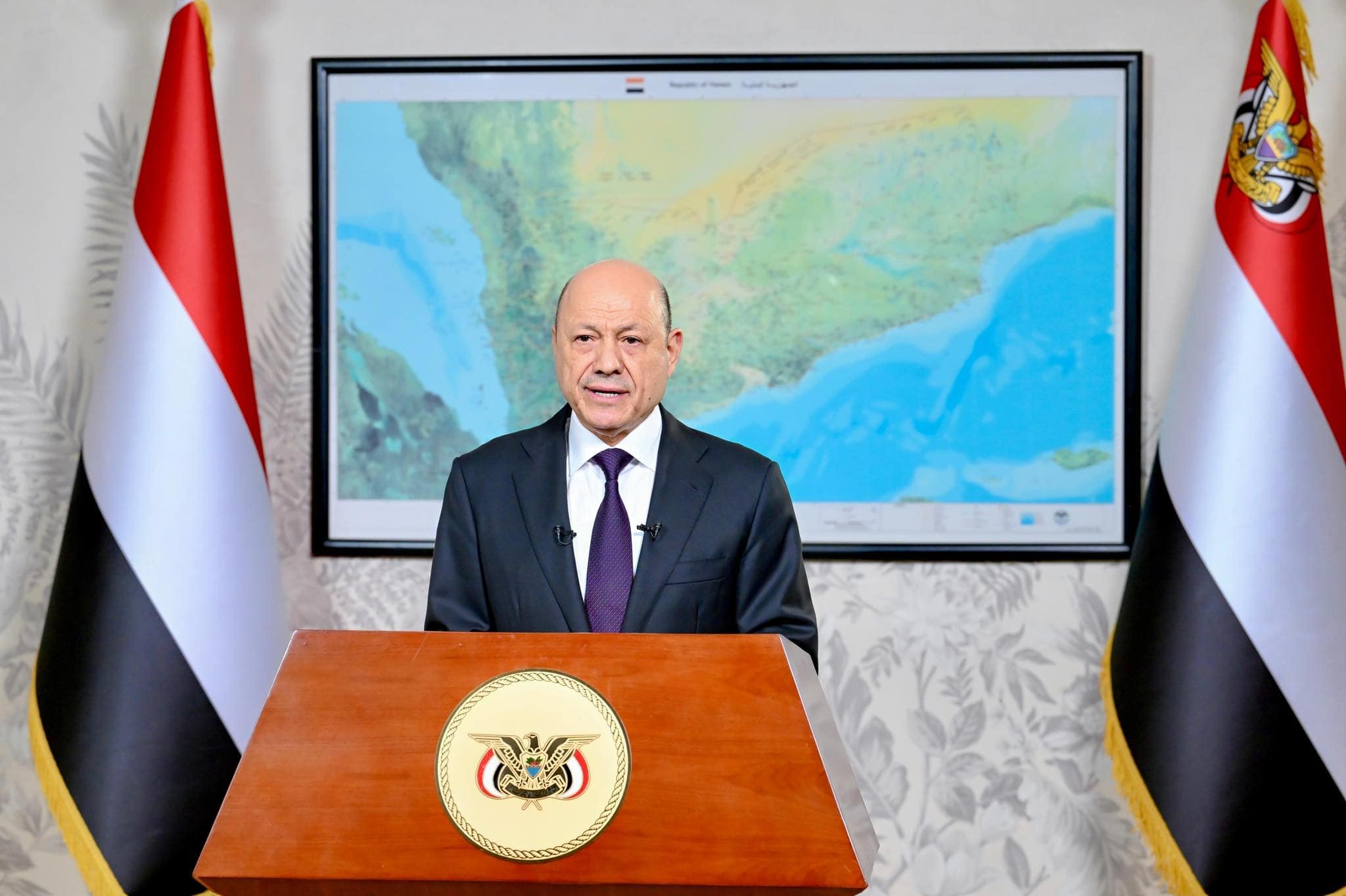
Yemeni Presidential Leadership Council Chairman Rashad Al-Alimi delivers his speech from Riyadh, May 21, 2026. (Saba News Agency)
23-05-2026 at 7 PM Aden Time
Riyadh (South24 Center)
Prominent Southern leaders have strongly criticized the speech delivered by Presidential Leadership Council Chairman Rashad Al-Alimi on the 36th anniversary of Yemeni unity, saying it revived the political language of the 1994 war and ignored the scale of political and military transformations that the Southern cause has undergone over the past decades.
The criticism followed Al-Alimi’s speech on Thursday (May 21), in which he described Yemeni unity as a national project carried by people in both the South and the North, while acknowledging that the project later suffered “serious deviations” that produced deep grievances, including exclusion, marginalization, and damage to the national partnership on which unity was founded.
Al-Alimi said the Southern issue lies at the heart of any just settlement and represents a key pillar for building sustainable peace. However, he stressed at the same time that addressing it “within the framework of the state” remains necessary to preserve national cohesion, complete the battle to restore state institutions, and achieve comprehensive peace.
These remarks triggered sharp reactions from Southern leaders currently present in the Saudi capital, Riyadh. The leaders rejected what they viewed as an attempt to place the anticipated Southern dialogue under a predetermined political ceiling based on the framework of unity.
Nasser Al-Khobaji, head of the Political Commission of the Southern Transitional Council (STC), said the declaration of disengagement announced by former Southern President Ali Salim Al-Beidh on May 21, 1994, “was not a passing event,” but rather a political project that remains present in Southern political consciousness.
Al-Khobaji said Al-Alimi’s speech repeated the same policies that had contributed to deepening the crisis, adding that it ignored the political and military realities on the ground. He also said the speech contradicted Saudi efforts aimed at sponsoring a Southern dialogue in Riyadh.
For his part, Southern leader Abdul Nasser Al-Wali, a member of the STC Presidium, said Southerners had responded to the Saudi invitation for dialogue in search of a comprehensive and just solution to the Southern issue, “not to return to projects that have already proven their failure.”
Al-Wali rejected any discussion of a Southern dialogue within the framework of unity, describing it as an evasion of the essence of the Southern issue. He said the South accepts dialogue under Saudi sponsorship to discuss the form of the future Southern state and the nature of its future relationship with Yemen.
Mohammad Al-Ghaithi, chairman of the Consultation and Reconciliation Commission supporting the Presidential Leadership Council, described Al-Alimi’s speech as detached from reality, saying that speaking about a unity no longer present in the conscience of people in the South does not reflect the depth of the current crisis.
Al-Ghaithi said one of the main reasons for the failure of the Yemeni experience was dealing with the South as “a file to be contained,” rather than “a political issue to be recognized.” He reaffirmed his rejection of any dialogue subjected to predetermined outcomes or imposed political ceilings.
Al-Ghaithi also called for prioritizing the liberation of Sanaa and the restoration of what remains of the state, instead of returning to what he described as “imaginary victories” in the name of unity.
In the same context, former Minister of Social Affairs and Labor Mohammad Said Al-Zaouri said the political discourse issued by what he described as the “Yemeni legitimacy” had spoken for years about partnership and dialogue, while practices on the ground reveal a reproduction of the discourse of dominance and guardianship entrenched since the 1994 war.
Al-Zaouri added that the people of the South have made immense sacrifices since the 1994 war and fought battles against projects of domination and terrorist organizations. He noted that Southern forces have played a pivotal role in protecting security and stability and securing international navigation in the Arabian Sea, the Gulf of Aden, and Bab al-Mandab.
He stressed that the Southern cause is no longer merely a protest demand, but has become a political reality with its own institutions, political representative, and broad popular representation. He said the South has imposed itself as a key partner in any future political arrangements.
In a related position, lawyer Yahya Ghalib Al-Shuaibi, a member of the STC Presidium, called for the return of the Southern delegation currently in Riyadh to the capital, Aden, before Eid al-Adha, saying Al-Alimi’s speech had removed the justifications for the delegation’s continued stay in Saudi Arabia.
Al-Shuaibi said the speech reproduced the “victory for unity” discourse associated with the 1994 war and placed Saudi efforts regarding the Southern dialogue in an embarrassing position.
He added that the continuation of exclusionary rhetoric, along with recent measures targeting Southern leaders, reinforces the conviction among the Southern public that the targeting is directed against the South as a cause, identity, and political project.
The official spokesman of the STC, Anwar Al-Tamimi, also issued a strongly worded response, accusing Al-Alimi of seeking to dismantle Southern political and security gains and impose projects that conflict with Southerners’ aspirations. He said Southerners would not accept anything less than independence and the restoration of a sovereign Southern state within its internationally recognized borders before May 22, 1990.
Al-Alimi’s speech also addressed political and security developments in Hadramout and Al-Mahra governorates, which he said had nearly affected the legal status of the state and threatened national and regional security. According to the state-run Saba news agency, Al-Alimi directed the competent authorities to review and drop arrest warrants against Southern figures.
He also called for the return of weapons, ammunition, and military equipment seized during the recent events to the relevant state institutions, saying this was necessary to strengthen the state’s monopoly over arms and consolidate security and stability.
On January 9, Saudi media broadcast a video showing a number of STC delegation members, two days after their arrival in Riyadh, announcing the dissolution of the Southern Transitional Council, amid ambiguous circumstances and reports that they had been detained, with some subjected to questioning and pressure. Several of them have not been allowed to travel or return to the South to date, according to an informed source who spoke to South24 Center.