SOUTH24 CENTER FOR NEWS & STUDIES
SOUTH24 CENTER FOR NEWS & STUDIES


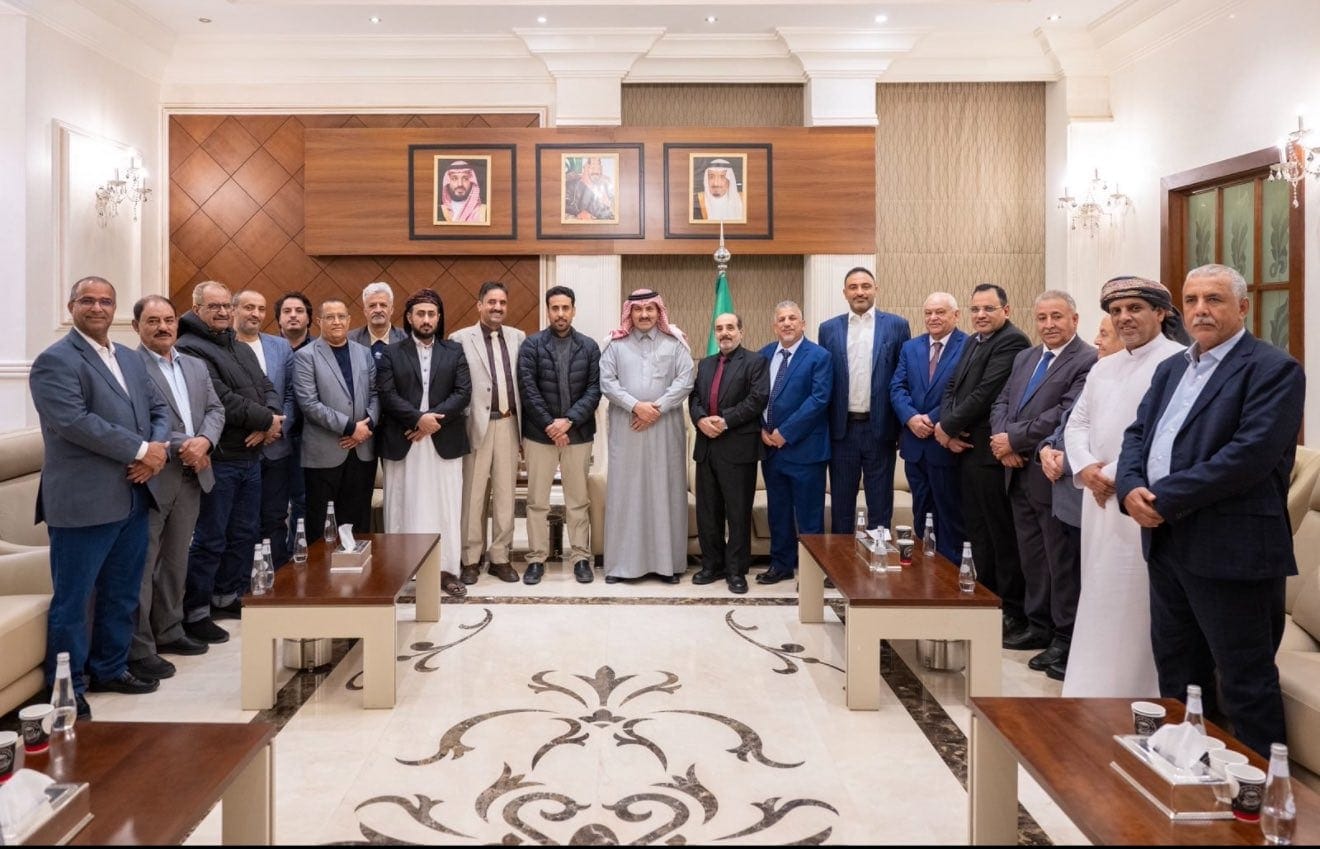
The Southern Transitional Council delegation with the Saudi Ambassador to Yemen, Mohammed Al Jaber, in Riyadh, January 8, 2026 (the ambassador’s Facebook page).
16-04-2026 at 2 PM Aden Time

“Despite the momentum surrounding Saudi sponsorship of a Southern dialogue, practical outcomes remain extremely limited. No official start date has been announced, nor have participation criteria or a preparatory committee been defined.”
Abdullah Al-Shadli (South24 Center)
Nearly three months after a high-level delegation from the Southern Transitional Council (STC) arrived in Riyadh on January 7, the results of its mission remain unclear. Questions are mounting within Southern circles over whether the visit has yielded any political gains or merely provided cover for arrangements that have reshaped the landscape in line with Saudi priorities.
The delegation’s departure followed rapid military and political developments. Southern forces had advanced toward Wadi Hadramout and Al-Mahra in an effort to secure them, but these gains were reversed after intensive Saudi airstrikes forced a withdrawal, paving the way for the rise of alternative Saudi-backed formations on the ground. Just two days after the delegation’s arrival, and in parallel with these developments, the dissolution of the Southern Transitional Council was announced from Riyadh on January 9 under what were described as opaque circumstances linked to direct political pressure, opening the door to complex shifts in the Council’s status and representation.
Despite the initial momentum accompanying the announcement of a Saudi-sponsored Southern dialogue earlier this year, including talk of forming a preparatory committee and organizing a comprehensive conference, the contours of this process remain undefined. No clear negotiating framework, timeline, or participation mechanism has been announced, reinforcing doubts about the nature and limits of the initiative.
Meanwhile, notable developments have unfolded on the ground over the past three months, affecting the presence of the STC in several governorates, most notably Hadramout and Aden. Signs of internal divergence within the Council have also emerged, alongside statements by some delegation members reflecting dissatisfaction with developments in Riyadh and raising questions about the delegation’s actual role.
Southern Dialogue: Unfulfilled Promise or Suspended Process?
Despite the political and media momentum surrounding Saudi sponsorship of a southern dialogue, its practical outcomes remain extremely limited. No official start date has been announced, nor have participation criteria or a preparatory committee been defined, despite early indications that such steps would accompany the delegation’s arrival in Riyadh.
Initial official statements pointed toward organizing a Southern–Southern conference under Saudi auspices, bringing together diverse factions and laying the groundwork for a new political phase in addressing the Southern issue. However, these promises have yet to materialize into concrete steps or institutional arrangements.
In this context, Mohsen Obaid, rapporteur of the STC Presidency and head of its restructuring committee, stated in Facebook posts on March 31 that “there is no dialogue at all, nor even genuine practical arrangements to hold one.” He added that this reflects what “the Southern delegation in Riyadh perceives, particularly those still committed to speaking the truth and remaining loyal to the South.”
Obaid further said he had become “fully convinced” that what is being presented as a “Southern dialogue” is an “artificial construct,” aimed at “pacifying Southerners and distracting them with false hope to prevent any reactive opposition.”
This view aligns with an assessment by Dr. Omar Bajardana, head of the Knowledge Center for Strategic Studies, who told South24 that the delegation “has not achieved any tangible progress, either politically or militarily, regarding the Southern issue or the project of restoring the South State.”
He added that current developments are limited to intermittent statements about arrangements for a Southern–Southern conference under Saudi sponsorship, noting that while such a conference is intended to represent diverse Southern constituencies and establish a new path forward, “it has yet to translate into concrete steps or visible results on the ground.”
The faltering of the dialogue cannot be separated from the context in which it emerged. The initiative came at a moment of sharp military shifts and a broader reconfiguration of power balances, leading many in the South to question whether it genuinely reflects the aspirations of the Southern cause or forms part of wider regional arrangements.
Accordingly, Bajardana stressed that the delegation should be judged by what it achieves in practice, not by political rhetoric, warning that the absence of tangible progress fuels uncertainty and concern among the Southern public.
Conversely, some Southern figures associated with the delegation have adopted a more optimistic tone, arguing that current developments represent preparatory steps rather than setbacks. Rajeh Bakrit, for instance, denied reports that the delegation is being held in Riyadh, asserting that its members remain there voluntarily as part of a political mission and that their return depends on completing their tasks.
Bakrit said the delegation came “solely for the South cause,” emphasizing unity of purpose and insisting that the Southern dialogue “is coming,” but requires careful preparation to ensure inclusive participation. He added that the delegation has helped preserve cohesion in the Southern position, avoid missteps, and maintain communication channels, stressing the need for flexibility and dialogue at this stage.
Similar views were echoed by delegation member Abdulnasser Al-Ja’ari, who noted on March 31 that Saudi Arabia’s role lies in supporting stability, development, and a conducive environment for dialogue, urging stakeholders to move beyond past mistakes and seize current opportunities.
Since then, the Saudi ambassador to Yemen, Mohammed Al-Jaber, has continued to host Southern figures as part of active diplomatic efforts aimed at supporting stability and advancing a comprehensive dialogue. On January 18, he hosted a consultative Southern meeting described as a preliminary step, and on February 12, he met Presidential Leadership Council member and Hadramout Governor Salem Al-Khanbashi.
On April 8, Al-Jaber met Major General Ahmed bin Brik, Hani and Yanouf Al Bidh, sons of the former southern president Ali Salem Al-Bidh, Al- Jaber also met Southern leader Salah Al-Shanfara. Discussions focused on developments in Yemen, particularly Hadramout, as well as efforts to support security, stability, development, and preparations for dialogue, with an emphasis on prioritizing dialogue among all parties.
From Political Representation to Ambiguity
Parallel to the stalled dialogue track, the status of the Southern delegation in Riyadh has become one of the most contentious issues, particularly given the shifts in its political standing since its arrival.
The delegation initially arrived as a representative of the STC amid tensions with Saudi Arabia. However, this status was significantly undermined just two days later with the announcement dissolving the Council from Riyadh, a move described internally as “illegal,” effectively suspending the delegation’s political and organizational legitimacy.
This created a clear paradox: a delegation meant to represent the Southern cause within an organized political framework suddenly found itself, after the STC Dissolution Announcement, stripped of the very mandate that conferred its representative status.
Sources within the STC told South24 that the Council distinguishes between political and humanitarian considerations, stressing continued demands for the delegation members’ return and rejecting any restrictions on their freedom, while also noting that it cannot currently rely on any political positions issued by them until the situation becomes clearer.
Reports since January of restricted movement and intermittent loss of contact with some delegation members have further fueled questions about their actual conditions in Riyadh and whether they are able to work freely.
In a notable development, recent weeks have seen statements from within the delegation itself reflecting dissatisfaction. Mohsen Obaid said in late March that members of the delegation are effectively being held in Riyadh, with only those aligning with the Saudi agenda permitted to return home.
This divergence was also evident in a statement issued by the Southern delegation following events in Mukalla, Hadramout, in early April. The statement blamed the Yemeni government, specifically the ministers of defense and interior, along with the Hadramout governor, for suppressing protesters, calling for an urgent investigation and accountability measures, including their dismissal.
However, despite its escalatory tone, the statement has not prompted any visible Saudi response or led to tangible political or field-level changes, raising further doubts about the delegation’s influence.
It also received limited coverage, even from media platforms aligned with the Saudi-backed track, including the recently established “Al-Janoub Today” channel, seen by some as an additional indication of internal divergence and declining influence.
Wedad Al-Douh, head of the UK-based Frontline Human Rights organization, said the delegation has effectively been placed under “de facto house arrest,” arguing that instead of participating in a political dialogue, it has been subjected to pressure and threats to relinquish its representative role.
"Al-Douh told South24 Center that the announcement of the dissolution of the Transitional Council 'was not an expression of the free will of the delegation members, but rather the result of pressures imposed on them under undisclosed circumstances.' She maintained that these factors 'undermine confidence in any dialogue process held under such conditions.’
Ground Developments: Reshaping the Landscape or Managing a Crisis?
In contrast to the lack of progress on the dialogue track, the past three months have seen significant developments on the ground, more tangible and impactful than the political process itself, affecting power balances and the STC’s presence across Southern areas.
Since January, several areas, including Shabwa, Aden, and Hadramout, have witnessed measures such as the closure of STC offices, carried out by Saudi-allied authorities. While not uniform across all governorates, these actions indicate a broader trend toward reducing the Council’s footprint during the delegation’s stay in Riyadh.
In Hadramout, developments have been particularly intense. Mukalla saw rising tensions in early April linked to public events associated with the STC. Local sources reported tightened security measures, bans on activities, and arrests of protesters, escalating into violations that resulted in casualties.
Subsequent local mediation efforts led by the Hadrami Consensus Authority produced agreements that included the release of detainees, cancellation of arrest warrants against STC leaders, and the reopening of two STC offices in Mukalla on April 11. Earlier, protesters had also managed to reopen STC offices in Aden on April 1.
These developments have coincided with ongoing economic and service crises in Aden and other Southern cities, with no tangible improvements despite earlier promises tied to the delegation’s presence in Riyadh.
Dr. Bajardana noted that continued protests reflect public expectations for tangible action, warning that the absence of such steps deepens skepticism about the current trajectory.
Taken together, these dynamics suggest a reality more complex than a stalled political process. They point to a parallel track involving the reshaping of the Southern landscape, through shifts in power balances and measures targeting the STC, while the political process that justified the delegation’s presence shows little progress.
In effect, what has been achieved over this period appears less like movement toward a political resolution and more like a reconfiguration of facts on the ground and the management of tensions, without producing a clear path forward for addressing the Southern issue.
After three months in Riyadh, the outcomes fall short of the expectations that accompanied the delegation’s departure. No clear dialogue framework has emerged, nor have tangible political results materialized, while developments on the ground continue to raise fundamental questions about the trajectory of the South.