SOUTH24 CENTER FOR NEWS & STUDIES
SOUTH24 CENTER FOR NEWS & STUDIES


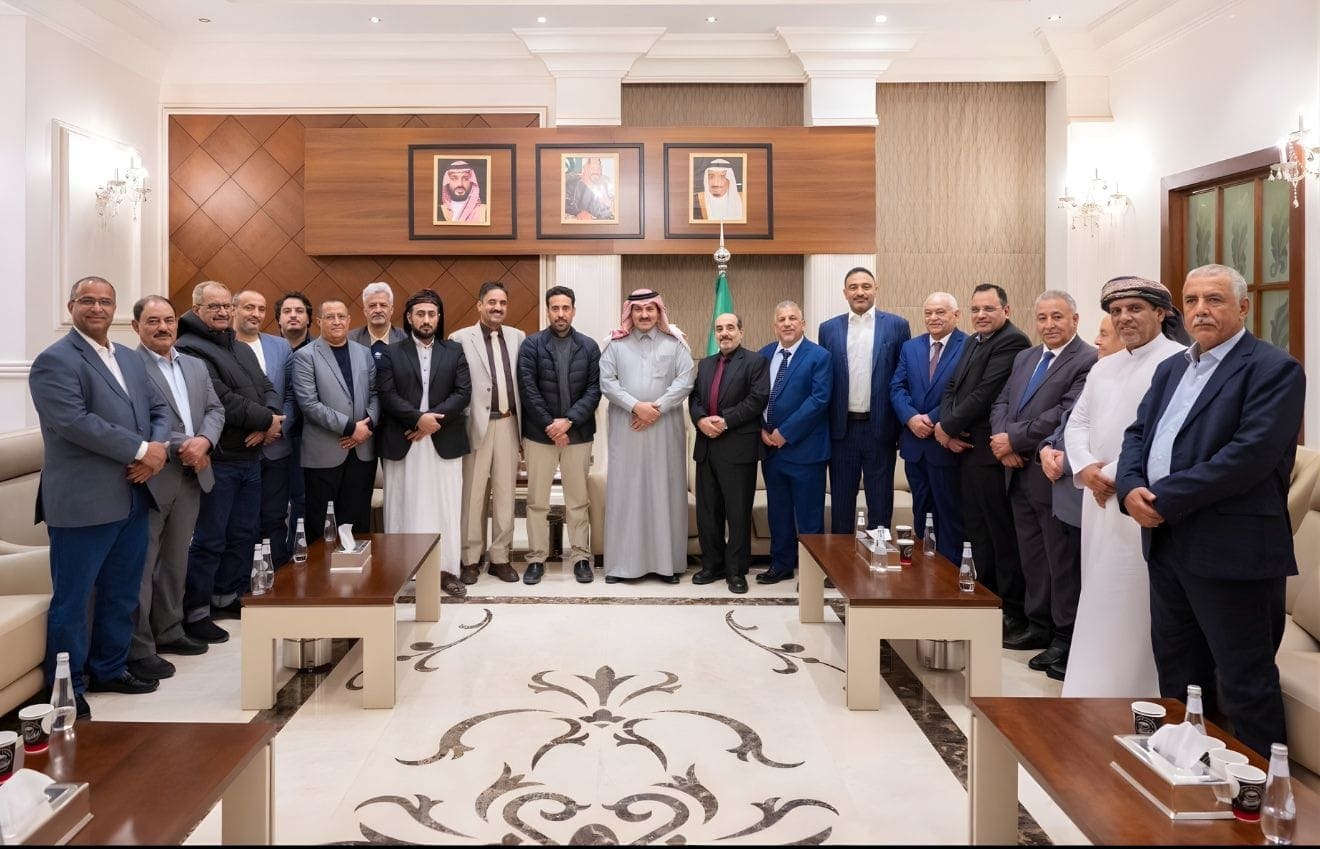
The Saudi Ambassador to Yemen, Mohammed Al Jaber, meets with the Southern Transitional Council (STC) delegation in Riyadh, January 8, 2026 (Official)
01-02-2026 at 4 PM Aden Time

“The division between a Southern delegation detained in Riyadh, the Southern grassroots that reject the dissolution of the Council, and a leadership that is absent yet symbolically present, exposed the deadlock of Saudi policy in the South.”
South24 Center Editorial
What has unfolded in South Yemen since December 3, 2025, was not a sudden escalation, but rather a moment of major revelation—laying bare a long trajectory of political and security accumulations, and the eventual collision of long-deferred projects that everyone had previously been dealing with using a logic of "time management" rather than genuine conflict resolution.
The rapid assertion of control by the Southern Transitional Council (STC) over Hadramout and Al-Mahra was not merely a military maneuver, but amounted to a political declaration that the South has entered a new phase of "imposing realities," and that the "fragile partnership" equation established after 2019 has effectively reached its natural end.
In contrast, Saudi reactions showed that what Riyadh considers "stabilizing the situation" is no longer possible using old tools.
The dispatch of the Saudi official Mohammed Al-Qahtani to Hadramout, along with the attempt to reproduce compromise solutions between a weak local authority and tribal armed groups, revealed early on that Saudi Arabia continues to treat the South as a sphere of security influence, rather than as a political issue with deep roots, identity, and broad popular representation.
As the Southern Forces expanded their control and the First Military District was expelled, the signs of Saudi concern began to unfold in two parallel tracks: security-wise, represented by the fear of losing control over the border strip and ports to forces backed by the UAE; and politically, represented by the fear of the emergence of an independent Southern entity outside the umbrella of hegemony exercised over its neighbors.
The subsequent escalation, from the Ghayl Bin Yamin clashes to the redeployment of the Nation’s Shield forces, and then the direct airstrikes targeting Southern facilities and forces, marked a clear Saudi transition—from the role of mediator to that of a direct party.
At this point, the conflict shifted from an internal Southern-Yemeni dispute to a regional confrontation over who owns the decision-making power for the South and its future.
Saudi Arabia’s public calls for the withdrawal of the Council's forces, and its adoption of the "Yemeni Unity" rhetoric at the height of military operations, were accompanied by an unprecedented mobilizing religious discourse, reviving conflict models that the region has failed to overcome.
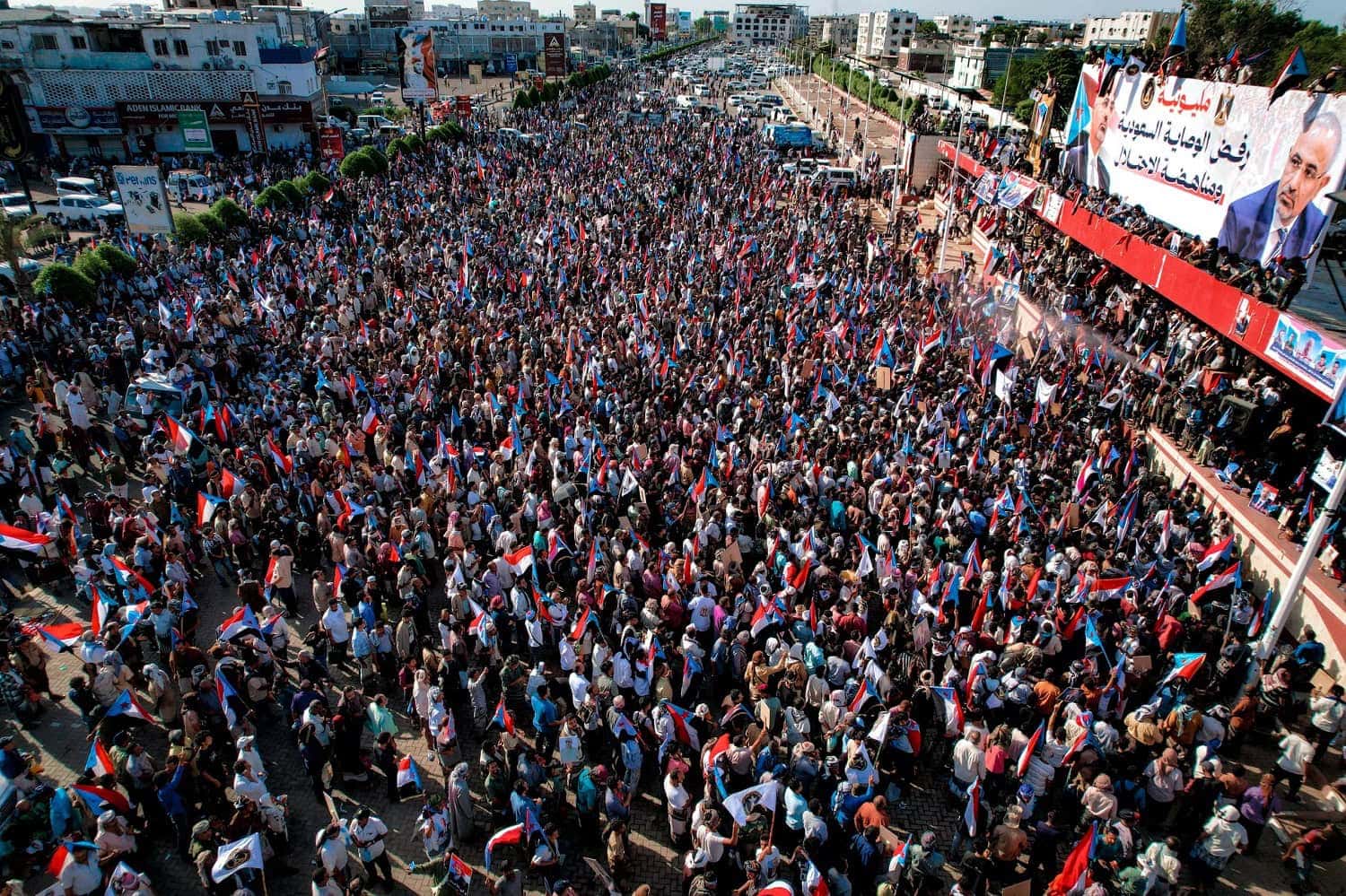
On the other hand, the Transitional Council succeeded, despite its miscalculations, in turning the confrontation into a test of legitimacy. Popular sit-ins, successive mandates, and the alignment of local authorities and administrative elites demonstrated that the Council is no longer just a temporary military or political entity, but has become, in the eyes of a wide segment of the people of the South, the de facto representative of the South cause.
The declaration of a transitional period, the call for a referendum, and then the signaling of a constitutional declaration were all steps aimed at shifting the conflict from the battlefield to the question of "Who represents the South?".
However, the most dangerous shift was Riyadh's decision to cross the red lines: bombing Southern forces, targeting Emirati equipment, then launching extensive strikes in Hadramout and Seiyun, and the subsequent security chaos, the proliferation of weapons, and the renewed fears of terrorism. All this cast Riyadh as a direct party in the power equation in the South.
This shift triggered rapid counterproductive results: the withdrawal of Southern forces from Hadramout, a security collapse and the looting of military camps with their full equipment, and warnings that weapons could fall into the hands of terrorist groups. Here, the most dangerous contradiction in the Saudi approach became apparent: seeking to regain political control through military means, at the expense of counterterrorism efforts—which Riyadh claims is a strategic priority—and at the expense of its relationship with the UAE and the Southern Transitional Council.
Politically, Saudi Arabia attempted to offset its field losses through the "South-South Dialogue" gateway, relying on Defense Minister Khalid bin Salman's support for the legitimacy of the South cause, and Rashad Al-Alimi's call for a Saudi-sponsored dialogue.
However, this initiative unfolded in a charged environment and amid coercive measures taken against the STC delegation and Council leaders from both sides. It culminated in the announcement of the Council's dissolution from Riyadh, a decision that lacked any popular or political backing in the South and was swiftly overturned by the Southern grassroots in the rallies of January 10, 16, and 23.
The division that followed—between a Southern delegation detained in Riyadh, the Southern grassroots that rejected the dissolution of the Council, and a leadership that is physically absent yet symbolically present—exposed the impasse of Saudi policy in the South.
On the one hand, Riyadh cannot accept de facto independence; and on the other, it is no longer able to impose an alternative that commands popular acceptance. Attempts to reconfigure the scene through presidential appointments, military committees, a new government, and summoning Southern elites to the Kingdom appeared more like crisis management than a solution.
As for Hadramout and Al-Mahra, they have turned into a new arena of conflict. Pushing projects like the "Eastern Region" or a "Hadramout State," with direct or indirect Saudi support, reflects a strategy aimed at fragmenting the South from within instead of engaging with it as a single political bloc.
This approach, while appearing to be a clever short-term tactic, carries strategic risks, as it opens the door to long internal conflicts, weakens any prospects of building true stability, and transforms the South cause from a national issue into one of regions and sultanates.
What this series of events reveals is that the Saudi approach is no longer based on supporting a clear political project, but rather on preventing the formation of an independent Southern political entity outside its control.
Saudi Arabia does not want an independence imposed by the Southern grassroots, nor does it seek to reproduce a weak Northern centralism; rather, it appears to be pursuing a formula that secures the South under its security apparatus while reorganizing its political elites to ensure continued direct Saudi influence over decision-making, ports, and the security file.
In conclusion, it seems that Saudi Arabia is leading the South toward a dangerous crossroads: either reshaping the relationship with the South based on a political partnership that recognizes its right to self-determination within a clear sovereign negotiation track where the South is a primary stakeholder, or continuing to manage the crisis through force and temporary containment—a choice that will lead to long-term attrition and place Riyadh in direct confrontation with an entire people, not just a political faction.
The coming weeks will reveal whether Riyadh is capable of shifting from a policy of coercion to a policy of settlement, or whether it will continue attempting to engineer the South by force, a wager that recent events have proven to be costly, uncertain in its results, and dangerous to the stability of the entire region.